

Who are Roberto Sánchez and Keiko Fujimori and what can decide the race to preside over unstable Peru
Keiko Fujimori and Roberto Sánchez are fighting an election marked by polarization, the undecided vote and the fragility of Peru's governance
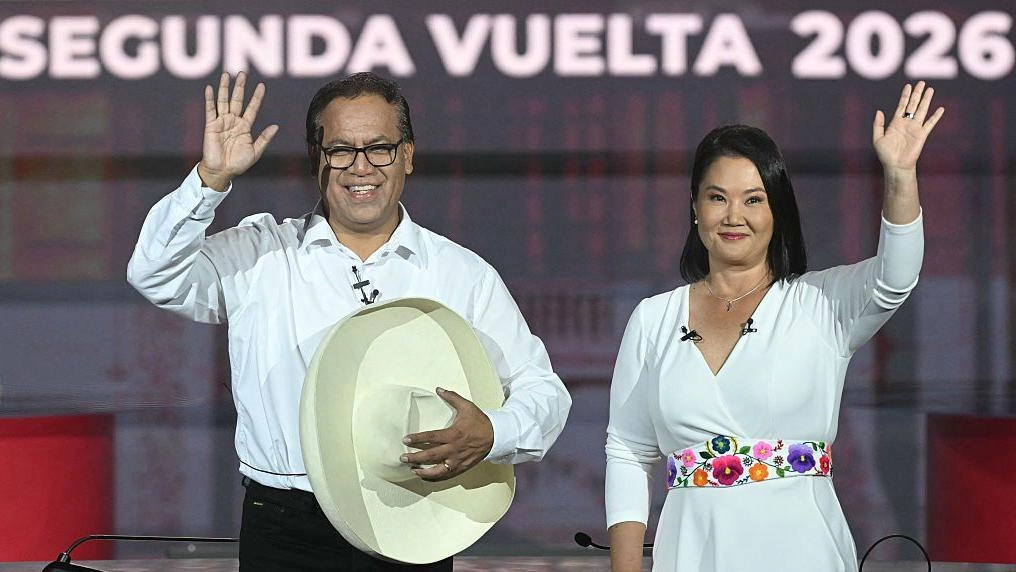

Peru elects its ninth president in a decade this Sunday.
After an eventful first round and a vote count that lasted a month, the South American country returns to the polls in a climate of political uncertainty.
The right-wing Keiko Fujimori, heir to Fujimorism and who obtained 17.92% in the first round, is competing for the presidency with the left-wing Roberto Sánchez, who obtained 12.03% of the votes.
This election repeats a pattern that has characterized Peruvian politics in recent decades: a confrontation between Fujimorism and another candidate, in which anti-Fujimorism usually plays a determining role.
Keiko Fujimori, daughter and political heir of the controversial former president Alberto Fujimori, has been characterized by her persistence.
This is the fourth time she has run for president and she has not recognized the results of the last two elections, in which she was defeated by the right-wing Pedro Pablo Kuczynski in 2016 and the left-wing Pedro Castillo in 2021.
Political scientist Alonso Cárdenas, professor of Political Science at the Antonio Ruiz de Montoya University, in Lima, Peru, affirms that ignorance of the electoral results has caused damage to Peruvian democracy.
“It has been one of the main triggers of the process of upheaval and political instability that the country has suffered in the last ten years, with eight presidents, a deeply discredited Congress and an institutional implosion that today marks political life,” he tells BBC Mundo.
“This situation has also led to the rise of organized crime, expressed in phenomena such as hitmen and extortion, and has significantly deteriorated the quality of life of the population.”
Also on the ballot will be Roberto Sánchez, who is running for the presidency of Peru for the first time.
He was Minister of Foreign Trade and Tourism during the government of former President Pedro Castillo, whose political heir is considered.
Castillo was sentenced last year to 11 and a half years in prison for the crimes of rebellion and conspiracy, after unsuccessfully trying to dissolve Congress and concentrate powers when he was at the head of the Executive in 2022.
The factors that will play a role in the choice
One of the determining factors in this election will be the undecided vote, which represents around 25% of the electorate, according to an IEP survey published last week.
"That percentage can go anywhere. In recent days, especially on social networks, many people have begun to remember everything that happened with Fujimorism, the cases of corruption, the violation of human rights, authoritarianism, kleptocracy," says Cárdenas.
“According to the information I have, the gap that existed in the surveys between Keiko and Sánchez has been increasingly reduced,” he adds.
Participation in different regions will also be key.
“It is not convenient for Keiko Fujimori that there is abstentionism in Lima, its main urban bastion, while Roberto Sánchez is not interested in abstentionism in the rural world and in the south of the country, where he is very popular,” he points out.
In this sense, electoral mobilization in urban versus rural areas may be decisive in what is expected to be a very close electoral result.
Another determining element is the historical rejection of both candidates, which functions as a political force in itself.
In the case of Fujimori, the so-called anti-Fujimorism activates memories of authoritarianism and corruption; In the case of Sánchez, his association with the management of Pedro Castillo weighs, which “is remembered as a very disorderly management, plagued by corruption and improvisation,” according to analyst Alonso Cárdenas.
Beyond who wins at the polls, another great unknown is the governability of the country, in a context in which the Peruvian Congress has become a key actor in political stability, with the ability to condition the action of the Executive.
In recent years, the combination of a fragmented party system and the absence of solid majorities has unleashed persistent instability.
The impeachment of presidents and the constant confrontations between powers have reinforced the perception that governability depends less on the electoral result and more on the president's ability to build alliances in a highly volatile Congress.
Below we tell you who are the two candidates who will compete for power this Sunday.
Keiko Fujimori, the heiress of Fujimori who seeks the presidency for the fourth time
Many things can be discussed about Keiko Fujimori, but not her perseverance: after three defeats, the Fuerza Popular candidate went to the second round for the fourth consecutive time.
Keiko has become one of the few lasting figures in Peruvian politics, which in recent years has devoured its leaders at the frenetic pace of successive corruption scandals.
She also had her own scandal: a case of money laundering within the framework of Odebrecht. But even after going to jail, the Constitutional Court ended up shelving the process. The ruling allowed her to become a candidate again just in time for these elections.
To seduce voters tired of corruption and insecurity, Fujimori did not hesitate to claim the legacy of his father, who died in 2024 and spent around 16 years in prison after being convicted of crimes against humanity.
With the electoral slogan of “order returns,” he tried to associate his image with that of Alberto Fujimori's admirers: a determined leader who stabilized a country hit by the economic crisis and the violence of the Shining Path in the 1990s.
However, his father remains a divisive figure in Peru and many also remember the human rights violations that occurred under his command, as well as the harsh cuts resulting from his economic reforms.
His last name is his great political asset, but also his main hindrance. In fact, Keiko's figure has always gone hand in hand with that of her father.
Born in 1975 and the first-born of four siblings, it fell to her to assume the institutional role of first lady of Peru when her parents' marriage broke up.
It was then that Peruvians met a young Keiko as her father's companion on public events and state trips.
After studying Business Administration in the US, he returned to Peru and dedicated himself fully to politics.
In 2006, with her father already detained in Chile, she was elected congresswoman for the first time.
Five years later she ran for president. He tried again in 2016 and 2021, losing each time against politicians who did not see the end of their terms.
Even so, he maintained undisputed leadership within Fujimorism, for which he fought even at the cost of stopping his father's release from prison (which he later requested) and deteriorating relations with his brother Kenji.
In 2022 she separated from American businessman Mark Vito, with whom she had two daughters and who is now part of the world of Peruvian television and entertainment.
This is the first time that Keiko Fujimori is a candidate for president after the death of her father. During the campaign he tried to make even more profitable this political capital and the feeling of many Peruvians that the country is experiencing an exceptional situation that requires a strong hand like the one he knew how to apply.
Among its proposals is the construction of maximum security megaprisons and removing Peru from the Inter-American Court of Human Rights.
After this Sunday's elections we will know if she once again falls short or if she finally achieves her dream of becoming president.
Roberto Sánchez, the survivor of the Castillo era
It seemed difficult to survive a shipwreck like that of the government of former president Pedro Castillo, imprisoned and prosecuted for several crimes, but Roberto Sánchez Palomino has managed to do it.
Although a few days before the vote, the Together for Peru candidate appeared far behind in the polls, he managed to concentrate votes in a short time and, benefiting from the fragmented Peruvian electoral landscape, is now emerging as the candidate who will compete in the second presidential round with Keiko Fujimori.
Born in 1969 in Huaral, an eminently agricultural town about 80 km from Lima, and a psychologist by training, Sánchez managed to convert his closeness to Castillo as head of Tourism and Foreign Trade (he was the only minister who survived his constant cabinet changes) into a political asset when for all the experts it seemed like a liability.
The candidate did not hesitate to claim his membership in the Castillo government and even dared to appear in the debates wearing the same peasant hat with which the former president made himself known to Peruvians and which became a symbol of rural and mountain Peru.
Thanks to this, he managed to gain the support of some of the sectors that brought Castillo to the presidency, especially in the south of the country, the hardest hit by the violence in the repression of the protests that followed the fall of the former president and where resentment towards the politicians of Lima is widespread.
With his soft manners and calm tone in the midst of the permanent political tension in the country, Sánchez knew how to maneuver skillfully and, unlike other members of the cabinet, he did not have to respond judicially for Castillo's failed attempt to dissolve Congress that ended up causing his dismissal and imprisonment in December 2022.
The then Minister Sánchez announced his resignation shortly after Castillo appeared on television announcing his exceptional measures with a trembling hand and abstained from the vote in Congress that ended up dismissing the president, which many interpreted as an attempt not to go down with him.
Castillo does not seem to hold a grudge against him. In one of his last court appearances he asked for the vote for him. And the candidate has known how to exploit the discontent of broad sectors of rural Peru with the fate of the former president.
Ramiro Escobar, a political analyst at the Pontifical Political University of Peru, told BBC Mundo that Sánchez's passage to the second round "shows that political circles in Lima still do not understand the magnitude of the unrest in the regions."