

LA Metro celebrates reinventing itself with ambitious goals and Karen Bass at the helm
“We are ready for the Olympic Games,” says Bass upon assuming the presidency of the Metro board of directors: he promises security and seeks cheaper service
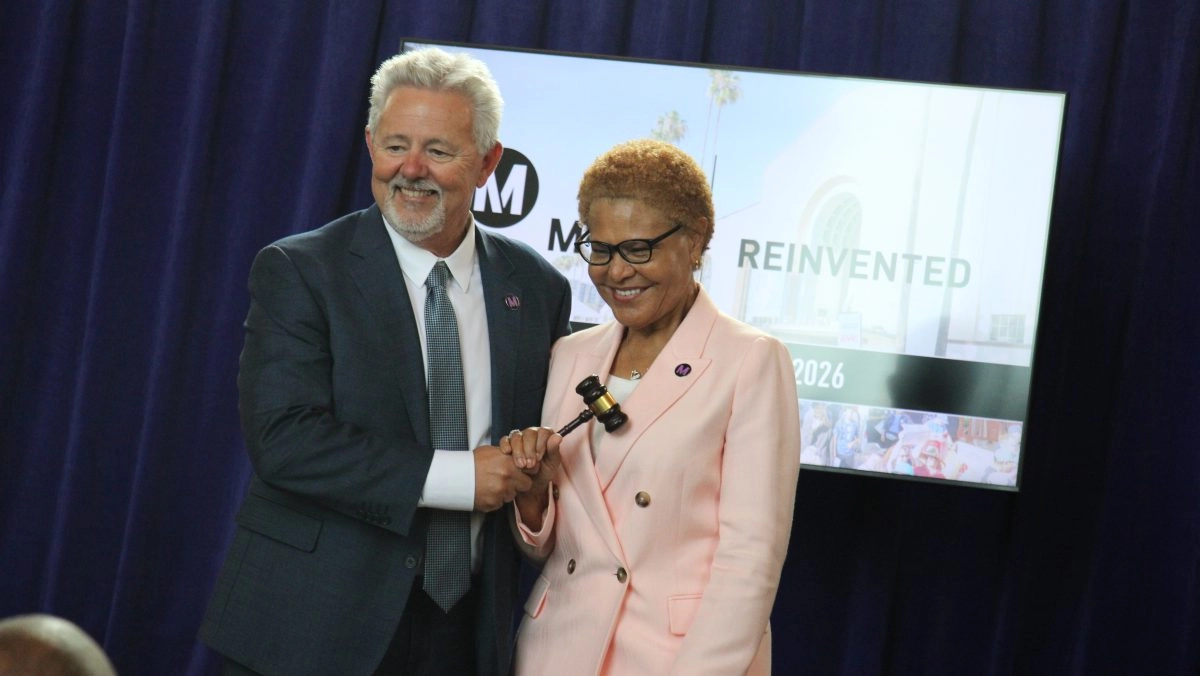

“Public transportation is one of the most powerful tools we have to transform lives,” said Los Angeles Mayor Karen Bass this Wednesday after assuming the presidency of the board of directors of LA Metro, where she declared that the county and the city are ready for the 2028 Olympic and Paralympic Games.
Bass, who replaces Fernando Dutra as president of the second largest transit agency in the United States, said that the job of government officials is to promote their work to make public transportation so affordable that it becomes the logical and sustainable option for family economies and people's daily lives.
“Every student, worker and family should always be able to afford safe, reliable travel, whether to school, work, a doctor's appointment or to visit loved ones,” Bass said.
The mayor added that the agency already offers free and reduced fares to those who need them most, and that it would work on developing a long-term financial strategy to make Metro a system at no cost to users.
“This is the Metro that I believe in and that I have fought for as mayor of the city where I was born and raised: a world-class transportation system that creates opportunities for everyone,” she said, maintaining that by expanding the reach of service and benefiting more people through Metro, it also creates well-paying jobs, supports local businesses and opens new avenues of access to education, health care and a better quality of life.
“That is the goal that I am committed to achieving over the next year, working together,” he indicated.
The LA Metro (Los Angeles County Metropolitan Transportation Authority) board of directors is composed of 13 voting members: the five Los Angeles County supervisors, Mayor Bass, who will serve as chair, three members appointed by her, and four mayors or council members representing the county's 87 incorporated cities.
In her speech, the mayor explained that her priorities will focus on safety, affordability, reliability and preparation for the 2028 Olympic and Paralympic Games.
Committing to these four priorities means establishing a system where anyone can get around easily without needing a car and where all communities can rely on public transportation.
LA Metro's achievements
Fernando Dutra, the outgoing president of LA Metro, delivered his latest annual report, highlighting the 200,000 round trips during the shuttle service offered for the eight World Cup soccer matches at SoFi Stadium. He noted that at its peak, Metro recorded more than 50,000 trips for a single game.
“This is making history,” Dutra said, in addition to mentioning the inauguration of the A Line extension to Pomona, which is now the longest light rail system in the world, and the D Line extension (Wilshire/La Brea, Wilshire/Fairfax, Wilshire/La Cienega). This extension connects 25,000 people with three new stations on the Wilshire Boulevard corridor.
He also reported that more than 200,000 people were received in downtown Los Angeles for the Dodgers' championship parade last November, and a milestone was marked by promoting projects such as the Sepúlveda Transit Corridor and the K Line extension through its environmental evaluation process.
“We achieved this by beginning work on improving the G Line (connecting North Hollywood with Chatsworth through the San Fernando Valley) and the North Hollywood and Pasadena bus rapid transit (BRT) projects,” the official explained, emphasizing that LA Metro not only dealt with public transportation or rail projects, but also made improvements to the I-605 freeway exit.
Indeed, several projects of the “Super 605” improvements included the South Street exit and the Katella Avenue interchange (Cerritos/Artesia/Los Alamitos); entrance and exit ramps in the areas of Whittier Boulevard, Beverly Boulevard and Slauson Avenue (Montebello, Whittier, Los Nietos, Santa Fe Springs).
The reinvention of LA Metro continues
Stephanie Wiggins, executive director of Metro who has led the agency since June 2021 with a budget of $9.7 billion and 13,000 employees, told La Opinión that Metro has reinvented itself and the process continues.
"We are not done. We are not satisfied. We are working to make the system safer, cleaner and more fun [sic], and to reach more areas for people," he said. “We will open new lines.
We will expand bus service and make them faster. Those are some of the improvements users can expect over the next year.”
Like other officials, Wiggins referred to users' concerns about their safety. “We have been making improvements to make the system safer for everyone: from having more support staff in the system to creating our own police department within Metro, so we will have sworn officers in service before the end of the year,” he said.
He added that they are also implementing more safety improvements, such as better lighting or higher access barriers to ensure people are using the system for its intended purpose. "We're seeing that all of these improvements make the system safer. So there will be more high barriers and more validation systems when exiting. There will also be greater security on board the buses."
Her husband was killed when getting off a bus
Fernando Dutra, who leaves his position as head of LA Metro, announced that violent crimes in Metro have decreased by 28% on train platforms, and that there is almost always an ambassador in a green shirt, a security agent or a member of the assistance team in a purple vest.
However, some users interviewed by La Opinión said that they do not feel safe traveling on the system's buses or trains.
“My husband was shot to death on December 24 (2025) when he got off a bus on LA Metro Line 206, near the 39th and Normandie street station (Expo/Vermont Station),” Deshane Odom told La Opinión. "We need greater safety in public transit, especially for children and the elderly. My daughter Janaya was left without a father"
Safety is the foundation of a strong public transportation system, noted Supervisor Kathryn Barger (County District 5). “While our work is far from over, Metro is making significant progress through better coordination, smarter investments and stronger partnerships,” Barger said.
“Violent crimes in the system have decreased more than 22% since 2024, and attacks on bus drivers have been reduced by half,” the supervisor added. "There is a change of direction... These results are important because every passenger and every employee deserves to feel safe when using public transportation. We will continue to build on this foundation with practical and responsible solutions that make Metro a system that people can trust."
Sharon Thomas, a visitor from Portland, Oregon, said her experience riding a Metrolink train had been positive. “I came to Los Angeles on vacation, I will travel by public transportation and I hope this vacation will be pleasant,” he said.
It was the same case for María Teresa Siqués and her mother, Montserrat Muñiz, tourists from Santiago de Chile who arrived in Los Angeles for vacation. “Some people who looked like homeless people were traveling on the train, but they didn't bother anyone,” Siqués said.