

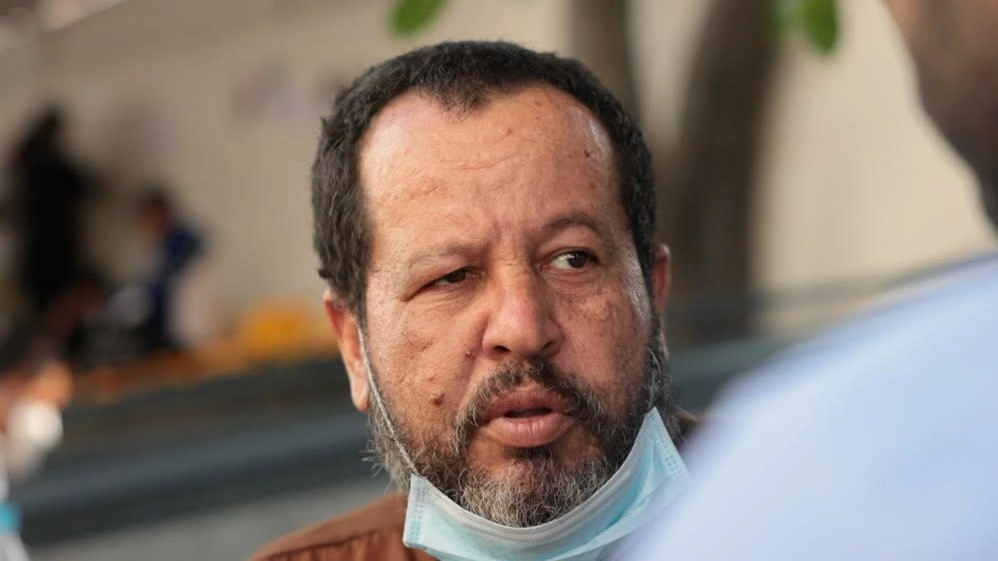
The father waiting in a hospital in La Guaira, Venezuela, for his missing 10-year-old son to appear
A father does not lose hope of finding his 10-year-old son among the survivors, although he fears that the boy believes his parents are dead

On the outskirts of the José María Vargas Hospital, in La Guaira, the atmosphere is one of desperation.
Dozens of people wait in front of their doors asking about missing relatives after Wednesday's double earthquake that shook Venezuela. To ease the search, health authorities have put up a list with the names of hospitalized patients.
Again and again, anguished faces scroll through the names in silence, with a mixture of fear and hope.
A few meters from the hospital entrance, Alí Rodríguez, a 50-year-old motorcycle taxi driver, tells me that he was trapped for eight hours under the rubble of a supermarket in La Guaira before being rescued.
"When it started to shake, I tried to go out with my wife, but she pulled us in. I was buried with her, chest to chest, with a sheet of zinc stuck through it. I had a child next to me... He died. An eight-year-old boy," he says with a broken voice.
"The strange thing is that when God doesn't want you to die, you don't die. We asked him a lot to not let us suffer so much," he adds, before confessing that he tried to take his own life.
“The looters saved us, they were the ones who gave us this light of life,” he adds, criticizing the slowness of the official response.
Their 10-year-old son had stayed at home while father and mother shopped. He says he doesn't know anything about him and refuses to leave the hospital, clinging to the hope that the little boy will appear at the hospital.
His wife has been transferred to a hospital in Caracas and he says he will stay there until his son appears.
“I think he's alive, but I'm afraid he thinks we're dead […] I'm sure he must be looking for me.”
The interim president of Venezuela, Delcy Rodríguez, assured this Sunday that 33 people were found alive on Saturday.
For his part, Deputy Jorge Rodríguez reported that the number of deaths in Venezuela has risen to 1,450 and the number of injured to 3,150 people.
He added that the country is now in “critical hours” to save lives.
“The girl is unconscious and very fractured”
Merlin Estrada is another Guaireña who desperately searches the hospital lists. Fighting back tears, she says she thinks her best friend may have died. She has just been told that her friend's teenage daughter is indeed alive.
"They supposedly took her daughter out, not my friend... If my friend is not there, well, I have to help her daughter. Today they told me that she is not here and that they supposedly transferred her to the Military Hospital [in Caracas]. The girl is unconscious and very fractured," she tells BBC Mundo before breaking down in tears.
He explains that he is now heading to the Military Hospital in Caracas, hoping to find the teenager.
"I'm going to see what we can do and give her all the help possible. The girl's father died last year of a heart attack," he continues.
“We really hope that people from other countries come: that they come as soon as possible, because there are many people alive and the important thing is to get them out and help them.”
Merlin is an immigration police official at the Maiquetía International Airport, in Caracas, which was completely inoperative after the 7.2 and 7.5 earthquakes that shook Venezuela on Wednesday and that have left, according to authorities, at least 1,400 dead and thousands injured.
Smell of decomposition
The UN estimates that there are around 50,000 missing, and warns that a significant portion could still be under the rubble.
"It was shocking. We lost control at one point, we didn't know where to run. Things were falling from the ceiling, air conditioning ducts, people were screaming," Merlin recalls.
He claims that he received an alert on his phone seconds before the first earthquake.
"I was in my office and I received a message that said: 'Earthquake with epicenter in Curacao moving towards the state of La Guaira.'
She managed to escape unharmed.
The president in charge of Venezuela, Delcy Rodríguez, visited on Thursday for the first time some of the areas most affected by the earthquakes in the state of La Guaira, where she supervised the deployment of emergency teams and care for the injured. During his tour, he assured that the state system remains fully active to respond to the crisis.
“The Venezuelan State has deployed the entire hospital network to guarantee care for the injured and ensure the referral of critical cases,” he said in statements to state media.
But around the hospitals and among the relatives of the victims, complaints about the official response and international aid multiply quietly, amid desperation due to the lack of information and the saturation of health centers.
An intense smell of blood and decomposition spreads around the José María Vargas Hospital and its adjacent morgue.
The volume of injuries has overwhelmed the health system in La Guaira. Most of the patients who arrive at this hospital – the main one in the state – are stabilized before being transferred to centers in Caracas, about 25 kilometers away.
Some health care workers are starting to feel exhausted.
"None of us have slept at all while providing support. Here we continue fighting until God decides to help us," nurse José David Villegas tells me.
“Patients are being transferred to other hospitals because we are overwhelmed,” he adds.
Meanwhile, around the hospital and its morgue, the wounded and bodies continue to arrive, while dozens of relatives try to identify the victims or look for news about their loved ones in a scene marked by uncertainty, tension and anguish.