

Venezuelans and Haitians reactivate fight for TPS after earthquakes and Supreme Court ruling
Immigrants ask for new protections against deportations and the worsening of crises in their countries
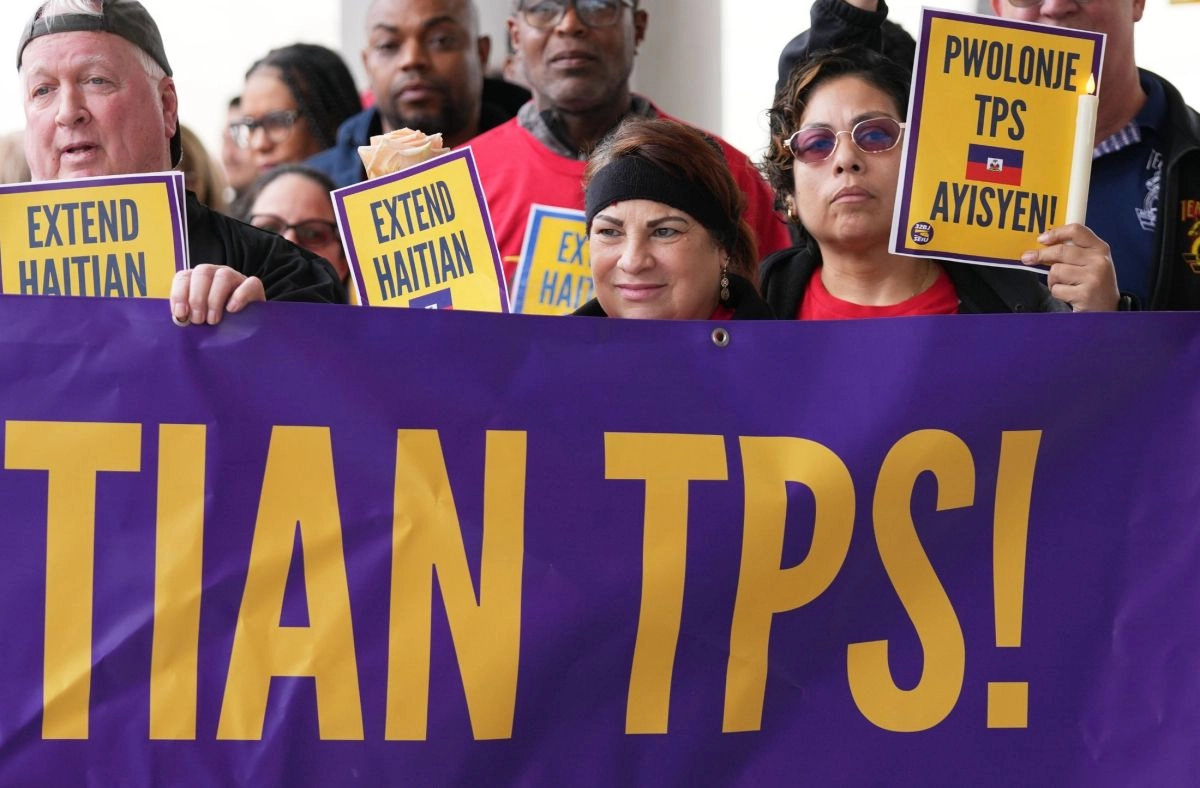

Immigrants from Venezuela and Haiti renewed their fight to obtain Temporary Protected Status (TPS) against deportation from the United States after the earthquakes in the South American country and the Supreme Court ruling against this benefit for 350,000 Haitians.
In Florida, where the largest diaspora of both nationalities in the United States lives, immigrants, civil organizations and officials today asked Congress and Donald Trump's Administration for a TPS that protects their respective communities from returning to countries plunged into crisis.
While collecting groceries in Doral, the city with the highest proportion of Venezuelans in the US, associations asked Trump for a new TPS due to the earthquakes, since of the 600,000 Venezuelans protected by TPS, 250,000 lost their protection last November and for another 350,000 it expires in October.
"It has nothing to do with the fact that a TPS has occurred before for Venezuelans. We are asking for a new chapter (...) for humanitarian reasons, not political ones," declared Helene Villalonga, president of the Multicultural Association of Voice and Expression Activists (Amavex), at an event at the 'El Arepazo' restaurant.
Groups such as Today for Venezuela, Venezuelans Persecuted Politically in Exile (Veppex) and Amavex signed a letter with their petition to Trump, arguing that the country cannot accommodate thousands of deportees after the earthquakes of magnitude 7.2 and 7.5 on Wednesday, the largest in 100 years, and which have left at least 920 deaths.
According to the organizers, the measure would benefit some 800,000 Venezuelans in the United States and would allow the release of some 5,000 who remain in detention centers.
As an alternative to TPS, they proposed a deferred action that would stop deportations to Venezuela for about 18 months.
“We are advocating for new TPS, granted by the new Administration, based on an extraordinary event (…) of a catastrophic natural phenomenon in the Venezuelan people,” said Villalonga.
Haitians seek permanent protection after judicial setback
On the other side of the Miami metropolitan area, in the Little Haiti neighborhood, community leaders asked Congress for permanent protection following Thursday's Supreme Court ruling that allows the Trump Administration to eliminate TPS for 350,000 Haitians, almost half of them in Florida.
Their work permits will begin to expire on July 1, according to the organizers, including Farel Auclair, a Haitian businesswoman granted TPS who has lived in the country since 2005.
“If they send me back to Haiti, it is a death sentence,” said Auclair, who said he feared for his life and that of thousands of Haitians and Syrians.
The businesswoman announced that she will request asylum, although she said that with this Administration that route “does not mean anything.”
“It is a very sad day, a day that did not have to come,” added the mayor of Miami-Dade County, Daniella Levine Cava, who described the measure as “inhumane,” rejecting the return of Haitians to a country mired in violence, with almost 6,000 murders in 2025, according to the UN.
The speakers called on the Senate to approve bill S.4814, intended to extend Haiti's TPS by three years and which the House of Representatives already endorsed in April with the support of 10 Republicans, including congressmen from the Miami metropolitan area.
The initiative, which has 19 cosponsors, seeks the support of Florida senators, Republicans Rick Scott and Ashley Moody, whom they cited on several occasions.
“We are in a community that the Haitian people built,” argued state senator Shevrin Jones, recalling that Miami is home to the largest Haitian diaspora in the country. "They should not return to their country; we must do everything we can to work with Congress to ensure they stay," he added.
The immigration policy coordinator of the Institute for Justice and Democracy in Haiti (IJDH), Steve Forrester, warned that in Florida alone 158,000 Haitians depend on TPS to work.
Organizations meanwhile offer free legal advice to those affected and ask them to distrust those who promise immediate solutions.