

Siding with the US is increasingly risky: Why far-right European parties are distancing themselves from Trump
Trump's economic policies and policies regarding Venezuela and Greenland have become toxic elements for his European allies
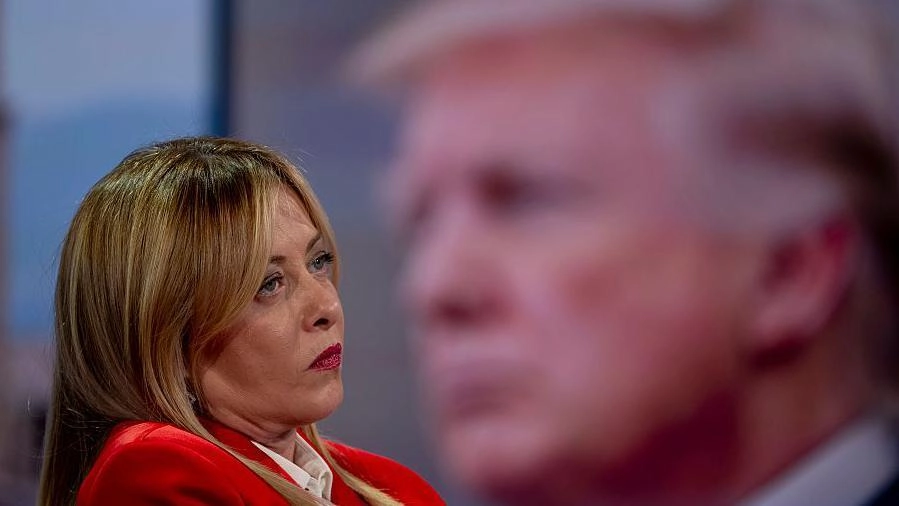

The romance between European nationalist right-wing parties and Donald Trump appears to be in crisis.
A year after the leaders of these parties celebrated the With the Republican's return to the White House, many have begun to distance themselves from the US president. The unprecedented military operation that Trump ordered on January 3 against Venezuela, which ended with the capture of Nicolas Maduro and his wife, Cilia Flores, brought the first tensions to light. “There are a thousand reasons to condemn the Nicolas Maduro regime: communist, oligarchic, and authoritarian, but state sovereignty is never negotiable,” wrote Marine Le Pen, leader of the National Rally (RN), the French far-right party, on her Twitter account. Weeks later, the US president's threats to impose new tariffs on European countries opposed to his plans to seize Greenland only widened the rift. “Friends can disagree. That's part of life and politics, but for a US president to threaten to impose tariffs unless we accept his appropriation of Greenland, by any means… that “It is a very hostile act,” declared British MP Nigel Farge, leader of the populist and Eurosceptic Reform UK party. However, it was Trump's statements downplaying the collaboration of his North Atlantic Treaty Organization (NATO) allies in the war in Afghanistan that finally broke the camel's back for many right-wing European politicians close to the US president. “Italy and the US are united by a strong friendship, based on shared values ??and historical collaboration… but friendship requires respect,” warned Italian Prime Minister Giorgia Meloni, who, thanks to her good rapport with the president, has been serving as a bridge between Europe and the US.every time there has been an impasse in transatlantic relations.
It all started in Canada
Although criticism and questioning of Trump from the so-called MEGA universe (Make Europe Great Again) have generated headlines around the world, this situation actually began months ago and much closer to the US.
“The boomerang effect that I identified at the beginning of 2025, according to which association with Trump becomes an electoral disadvantage at the national level, is now manifesting itself in Europe in relation to its far-right parties, but we saw it earlier in Canada,” Alberto Alemanno, professor of European law at the HEC Paris business school (France), told BBC Mundo.
The Italian professor recalled that the current Prime Minister of Canada, Mark Carney, won the 2025 general election, even though just a few weeks earlier polls predicted an opposition victory. Conservative.
Alemanno attributed the Liberal Carney's victory to his "fierce opposition to Trump's agenda," who during the Canadian election campaign not only imposed tariffs on its northern neighbor but also repeatedly threatened to make it the 51st state.
"The old relationship we had with the U.S., based on deepening the integration of our economies and close military and security cooperation, is over. It is clear that the U.S. is no longer a reliable partner," the then-Liberal candidate and current prime minister once said.
"Trump's attempts to weaken U.S. allies—whether Canada, Mexico, Australia, Denmark, or the European Union (EU)—have politically revitalized them and encouraged them to become more self-reliant," Alemanno asserted.
The expert also highlighted that "Trump's clumsy effort to extract concessions from his allies" has ended up damaging their popularity. disciples of the far right in those countries.
“The leader of the Canadian Conservative Party, Pierre Poilievre (close to Trump), lost the seat in Parliament he had held for more than 20 years,” he mentioned as an example.
Miscalculation
The distancing of part of the European nationalist right from Trump has intensified just weeks after Washington published its new National Security Doctrine, in which it announced its support for European “patriotic” political parties to halt the supposed “elimination of civilization” facing the old continent.
However, some experts believe that internal situations, particularly the electoral prospects of these parties in the various countries, have weighed more heavily than the support from the White House.
“The Trump administration seems to have miscalculated its steps and actions regarding Greenland,” Brandon Bohrn, director of the Transatlantic Relations Project at the Bertelsmann Foundation in Germany, told BBC Mundo.
For his part, Alemanno asserted: “Trump’s usefulness to European populists ends where his voters’ red lines begin. Greenland is one of those lines.”
Justin Logan, a foreign policy analyst at the libertarian Cato Institute in Washington, expressed similar sentiments.
“Regardless of what Alternative for Germany (AfD) or the National Rally think about the disappearance of civilization and migration in Europe, they are not in favor of the annexation of a large part of the continent by the US,” he told The New York Times.
Although the AfD is one of the right-wing parties that has received the most support from the Trump administration, its leader, Alice Weidel, accused the Republican for “breaking his fundamental campaign promise: not to interfere in other countries.”
“And he has to give explanations to his voters,” he added.
Bohrn attributed the reaction of this party, which German intelligence services have described as a “threat to democracy,” to the polls.
“In countries like Germany, public perception of the US has deteriorated considerably over the past year, especially in the last two weeks, making it increasingly risky to take an open pro-US stance from a domestic policy perspective,” he said.
A poll by ARD-DeutschlandTrend published last week revealed that only 12% of Germans support both Washington’s actions in Venezuela and its position on Greenland, while barely 15% see the US as a reliable partner.
Something similar is happening in the UK. Today, 35% of Britons view their former ally as “hostile,” and 30% would support imposing economic sanctions should it invade Greenland, while 14% consider a military response appropriate in such a scenario, according to data from two polls conducted by YouGov. These figures would explain why Farage, the leader of Reform UK and a fervent admirer of the Republican leader, admitted that the threats to Greenland represent the “greatest fracture” in the transatlantic relationship since the Suez Crisis of 1956. Today, nationalist or far-right groups hold 26% of the seats in the European Parliament, according to the German Institute for International and Security Affairs. And in many EU countries, they are leading in the polls or competing for that position.
A division brewing?
But while Meloni, Le Pen, Farage, and Weidel are making headlines for their public criticism of the US president's recent actions, other leaders in the so-called MEGA universe remain silent.
This group includes the prime ministers of Hungary, the Czech Republic, and Slovakia: Viktor Orban, Andrej Babis, and Robert Fico, all declared admirers of the Republican magnate.
Meanwhile, the Spanish party Vox has avoided criticizing Trump not only for the tariff threats against Greenland but also for excluding Venezuelan opposition leader Maria Corina Machado from the post-Maduro era.
This silence reveals a division within European right-wing parties, which, although never united, could end up seeing their differences deepen.
“If Trump continues to represent a threat to the sovereignty of European countries, of course that will divide them.” “to the European radical right,” predicted political scientist Daniel Hegedus, director for Central Europe at the German Marshall Fund in the US, in an interview with Fortune magazine.
Tactical Retreat
But while Trump seems to be dividing the more radical and nationalist European right, he has united the leaders of the allied countries he has attacked and lashed out at for more than a year.
“Trump’s actions have revived the Franco-German alliance—historically the engine of the EU’s economic growth—which will transform the bloc’s political trajectory. France and Germany now share a purpose: to achieve strategic independence from the US and strengthen Europe’s geopolitical resilience against its unpredictable and unreliable president,” Alemanno emphasized.
And if the above were not enough, he also blamed the White House occupant for the “unexpected” rapprochement between the EU and the UK.
“While after “With Brexit, the UK retains the formal freedom to align itself with either the US or the EU, and Prime Minister Keir Starmer has clearly aligned himself with Europe,” he added.
Is the distancing between Trump and the European right a temporary situation or a definitive break? Experts consulted by BBC Mundo said it is too early to answer.
“For now, this seems more like a tactical distancing than a fundamental break, but it is too early to draw definitive conclusions. Much will depend on the next steps the US takes regarding Greenland,” Bohrn asserted.
This is a thesis supported by Alemanno, who pointed out: “Trump’s imperial rhetoric threatens the ‘respectable nationalism’ that European far-right groups have carefully constructed.”