

Latinos urged to go out and vote in Los Angeles
Car caravan motivates residents in Southeast Los Angeles to fulfill their civic duty to defend their own community at the polls
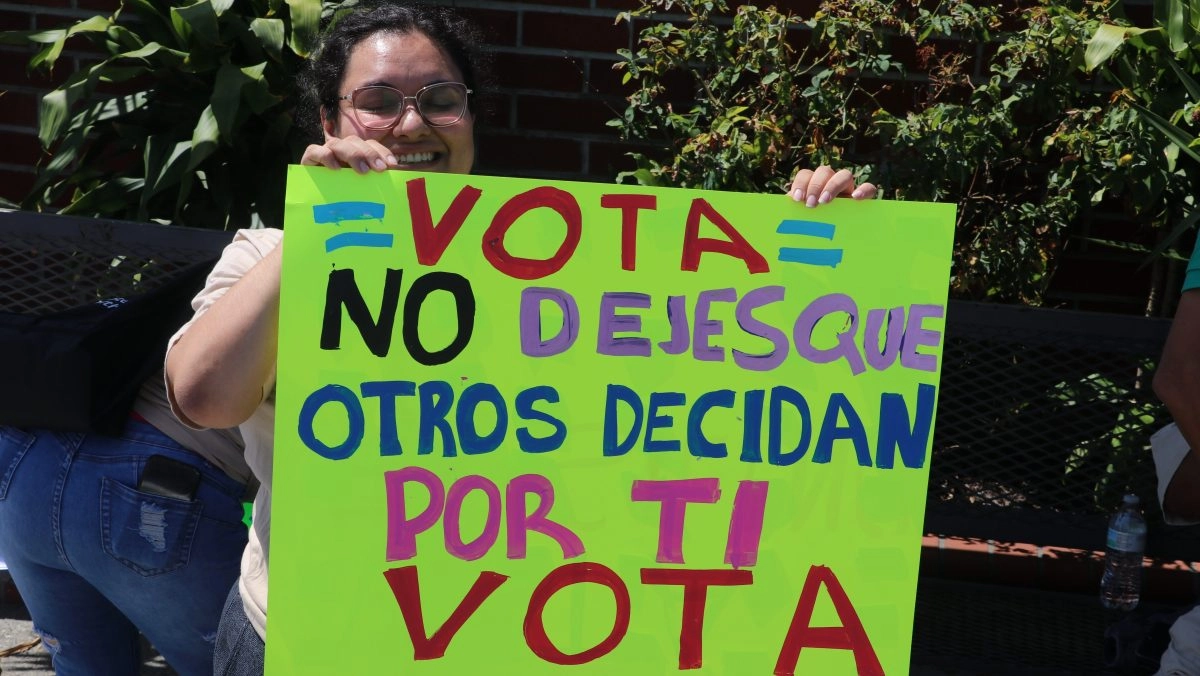

The message to the Latino community after holding a vehicle caravan through several cities southeast of Los Angeles was simple: those who can vote and be part of the changes they would like to see in their schools, communities and governments.
“Today more than ever it is important for our people to go out and vote,” declared Francisco Moreno, executive director of the Council of Mexican Federations in North America (COFEM).
This Tuesday the primary elections are held in California, and in the city and county of Los Angeles issues of utmost relevance to everyone's lives are decided: the probable re-election of Mayor Karen Bass, that of the county sheriff, Robert Luna, and the ER measure, whose "yes" vote supports the increase in the sales tax from 9.75% to 10.25% for five years to provide financing to local health departments and services, in the face of cuts made to the health system by the administration of President Donald Trump and Medi-Cal.
Very early in the morning, staff from the organizations COFEM, SELA Collaborative and AltaMed gathered in the SELA Collaborative parking lot, where they printed messages of encouragement for the Latino community in various cities southeast of Los Angeles, known for their low participation at the polls.
Call to cities with a huge Latino population
Although the main cities that make up the Southeast Los Angeles region (known as SELA), such as Huntington Park, Bell, South Gate, Lynwood, Maywood and Bell Gardens, are strategically located between the south of the Los Angeles metropolis and Orange County and stand out for their strong cultural heritage and Latino demographics, it is also true that a low percentage of voters cast their vote.
"Electoral participation remains extremely low. In some elections less than 28% of eligible voters go to the polls," emphasized Francisco Moreno.
“This means that more than seven in 10 people eligible to vote are letting others decide for them and when we don't vote, others decide how our taxes are spent, the future of our schools, housing, public transportation, public safety, health, the environment and economic opportunities for our working families,” he added.
"Vote! Silence changes nothing." “Raise your voice with your vote!” “SELA votes.” "Don't let others decide for you. VOTE." “Your vote makes the change.” Those were some of the messages that could be read on the doors of the cars that drove from the offices of NewStar Housing Corporation, at 3355 East Gage Avenue, in Huntington Park.
With megaphone in hand and maneuvering with great care, Francisco Moreno harangued passersby passing by on the sidewalks and those surprised by the loud music of “La Chona,” by Los Tucanes de Tijuana.
“Have you voted yet, kid?” Moreno asked an individual who was crossing the traffic light at the intersection of Pacific and Firestone boulevards. The aforementioned nodded with a signal.
“Tell your family to vote!” recommended the executive director of COFEM.
one million votes
The caravan made a stop on Garden View Avenue, where organizers found Ismael Ambriz, a 73-year-old American citizen of Mexican origin, and Hermilo Carrillo, 74, born in Nueva Italia, in the Mexican state of Michoacán.
“It is important to exercise the right to vote to defend the rights of the Latino community in the United States,” considered Mr. Ismael, who lives in the city of South Gate.
“We have to change things with our votes, because, imagine, I am already retired and I have to pay around $5,000 in annual property taxes, and with the high taxes that one pays it is no longer enough to live on,” he said. “At my age, I feel unable to pay a decent rent.”
He revealed that he would change his mind about voting for Tom Steyer, California's gubernatorial candidate, after learning that the billionaire invested a lot of money in private ICE detention centers in the past.
“I am going to reconsider my vote for tomorrow [Tuesday],” he added.
Carrillo, for his part, assured that for nothing in the world would he stop voting in the elections “to show that the immigrant vote counts.”
He indicated that he voted early by mail and supported Xavier Becerra for governor and Karen Bass for mayor of Los Angeles. “I like Karen Bass because she has been the only one who has defended immigrants from ICE,” he said. “The lady has been very brave.”
According to preliminary figures released by Los Angeles County Civil Registry authorities, up to one day before the primary elections, one million people had voted.
“We are excited to see all the people who have participated, but there are still many left to vote,” said Mónica Flores, assistant county registrar. “We suggest people go out and vote as soon as possible.”
The voting centers will be open this Tuesday from 7:00 a.m. until 8:00 p.m. In Los Angeles County there are approximately 400 ballot drop boxes and more than 600 voting centers.
“Don't wait until the last hour,” Flores advised those present gathered around a mobile voting booth that was installed next to the NewStar Housing Corporation.
Precisely, Mr. Jesús Herrera (84 years old), his wife Victoria (77) and his daughter Laura arrived at that place to fulfill their civic duty.
“Since I became an American citizen I have never stopped voting,” Mrs. Victoria revealed. "And now I did it with even greater reason, because I don't like what is happening and how they are treating undocumented immigrants. With the vote we have a chance [opportunity] to change those who govern and improve our economy."
“Fight for a better future”
Lisette Escobedo, vice president of Government Relations and Civic Engagement at AltaMed, the health system that serves nearly 700,000 patients, noted that for too long communities like those in Southeast Los Angeles have had to fight for their power, having been excluded from conversations about their own future.
“However, time and time again, these communities have demonstrated something very powerful: they are not defined by the barriers that stand in their way, but by the ability to organize, support each other, and make their voices heard,” he said. “This is where I learned the value of community resilience and what it means to fight for a better future.”
A better future like the one that Angélica Chávez and Paty Chávez hope for, with no relationship between them.
“It is crucial to assert our rights and elect whoever we want,” said Angélica Chávez, 59, originally from Apatzingán, Michoacán.
“My wish is that we achieve immigration reform to recognize the rights of immigrants who work hard and have lived in the country for many years,” he added. “This time it is not possible, but in November I will go with that idea in mind, before voting.”
Paty Chávez, from Zamora, Michoacán, said that she arrived in the United States 22 years ago, but as a permanent resident she cannot vote.
“What I can do is call on my community to go out and vote, especially given the context of the current immigration situation and the organized persecution against Latinos,” he indicated. “Even though some do not vote out of fear or believe the system is rigged, it is necessary to participate in elections to influence positive change.”