

What is the 'trade bazooka'? EU action that France is asking to be activated to respond to Trump's tariff
The Instrument for the Prevention of Economic Coercion allows Brussels to impose tariffs on other countries
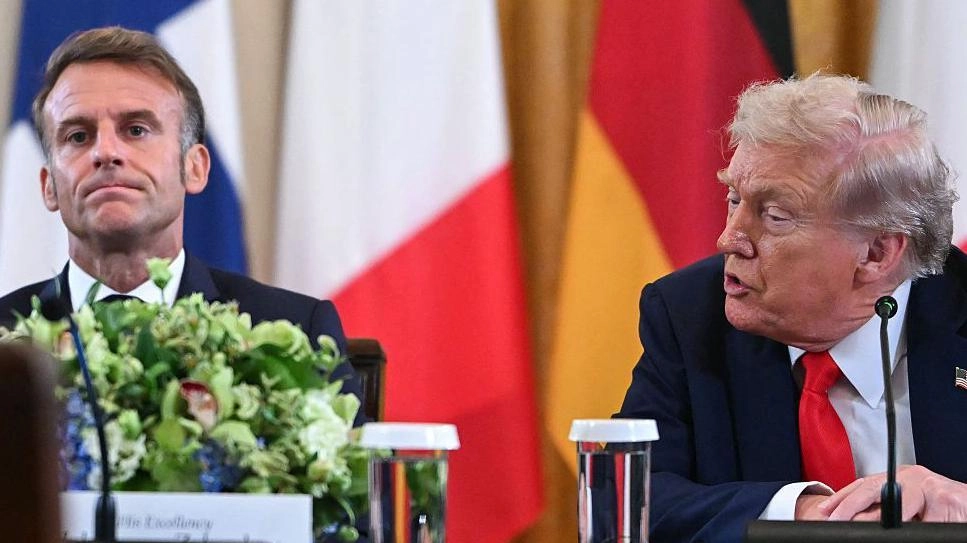

“Europe will not be blackmailed.”
“World peace is at stake! China wants Greenland, and Denmark can do nothing about it,” the Republican president stated on Saturday via his Truth Social account, and then revealed that products arriving in the US from Denmark, Norway, Sweden, France, Germany, the UK, the Netherlands, and Finland will be subject to a 10% tariff. The percentage will rise to 25% in June and will remain so until Danish authorities agree to sell the Arctic island.
Trump made his announcement days after the sanctioned countries sent a military mission to Greenland to reinforce the territory's security.
Although the governments of the affected countries have initiated diplomatic contacts with the US administration and have shown their "willingness to engage in dialogue based on the principles of sovereignty and territorial integrity," on this occasion some have sent signals indicating they are preparing for an unprecedented confrontation with Washington.
Proof of this is the request from French President Emmanuel Macron, who has asked his European Union (EU) counterparts to activate the Instrument against Economic Coercion (ICA), known as the "trade bazooka," to respond to Trump's "unacceptable" threat.
Shield against foreign pressure
The ICA was approved in 2023 by the EU and is a “deterrent” weapon for resolving trade disputes, as explained on the European Parliament's website.
In addition to seeking to “deter third countries from taking coercive measures against the interests of the Union”,The instrument “ultimately allows for the application of retaliatory measures.”
What are those retaliatory measures it provides for?
The instrument authorizes “the imposition of trade restrictions, in the form, for example, of higher tariffs, import or export licenses, restrictions on trade in services, or restrictions on access to foreign direct investment or public procurement.”
If the French request is approved, the EU could not only impose additional tariffs on US imports, but could also prevent US companies from buying shares in firms from any of its 27 member states, receiving public or private financing, and participating in tenders for public contracts with their governments.
Furthermore, the ICA authorizes the EU to demand financial “reparation” from the country that exerts coercion against it.
With China and the US in the sights
The text was designed to discourage third countries from “attempting to pressure the EU or a member state to take a specific decision by applying, or threatening to apply, measures that affect trade or investment.”
“This instrument allows us to react quickly to pressure from other countries,” said German MEP Bernd Lange after the legislation was adopted. “We now have a wide range of countermeasures, completing the defensive tools at our disposal. While the objective is primarily deterrence, we will also be able to act if necessary to defend the sovereignty of the Union,” the German legislator added. EU authorities began designing the ICA shortly after the end of Trump’s first presidency, during which transatlantic trade relations suffered several setbacks. However, it was an incident affecting Lithuania in 2021 that finally spurred the initiative. That year, China imposed trade restrictions on the Baltic country after its authorities announced they would improve trade relations with Taiwan, an island the Asian giant considers a “renegade province” and whose annexation it seeks. “A few months after the announcement, Lithuanian companies reported difficulties in renewing or entering into contracts with Chinese companies. They also had problems with shipments that were not cleared and with the denial of import applications,” the European Parliament website recalls. At the time, the EU justified the approval of the ICA by arguing that “coercion” is not contemplated in the World Trade Organization (WTO) agreements and, therefore, cannot be resolved through the WTO dispute settlement system. Last year,When Trump started his global tariff war and hit the EU, the possibility of applying the instrument was explored. However, on that occasion, Brussels opted simply to resort to dialogue.
Exhausting Diplomacy
Before requesting the activation of the ICA, Macron had made clear his displeasure with Trump's announcement.
“No intimidation or threat will influence us, neither in Ukraine, nor in Greenland, nor anywhere else in the world,” he declared.
In addition to the French president, another European leader who has spoken about the EU's so-called “trade bazooka” was the Irish Prime Minister, Micheal Martin, who this Sunday reiterated that the instrument “is on the table.”
However, in an interview with Irish public broadcaster, Martin advocated exhausting the path of dialogue first.
Other European leaders, including some from countries threatened by Trump, have also advocated for diplomacy before preparing to engage in a trade battle with the US.
“We must be very “We must be careful not to enter into a trade war that spirals out of control. I don’t think anyone would benefit from that,” Norwegian Prime Minister Jonas Gahr Stork told NRK. Trade in goods and services between the EU and the US reached US$1.8 trillion in 2023. This means that every day, goods and services worth US$5 billion cross the Atlantic between the EU and the US, according to the European Commission. In terms of goods, the EU maintained a surplus of more than US$170 billion, while in services, the US was ahead with almost US$120 billion. Last July, Washington and Brussels reached an agreement whereby the former reduced tariffs from 25% to 15%, in exchange for the latter committing to invest billions of dollars in the industrial and defense sectors. American.
The possibility of this pact being frozen is also on the table.
The ambassadors of the 27 EU countries were scheduled to meet in emergency session this Sunday to analyze the situation and assess the next steps.