

Spain-Argentina: from the canceled match to a World Cup final
Spain and Argentina were supposed to play the Finalissima in Qatar, but it was cancelled. Four months later they will face each other for the World Cup
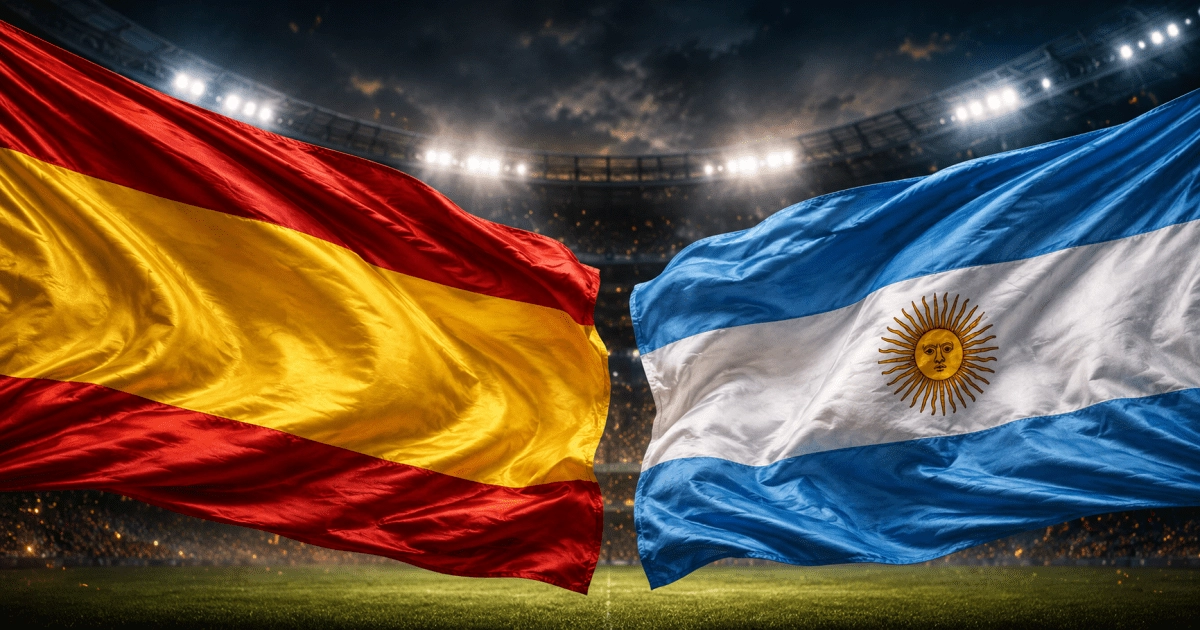

The European champion and the American champion were due to meet in March in Qatar, but the crisis in the Middle East and the lack of agreement to find another venue caused the Finalissima to fall. Four months later, football brought them together again on an even bigger stage: the 2026 World Cup final.
For months, Spain and Argentina looked for a place on the calendar to compete in the Finalissima. When they finally found it, an international crisis forced the headquarters to be scrapped. Then came the negotiations, alternative proposals and reproaches between the federations. The match ended up being cancelled.
Argentina-Spain, the Finalissima that the World Cup makes a reality
Spain and Argentina will meet on Sunday, July 19 in the final of the 2026 World Cup. The match will begin at 3:00 p.m. on the east coast of the United States, 4:00 p.m. in Argentina, and 9:00 p.m. in Spain. It will be played at New York New Jersey Stadium in East Rutherford, New Jersey.
It will be an unprecedented final. Argentina will seek its fourth World Cup and the second in a row, after consecration in Qatar 2022. Spain will try to achieve its second star, 16 years after the title achieved in South Africa 2010.
The Finalissima that was to be played in Lusail
The meeting between both teams had a specific sporting explanation. Spain arrived as champions of Euro 2024, which they won by defeating England 2-1 in Berlin. Argentina obtained its place after winning the 2024 Copa América: it beat Colombia 1-0 in overtime and reached the continental title for the sixteenth time.
The Finalissima pits the champions of Europe and South America against each other and is part of the cooperation agreement between UEFA and Conmebol. In its modern version, the most recent precedent was Argentina's 3-0 victory against Italy at Wembley, in June 2022. Previously, the 1985 editions had been held, won by France against Uruguay, and in 1993, when Argentina beat Denmark on penalties in Mar del Plata.
Spain and Argentina were due to play on Friday, March 27, 2026 at the Lusail stadium in Qatar. The stage had a special symbolic load for Lionel Scaloni's team: there they had defeated France on penalties in the 2022 World Cup final.
But the escalation of war and the security situation in the Middle East made the organization unviable. On March 15, less than two weeks before the match, UEFA and Conmebol confirmed that the Finalissima was cancelled.
You can see: Tears of happiness
A negotiation that ended between accusations
The cancellation was not solely due to the inability to play in Qatar. Attempts to move the match to another venue and to find a date acceptable to both teams also failed.
According to the reconstruction published by UEFA, one of the alternatives was to keep March 27 and play the match at the Santiago Bernabéu stadium in Madrid, with the tickets divided equally between the two fans. The European entity maintained that the Argentine Football Association rejected that possibility because Spain would have acted as a local team.
It was also analyzed to convert the Finalissima into a round-trip series: a match in Madrid and another in Buenos Aires before the Euro Cup and the Copa América in 2028. That formula did not prosper either. UEFA assured that it later offered to play on March 27 or 30 on a neutral field in Europe, while Argentina proposed moving the match to after the World Cup or playing it on March 31. None of these options could be incorporated into the Spanish calendar.
Thus ended a long-awaited match, also crossed by the attraction of facing Lionel Messi and Lamine Yamal. It seemed that the duel between the continental champions would be shelved, at least for several years.
The World Cup gives away the pending match
Four months later, Spain and Argentina achieved what their federations had not been able to achieve at a negotiating table: winning all the necessary matches to find themselves in a final.
Spain finished undefeated on its journey until the decisive match. They will enter Sunday with a streak of 37 games without defeats, including official and friendly matches, and with the least defeated defense: they only scored one goal. Argentina traveled a more bumpy path, but won its seven games and reached the final as the highest scoring team in the championship, with 19 goals, although it also conceded seven.
It will also be the confrontation between the two teams that occupied the first places in the FIFA ranking at the beginning of the tournament: Argentina was first and Spain, second. And he will have a generational image that is difficult to ignore: Messi, leader of the current champion and in what will probably be his last World Cup, opposite Yamal, the figure who represents the present and the future of Spanish football.
Spain and Argentina only met once in a World Cup. It was in the group stage of England 1966, when Argentina won 2-1. The most recent precedent, however, greatly favors Spain. In March 2018, the Spanish team beat Argentina 6-1 in Madrid. It was a friendly prior to the World Cup in Russia and Messi did not participate due to physical discomfort.
That result already belongs to another stage. Eight years later, the two teams arrive as continental champions, occupy the top of international football and will compete in a World Cup final against each other for the first time.
You can see: When penalties were invented as a method to break ties in football
A cup and several historical chapters at stake
Argentina will try to become the third team to win two consecutive World Cups. Only Italy, champion in 1934 and 1938, and Brazil, winner in 1958 and 1962, did so. In addition, a victory would allow them to achieve their fourth title, after those obtained in 1978, 1986 and 2022.
Spain seeks to return to the top after its consecration in 2010. A new world championship would reinforce the cycle that began with Euro 2024 and would confirm a generation that combines experienced footballers with young people like Yamal.
The match that was supposed to decide who was the best continental champion ended up falling due to political, security and calendar reasons. Now there will be no need to organize it or find a location for it.
Spain and Argentina will meet again, but not to define the Finalissima. They will do it for something even bigger: the World Cup.