

The analysis behind the controversial and criticized “cooling break”
Who benefits and why the novelty introduced in this World Cup has caused controversy
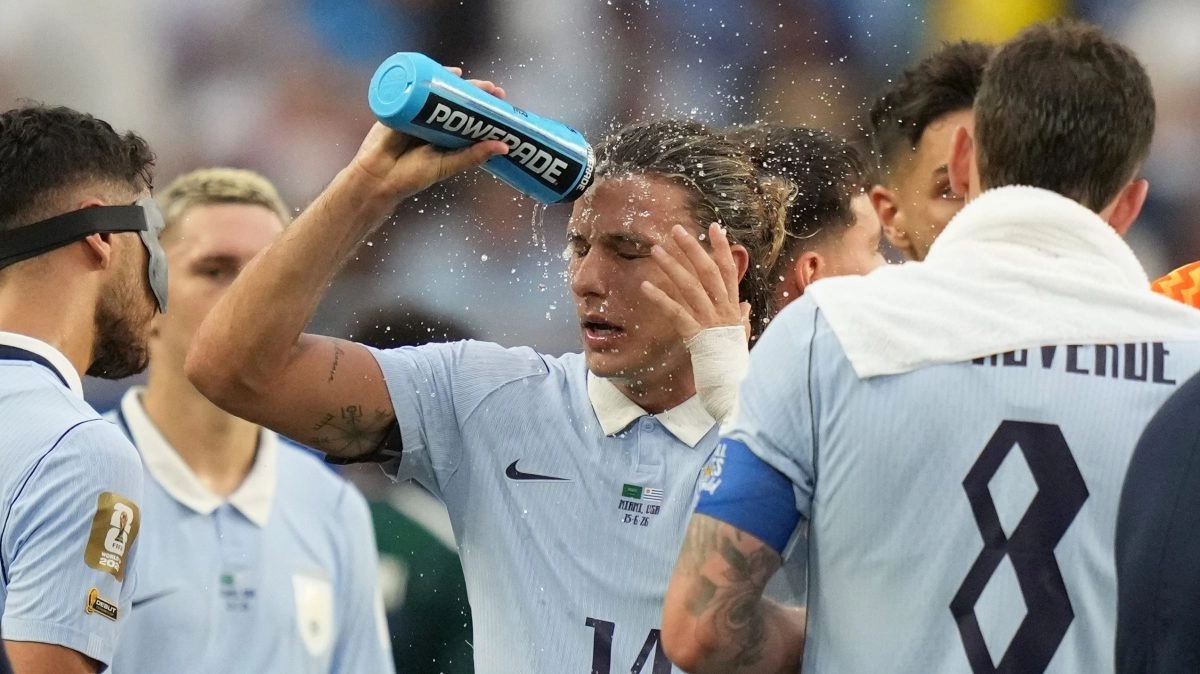

It has become a common scene at World Cup matches. The referee blows the whistle to stop play at the 22nd minute of each half, to allow the players to hydrate.
The mandatory three-minute drink break, present in all 104 matches, has been introduced to help players cope with the sweltering heat and high humidity levels in Mexico, Canada and the United States, the tournament's hosting countries.
Some have called these pauses commercial interruptions meant to satisfy American networks.
Hydration breaks are even applied in stadiums with retractable roofs and indoor climate control.
Asked about these interruptions in every part of every game, Mauricio Pochettino, United States coach, said: "I don't like them. I only like them when the conditions are extreme.
“But when conditions are good, they are not necessary.”
Who wins and who loses with hydration breaks in the World Cup? And how have they influenced the first games?
"Hydration breaks? I call them inertia breaks."
When Brazil's players stopped to hydrate midway through the first half at New Jersey New York Stadium on Saturday, they were rightfully trailing Morocco 1-0 after a lackluster start.
Six minutes after the game resumed, they were already tied.
Yes, it was all down to a moment of individual brilliance from Vinicius Jr., who cut inside with his right leg before sending a powerful shot into the top corner.
But, as Brazil coach Carlo Ancelotti later acknowledged, the hydration break allowed him to give new instructions to his players and adjust the system.
Having been outmatched until then, the five-time world champion team suddenly regained momentum.
“You can explain a problem to the players,” declared the Italian coach after the game, when asked about the benefits of these breaks.
“[You can] make a tactical adjustment that can be very useful.”
If hydration breaks are intended to protect players' well-being, should coaches be able to give new instructions?
United States coach Emma Hayes explained to ITV Sport that stopping play for a break breaks the momentum of the dominant team.
“It favors the team that loses momentum, that's why I call them inertia breaks,” he said.
“When you are dominating you don't want it; when you are losing, yes.
"Sometimes it's not even about giving instructions during the hydration break. It's about drinking and calming the players down. Sometimes doing nothing can also be considered a form of training.
"It's a shame. I can understand it in very hot areas of the country, but it seems like something that's here to stay."
Like Brazil, Canada also equalized shortly after a hydration break — this time in the second half — when substitute Cyle Larin equalized Bosnia-Herzegovina's opening goal on Friday.
Scotland scored the only goal of the game in their victory against Haiti shortly after a break, while Australia scored the first goal in similar circumstances in a 2-0 win against Turkey.
Juan Mata, world champion with Spain in 2010, stated that he would not have liked a three-minute pause in each half when he played.
“As a player, it doesn't seem like a positive thing to me,” he told ITV Sport.
"When you're losing you want to score, and when you're winning you want to keep the ball. I think they break the rhythm of the game," said the Spaniard.
“Another way to advertise”
So who loses, apart from the fans who have paid high prices for tickets to watch free-flowing, entertaining football, only to have the game stop at every half?
Well, World Cup debutants Curacao were having a dream moment after drawing 1-1 against Germany shortly before the first-half drinks break in Houston on Sunday.
However, the smallest country to have participated in a World Cup, both in size and population, was not the same after the resumption of play and lost 7-1 after the break allowed the Germans to regroup.
The Czech Republic dominated during the first half against South Korea, but the hydration break abruptly ended that stretch of pressure and after the restart, they lost momentum.
Despite taking the lead on the scoreboard, they ended up losing the match 2-1.
Meanwhile, the Netherlands led Japan 2-1 before the second-half hydration break in Arlington, Texas, on Sunday. They failed to maintain the advantage and tied 2-2.
Of course, hydration breaks don't always explain these changes in pace.
But as the tournament progresses, it will become clearer whether these interruptions become a determining factor.
Former Arsenal and England striker Ian Wright made his position on these breaks clear.
“I think from the American point of view they are just another way to get publicity,” he said.
The American network Fox extended the advertisements during a hydration break in the opening match of the tournament between Mexico and South Africa.
“They've used the argument that it's for the players, but for me it's not like that,” Wright added.
Although these pauses have detractors, others consider them to be a positive measure.
"I'm always interested in the health of my players. I think it's the right move: take a break, refresh and continue," Spain coach Luis de la Fuente said ahead of his team's opening match against Cape Verde on Monday.
That match was being played in Atlanta, in a stadium with a retractable roof and temperature control.
“Tomorrow there will be cool temperatures in the stadium,” De la Fuente added on Sunday.
"During the week we have seen very high temperatures. It is very difficult to endure them for so long when working.
“In my opinion, the best thing is to drink a lot of water, take a break, let them breathe for a few seconds.
“It won't be as hot [Monday], but we need to give them a chance to breathe and then a minute or two to give some directions.”
Netherlands international Virgil van Dijk said that “going to commercials every time is not something I like.”
“For neutral viewers, it's not great either,” the Liverpool defender added.