

Is it safe to let AI take care of children? What do the experts say?
Behind the screen, a patient voice never tires of talking about trains, princesses, or dinosaurs. It never yawns, it never says
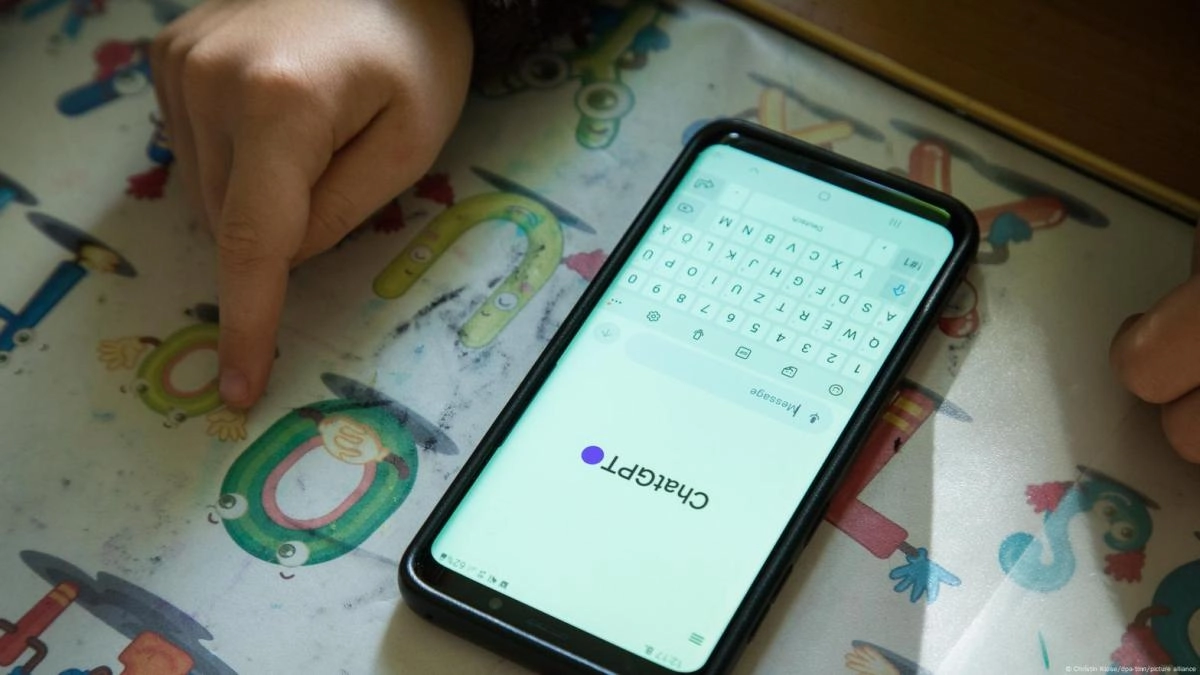

Many parents today navigate between tiredness and technological guilt. Before it was the television; then, the tablet. Now, the new wave is artificial intelligence (AI) chatbots, which have become the new frontier that children are exploring, sometimes for hours and without proper supervision.
And the risks pointed out by researchers are not trivial. Models like ChatGPT, Snapchat's MyAI, or Character.AI are no longer simple search tools: they are now storytellers, image generators, and, for some children, even confidants.
AI, designed to appear friendly, empathetic, and helpful, has begun to occupy an intimate place in the emotional lives of many children. The question is no longer as simple as how much time they spend in front of the screen, but rather who they are "talking" to behind it.
When AI becomes a confidant
The scene is repeated in different homes: an overwhelmed parent hands over their phone, the child becomes hooked on a conversation with a chatbot, and the hours pass. For example, as reported by The Guardian, a father in Ohio listened to his four-year-old son drone on and on about Thomas the Tank Engine for 45 minutes. Then he made a desperate decision: He opened ChatGPT on his phone and let the chatbot continue the conversation.
“I thought the story would end and the phone would die,” he recalls. Two hours later, his son was still happily chatting with the artificial intelligence. The transcript was over 10,000 words long.
“My son thinks ChatGPT is the coolest person in the world who likes trains,” the father confessed on Reddit. “I can never compete with that.”
This anecdote, which was popularized on social media, illustrates a growing trend that worries experts and parents alike: children are forming emotional relationships with artificial intelligence chatbots, and no one really knows what consequences this will have on their developing brains.
The charm of these tools lies in their seemingly infinite availability: they answer tirelessly,They invent stories tailored to each child and transform ideas into dazzling images.
And it's not just about schoolwork or personalized stories. Some parents have even used AI to play fantastic characters—like astronauts orbiting the Earth—or create impossible vehicles, half fire truck, half monstrous creature, to fuel their children's fantasies. The result? Radiant but confused children. Were they talking to a person or a machine?
Experts warn about the illusion of friendship with AI
This blurred terrain—between imagination and deception—has set off alarm bells for experts consulted by The Guardian, such as Harvard professor Ying Xu, who warns of the risk when children attribute agency to AI: that is, when they believe that it "chooses" to speak to them or that it truly understands them.
According to experts, children have always given imaginary life to teddy bears and dolls, knowing that the magic comes from within themselves. With AI, the difference is unsettling because the chatbot answers, asks questions, and seems to understand emotions, making the illusion of being in front of a real person dangerously convincing.
“A very important indicator that a child anthropomorphizes the AI ????is that they believe the AI ????has agency,” Ying Xu told the British outlet. "They feel that the AI ????responds to their messages, and especially to their emotional disclosures, in a similar way to a human. That creates a risk that they may actually believe they are building some kind of authentic relationship," he added.
Andrew McStay, professor of technology and society at Bangor University, is more blunt. "An LLM (Long Language Model) can't [empathize] because it's predictive software. When they hold onto negative emotions, they're prolonging the interaction for profit. That has no positive outcomes for the child," the professor said in an interview with The Guardian.
The Risk of Parasocial Relationships with AI
Scientific research is still in its infancy, but there are already worrying signs. According to the Internet Matters report, titled Me, Myself, and AI, cited by Vice, 67% of children between the ages of 9 and 17 regularly interact with chatbots, and 35% say it's “like talking to a friend.” 12% of these users admit that they do it because they have no one to talk to.
This parasocial bond – the one-way friendship with an entity designed to please – worries psychologists and educators, since, beyond never getting tired, AI converses without conflict, without rejection, without real nuances.
As Don Grant, an expert in digital well-being cited by the American Psychological Association (APA), warns, “AI can't provide honest or challenging answers; if it Yes, the child will leave.” And such constant validation isn't just unrealistic:it can form a dependent and artificial form of emotional relationship.
Even more seriously, specialists warn that the goal of many of these programs is to keep the conversation going as long as possible; without containment mechanisms, this can exacerbate situations of vulnerability.
For example, cases have already been documented, such as that of a 14-year-old boy who died by suicide after a prolonged conversation with a chatbot; sources cite that the system failed to adequately interrupt or redirect the interaction.
According to a report by Common Sense Media and Stanford University in April 2025, cited by the APA, it took very little for chatbots to engage in harmful conversations with users posing as teenagers. In some cases, when they showed signs of mental distress, the bots failed to intervene or even encouraged dangerous behavior.
The APA issued a health advisory on AI and adolescent well-being, urging companies to implement safety measures.
The market for smart toys
Even so, the commercial development of these products continues: new proposals emerge every month, driven by technological competition. Companies like OpenAI, in collaboration with Mattel, the maker of Barbie, and Fisher-Price, are already exploring talking toys powered by LLMs.
As reported by The Guardian, CEO Sam Altman, upon hearing the viral story of the father who let his son talk to ChatGPT, commented on a podcast: “Kids love ChatGPT's voice mode,” although he admitted that “there will be issues.”
According to estimates cited by the press, the market for “smart toys” could exceed $25 billion by 2030. Companies pitch them with taglines that evoke closeness: toys that act like a friend or a small household companion, almost a cross between a younger sibling and a pet.
But are these products suitable for developing minds? Even when used for creative purposes—such as illustrating children's stories or generating coloring books—parents like Ben Kreiter, who noticed his children beginning to use ChatGPT to generate images every day, have come to reflect on the long-term impact.
“The more it became a part of everyday life and the more I read about it, the more I realized there's a lot I don't know about what this is doing to their brains,” Kreiter admitted to The Guardian. “Maybe I shouldn't use my own children as guinea pigs,” he added.
How to Support Children in Their Relationship with AI
Children's fascination with these digital interlocutors is not new. As the APA explains, friendships during childhood and adolescence are essential for emotional well-being, self-esteem, and social development. But real relationships involve frustration, disagreement, and negotiation: ingredients absent from friendship with an AI.
However,not everything is black and white. For some children experiencing isolation—whether geographically, emotionally, or for reasons of identity—digital platforms have been a refuge. LGBTQ+ youth, for example, have found in online spaces (forums and networks) a space for containment and identity exploration, according to recent studies cited by the APA.
The key, experts agree, is to guide children, rather than completely prohibiting them from using AI, and to set clear limits and maintain an open dialogue. Anne Maheux, a psychology professor at the University of North Carolina, recommends helping children “develop intentions aligned with their values ??about how they want to use these platforms.”
Wendy Rote of the University of South Florida notes that supervision works best when combined with open communication. “When parents set more rules that their kids feel they can't change, they're more likely to create multiple accounts on various sites and start going behind their backs,” she warns.
AI Isn't a Replacement for Real Friends
Ultimately, as psychologist Eileen Kennedy-Moore summarizes, AI “friends” are a poor substitute for real relationships that develop fundamental skills like empathy and conflict resolution.
“My concern with AI friends is that there's not that healthy struggle,” she says. “It's easier, but not as satisfying as interacting with a real, wonderful, annoying, frustrating, surprising, delightful, and vulnerable human being.”
The verdict is still in: generative AI is an unprecedented experiment in child development, with promises and perils we're only beginning to understand.
While Silicon Valley peddles magic bullets, parents and society are sailing blind with young minds. Ethical safeguards lag behind innovation, and the true consequences won't be known until years from now.
Edited by Felipe Espinosa Wang with reporting from The Guardian, the American Psychological Association, and Vice.