

NASA reveals new images of interstellar comet 3I/ATLAS and rejects rumors about alien spacecraft
NASA says third interstellar visitor comes from a solar system older than ours
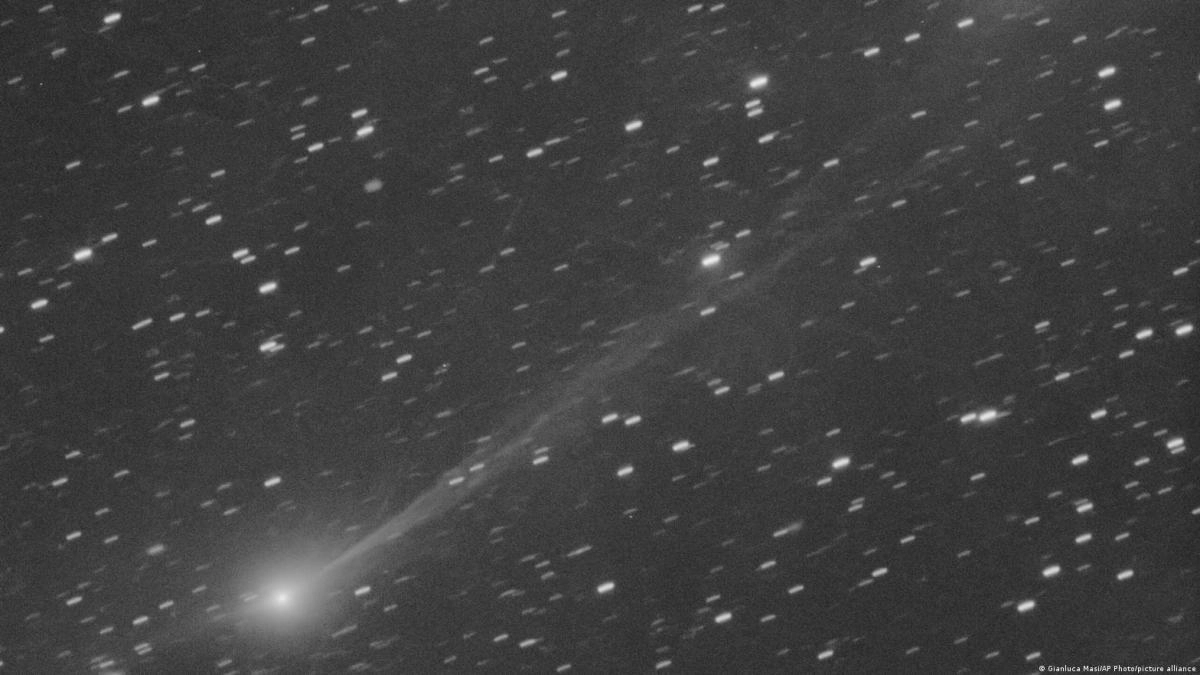

NASA revealed the long-awaited new images of the interstellar object 3I/ATLAS, the third visitor to our cosmic neighborhood, possibly older than our entire solar system.
The space agency also confirmed that it is a naturally occurring comet, dismissing speculation about artificial technology or an alien spacecraft.
The delay The publication of these images, caused by the US government shutdown, had fueled rumors about the discovery of life beyond Earth.
An object that raises questions
The comet was detected in July by the ATLAS telescope system located in Chile. Since then, astronomers have intensively studied its unusual trajectory, which would indicate that it comes from an unknown region. “It’s natural to wonder what it is. We love that the world has wondered along with us,” said Nicola Fox, associate administrator of NASA’s Science Mission Directorate. This is the third interstellar object identified in our cosmic neighborhood, after 1I/'Oumuamua in 2017 and 2I/Borisov in 2019. NASA dismisses rumors about alien spacecraft. Media attention on 3I/ATLAS grew after a scientist suggested it could be an object made with alien technology. However, agency experts completely dismiss this and reiterate that its behavior is that of a typical comet.
“To begin, I’d like to address the rumors. I think it’s important to talk about that. This object is a comet. It looks and behaves like a comet. And all the evidence points to it being one,” clarified Amit Kshatriya, NASA’s associate administrator.
“We were able to say quickly, ‘Yes, it definitely behaves like a comet. We certainly haven’t seen any technosignals or anything that would lead us to believe it’s anything other than a comet,’” added Nicola Fox.
Chris Lintott, an astrophysicist at Oxford University who is not affiliated with NASA,He believes the idea of ??an alien spacecraft is “simply absurd. There is nothing to suggest such a thing, and it would be like arguing that the moon is made of cheese,” he stated. The search for life beyond Earth continues. Although it has ruled out an extraterrestrial origin for this interstellar object, NASA continues its active search for biosignatures on other worlds. Kshatriya recalled that a rock sample collected on Mars by the Perseverance rover could contain evidence of ancient microbial life. “We are very eager to find signs of life in the universe,” she insisted. Images captured from multiple locations: The object was studied by more than a dozen instruments, including the James Webb and Hubble space telescopes, as well as satellites orbiting Mars. Although somewhat blurry, the new images show 3I/ATLAS with a clear and characteristic coma—a cloud of gas and dust around the nucleus—and a well-defined dust tail. A traveler from another solar system: Scientists believe the comet comes from a solar system older than our own, which formed about 4.5 billion years ago. “It’s not just a window into another solar system, it’s a window into the distant past, so distant that it even predates the formation of our Earth and our Sun,” says Tom Statler, NASA’s principal scientist. Scientists also highlight chemical differences compared to local comets: “It came from a different environment than ours, and we’re already seeing some very interesting differences compared to comets in our solar system,” suggests Fox. Larry Denneau, an astronomer at the University of Hawaii and co-principal investigator of ATLAS, explains that the object is about to leave our solar system and that its closest approach to Earth will occur in about a month, although it poses no threat to our planet.as well as satellites orbiting Mars.
Although somewhat blurry, the new images show 3I/ATLAS with a clear and characteristic coma—a cloud of gas and dust around the nucleus—and a well-defined dust tail.
A traveler from another solar system
Scientists believe the comet comes from a solar system older than our own, which formed about 4.5 billion years ago. “It’s not just a window into another solar system, it’s a window into the distant past, so distant that it even predates the formation of our Earth and our Sun,” says Tom Statler, NASA’s principal scientist. Scientists also highlight chemical differences compared to local comets: “It came from a different environment than ours, and we’re already seeing some very interesting differences compared to comets in our solar system,” suggests Fox. Larry Denneau, an astronomer at the University of Hawaii and co-principal investigator of ATLAS, explains that the object is about to leave our solar system and that its closest approach to Earth will occur in about a month, although it poses no threat to our planet.as well as satellites orbiting Mars.
Although somewhat blurry, the new images show 3I/ATLAS with a clear and characteristic coma—a cloud of gas and dust around the nucleus—and a well-defined dust tail.
A traveler from another solar system
Scientists believe the comet comes from a solar system older than our own, which formed about 4.5 billion years ago. “It’s not just a window into another solar system, it’s a window into the distant past, so distant that it even predates the formation of our Earth and our Sun,” says Tom Statler, NASA’s principal scientist. Scientists also highlight chemical differences compared to local comets: “It came from a different environment than ours, and we’re already seeing some very interesting differences compared to comets in our solar system,” suggests Fox. Larry Denneau, an astronomer at the University of Hawaii and co-principal investigator of ATLAS, explains that the object is about to leave our solar system and that its closest approach to Earth will occur in about a month, although it poses no threat to our planet.