

What is CZT, the amazing material that is generating a technological revolution
Only a handful of companies can produce cadmium zinc telluride, a material with powerful properties

Lying on your back inside a large hospital scanner as still as possible, with your arms above your head, for 45 minutes isn't the most fun.
That's what patients at London's Royal Brompton Hospital had to do during certain lung scans, until the hospital installed a new device last year that reduced these exams to just 15 minutes.
This is partly due to the scanner's image processing technology, but also to a special material known as CZT (short for cadmium zinc telluride), which allows the machine to produce highly detailed three-dimensional images of patients' lungs.
“This scanner produces beautiful images,” says Dr. Kshama Wechalekar, head of nuclear medicine and PET (Positron Emission Tomography).
“It’s a real feat of engineering and physics.”
The CZT in the machine, installed at the hospital in August, was manufactured by Kromek, a British company and one of the few in the world that can produce it.
You may never have heard of it, but—in Wechalekar's words—it is causing a “revolution” in medical imaging.
The wonderful material also has many other uses, such as in X-ray telescopes, radiation detectors, and airport security scanners.
And it's becoming increasingly popular.
The lung scans of patients conducted by Dr. Wechalekar and her colleagues involve looking for the presence of many tiny blood clots in people with long Covid, or a larger clot known as a pulmonary embolism, for example.
The scanner, which costs £1 million (around US$1.4 million), works by detecting the gamma rays emitted by a radioactive substance injected into the patient's body.
But the scanner's sensitivity means that less of this substance is needed than before.
“We can reduce the doses by approximately 30%,”says the doctor.
High demand, low supply
While CZT-based scanners are not new in general, large-scale, full-body scanners like this one are a relatively recent innovation.
CZT has been around for decades, but manufacturing it is notoriously difficult.
“It has taken a long time to develop it into an industrial-scale production process,” says Arnab Basu, founding CEO of Kromek.
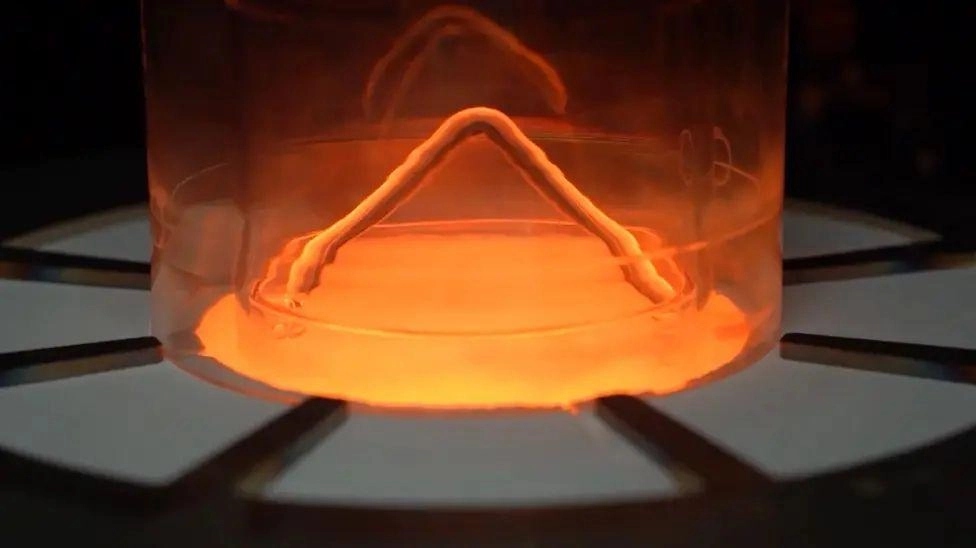
At the company’s facility in Sedgefield, England, there are 170 small furnaces in a room that Dr. Basu describes as “similar to a server farm.”
In these furnaces, a special powder is heated, melted, and then solidified into a single-crystal structure.
The whole process takes weeks.
“Atom by atom, the crystals rearrange themselves […] until they are completely aligned,” Basu explains.
The newly formed CZT, a semiconductor, can detect tiny photon particles in X-rays and gamma rays with incredible accuracy, like a highly specialized version of the light-sensitive, silicon-based image sensor found in your smartphone camera.
Each time a high-energy photon strikes the CZT, it mobilizes an electron, and this electrical signal can be used to generate an image.
Previous scanner technology used a two-step process, which wasn't as accurate.
“It’s digital,” Basu explains.
“It’s a single conversion step. It retains all the important information, such as the timing and energy of the X-rays hitting the CZT detector; color or spectroscopic images can be created.”
He adds that CZT-based scanners are currently used for explosives detection at UK airports and to scan checked baggage at some US airports.
“We expect CZT to be incorporated into the hand luggage segment in the coming years.”
The Chosen Material
But CZT isn’t always easy to obtain.
Henric Krawczynski, of Washington University in St. Louis, USA, has previously used the material in space telescopes tethered to high-altitude balloons.
Those detectors can to capture X-rays emitted by both neutron stars and plasma around black holes.
Professor Krawczynski needs very thin pieces of CZT, 0.8 mm, for his telescopes, as this helps reduce the amount of background radiation they pick up, allowing for a clearer signal.
“We would like to buy 17 new detectors,” he says. “It’s really difficult to get them thin.”
Kromek couldn't help him because, according to Basu, his company is currently in high demand. “We support many research organizations,” he adds. “It’s very difficult for us to do a hundred different things. Each research project requires a very particular type of detector structure.”
For Krawczynski, it’s not a crisis: he says he could use CZT he has from previous research or cadmium telluride, an alternative, for his next mission.
However, there are more serious problems at the moment.
The next mission was supposed to launch from Antarctica in December, but “all the dates are changing,” says Krawczynski, due to the US government shutdown in November.
Many other scientists use CZT.
In the UK, a major upgrade of the Diamond Light Source research center in Oxfordshire will improve its capabilities by installing CZT-based detectors.
Diamond Light Source is a synchrotron that fires electrons around a giant ring at near-light speed. The magnets cause these electrons, as they whizz past, to lose energy in the form of X-rays, and these are directed from the ring into beams of light to, for example, analyze materials. Some recent experiments have involved analyzing impurities in aluminum during its melting. A better understanding of these impurities could help improve recycled forms of the metal.
With the Diamond Light Source upgrade, scheduled for completion in 2030, the X-rays produced will be significantly brighter, meaning existing sensors will be unable to detect them properly.
“There’s no point in spending all this money upgrading these facilities if you can’t detect the light they produce,” says Matt Veale, leader of the detector development group at the Science and Technology Facilities Council, a stakeholder in Diamond Light Source.