

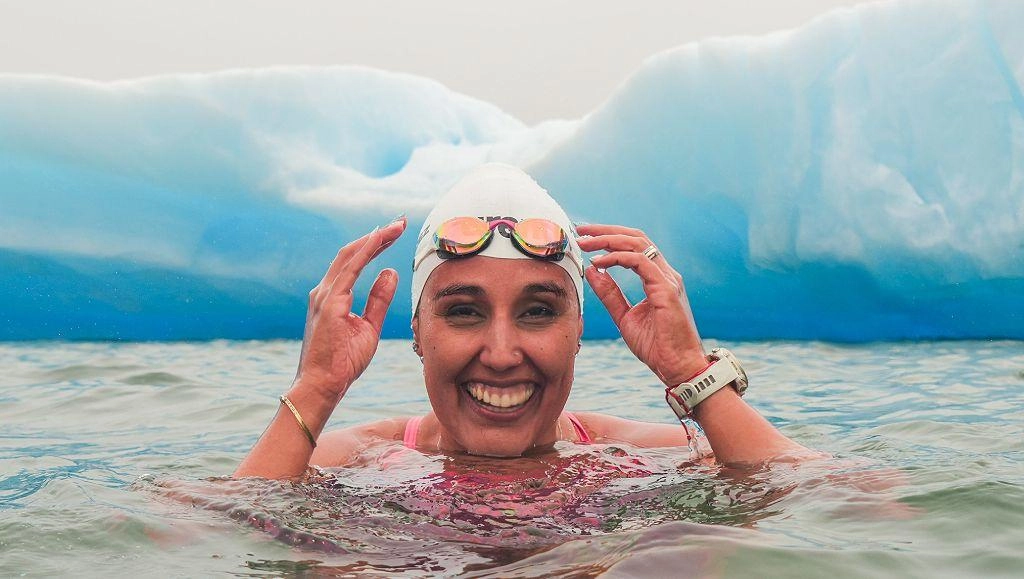
Barbara Hernandez, the Chilean who swims in glacial waters and holds a record for the longest swim in Antarctica
Her success is an unexpected turn of events for someone who, as a child, was the target of ridicule for her social status and never felt good enough in the pool.

“I remember the rescue divers pulling me out of the water, and then, when they put me on the stretcher onto the ship, I see the giant Chilean flag, the entire crew waiting for me, and I hear 'The Eye of the Tiger', the song from (the movie) 'Rocky'.
“I remember literally dying, and also laughing a lot, an emotion that is very difficult to describe.”
The woman who had that fit of laughter when she was on the verge of death is Bárbara Hernández.
She had just been pulled from Antarctic waters. Her body temperature had dropped to a dangerous 25°C. She was in the grip of severe hypothermia.
“Feeling like I was shivering, my stomach was cold, my back, my legs, my arms, it's super uncomfortable.
“I am a very controlling person. I control my thoughts a lot, my body, my team, what needs to be done, the purpose, what do I know.
“But that stage is the most vulnerable because I have nothing to do. I have to surrender to that uncomfortable feeling and, with faith, believe that it will pass.”
Not only did the feeling pass, but that day, February 5, 2023, she broke a world record for swimming the longest distance in history in those icy waters: 2.5 kilometers.
The previous year, she had set another Guinness record at Cape Horn, in the dreaded Drake Passage, the stretch of sea that separates South America from Antarctica. She swam the first nautical mile in 15 minutes, 03 seconds, earning a Guinness Record for speed, and she continued swimming until she completed 3 miles (5.5 km), the longest distance ever swum in that place.
Add to that many medals and cups in world championships in icy waters, as well as achievements for being “the first” in various challenges; as if that were not enough, she has a master's degree in Psychology.
Hers is a unique experience... what does it feel like?
In her home country of Chile, Barbara is affectionately known as the Ice Mermaid.
She specializes in extremely cold waters. Swim,Often surrounded by glaciers, and always without a wetsuit or grease to insulate her body.
The water temperature can be as low as 2°C, and incredibly, she can stay there for 45 minutes.
People often assume that Barbara grew up by the sea, but she didn't. Her beginnings were very urban.
The Seed
When she was a child, her family couldn’t afford to go to the beach often.
“We went once or twice a year with a lot of effort, maybe two days a week.
“I remember being in the water all day long and feeling like I really was Disney’s Little Mermaid, but a much more Latin and dark-skinned version.”
Her parents noticed her passion for the water, so the Latina mermaid started taking swimming lessons at age 6, but she didn’t always come out happy.
“Chile is still a super classist country. And 30 years ago, the socioeconomic differences were very noticeable.”
Arriving at private clubs in the taxi her father drove and wearing secondhand swimsuits “made people look at you funny.”
“It’s really sad to say hello and have no one answer you.”
“And it was a difficult time too because I was never fast enough in competitions to be selected for the national team.”
She may not have been national team material, but Barbara has a steely determination: she wasn’t going to give up swimming.
At age 9, she began training with Gabriel Torres.
Between the two of them, they thought that maybe she was taking on the wrong challenges, and they considered other types of competitions.
“I started doing open water when I was 17.”
“It was the first time I had the opportunity to go to southern Chile, to Valdivia, and the first time I saw clean rivers, because the only image I had was that of the Mapocho River (which runs through Santiago de Chile), which at that time carried a lot of garbage and was very brown.
“To think that I could swim in a river where there were swans, sea lions, and trees and grass on the banks was crazy.”
In fact, the whole idea was a little crazy.
“We didn’t have any female role models in open water swimming.
“There was a swimmer who swam the English Channel in the 80s who was Tiburón Contreras, but there were no girls swimming in the ocean or women making big crossings.
“In fact, we didn’t even know if it was possible, or if I was going to die there in the middle of the river.”
The attempt was a revelation.
“I realized that I didn’t necessarily need to be the fastest, but the most persevering, the one that best adapted to the conditions of rain, wind, waves.
“There began a seed.I wondered if I could actually become that first Chilean, if I could inspire more girls or women to enter the sea, to connect, to learn.”
The First Glacier
Open water swimming was an attractive but challenging prospect, as it can be dangerous and requires rigorous preparation.
Hypothermia is a very real threat, and can be fatal.
Both Barbara and her coach sought information from countries where they had more experience with cold water culture to prepare.
And in 2014, she was invited to swim in Argentina, in a lake near the Perito Moreno Glacier.
“It was the first time I saw snow, and I was next to that tremendous glacier.
“It was like a winter swimming festival. I met swimmers from all over the world, and I was the most anonymous of the entire group.
“The thought of swimming there and with them, they scared me a lot. I didn't know if it was possible, if my body was going to adapt."
But when she got into the water...
"I realized that I was very strong and that I adapted, and I was able to finish first in that circuit."
First of all, men and women, in her first swim on a glacier.
"When I finished, I looked at the glacier... amazing, the snow, the rocks, not feeling my feet, my hands..."
Barbara was just over 20 years old and, unlike many in that sport, she had no financial backing. And it is a very expensive activity.
But at that point there was no turning back: she was overcome with passion.
She began knocking on all doors and, although it was difficult, in the end she found a sponsor.
"At first nobody knew me, so I wrote to many of the brands that sponsor me now. I told them there was a World Championship in Siberia in 2016, which might bring me a podium finish.
“And I was lucky enough to meet a great and beloved businessman in Chile, in Patagonia, and he financed my first trip.”
Seven Seas
Among Barbara’s many dreams, one was to complete the Seven Seas challenge.
It’s marathon swimming, unassisted for hours on end, through seven of the world’s toughest stretches of water, where you face strong currents, rough seas, jellyfish, and sharks.
There are many rules, including that swimmers can only wear standard swimwear, a cap, goggles, and earplugs, and physical contact with the support boat is prohibited, although its crew can throw food and drinks into the water.
Only 34 people in the entire world have achieved it so far now, but none of those details were going to discourage her.
In 2018 he overcame the first challenge when he swam across the Strait of Gibraltar; A year later, she crossed the Catalina Channel and the English Channel, where she fulfilled her dream of becoming the first Chilean to do so.
In 2021, after the pandemic, the challenge was the Molokai Channel, a stretch of water that separates the Hawaiian islands of Molokai and O'Ahu.
It's 42 kilometers through a channel in the middle of the Pacific Ocean, with deep waters (701 meters), with extraordinarily strong currents and abundant marine life.
The crossing is long, usually more than 15 hours, so you often swim in the dark.
"I love swimming at night. I go deep inside, into my thoughts, to recognize what scares me. I learned to name my fear.
"When I'm at sea, I think what I'm afraid of is failing the people who have believed in me. That really distressed me, and I had to work on it.”
There’s also profound beauty in swimming at night.
“We’ve swum with bioluminescence with noctilucas (Noctiluca scintillans, sea spark).
“It’s very special because it feels like you’re dreaming. When you move your arms, you see lights all around you…
“And swimming with dolphins, hearing them, seeing them, knowing they’re there, is something truly, truly special.
“They get very close—they can be less than a meter from you—and the hardest thing is to keep swimming because you want to stay and play with them.”
It sounds idyllic… swimming at night, in luminous water, with dolphins… and suddenly…
“I touched something that I assumed was a jellyfish because it was burning, but too much: a pain that goes down to the bone. I remember having said, 'Barbara, what's wrong with you? This isn't your first jellyfish.'
But it was her first Portuguese man-of-war, a particularly venomous creature.
“It hurt so much that I started to cry.
“At the next hydration station, I asked for an anti-hypertensive and ibuprofen, but it still burned. Afterwards, I got scared because I couldn't move my leg.
“I kept going, swimming slower; getting out of the water wasn't an option for me. And we were able to finish the crossing.
“It was very impressive to be able to finish, very beautiful. I have the best memories of Hawaii. Swimming in wonderful warm turquoise water - I'm generally used to coming out with hypothermia. It was like a dream.”
Nevertheless, the Portuguese man-of-war had wreaked havoc.
It took six months to flush the toxin out of her body, her leg remained numb, and she suffered spasms at night.
But Barbara insisted on continuing the challenge, so in July 2022 she completed the North Channel, the fifth in the challenge.
And then, they came up with a new plan:go to Antarctica to attempt a world record.
Agony and ecstasy
Barbara not only loves Antarctica but also wants to raise awareness of the impact of climate change, hence the record attempt.
The previous record, set in 2015, was 2.25 kilometers.
To beat it, she had to swim 2.5 kilometers in water temperatures of around 2°C.
Easy enough to say, but the risk of hypothermia is serious.
Your body loses heat faster than it can gain it. As your extremities get cold, your body slowly begins to shut down.
You lose your ability to think clearly. The next stage may be respiratory. And finally, heart failure.
There can be telltale signs, which is why, when Barbara is swimming, there is someone on the boat in charge of making the decision to take her out: her now husband Jorge Villalobos.
The Chilean Navy got involved in the planning process because it has a lot of experience working in Antarctica.
After years of research and dreaming, they set off in February 2023.
They sailed for 20 days to reach their destination and, once there, they had to wait for the right conditions to perform the feat.
“That was crucial. We didn’t want too much wind, or whales, or leopard seals, and also no penguins, because that meant the seals could be hunting.”
Those seals, in fact, had been the subject of the prior planning.
“There were even meetings with marine biologists to define the color of my suit bathing, for example, because orange could attract a lot of attention.
“Leopard seals are dangerous, which is why it is so important to monitor them.
“It’s not that they feed on humans, but they identify their prey through taste, so they try a little bit of you and when they realize it’s human blood, they don’t like it and they leave you there.
“But, of course, by then, you’ve already lost a hand, an arm, or a foot.”
Barbara says that when the crew and her team discussed what could happen to her, she would go somewhere else.
“They talked about many things that make you nervous.
“My mom has a very beautiful saying: you shouldn’t be afraid of fear, and throughout my life it has meant different things; sometimes it means knowing that your fear exists, but that it can’t condition your life.”
Finally, a window of opportunity opened.
Barbara got on a boat with Jorge, one of her best friends and the medical team, and from there she jumped into the water.
At some point, she says, she got worried because her “heart and stomach felt cold,” but she concentrated on “swimming,and I also had moments of being very connected to the place where I was, the color of the water, so clear and so salty.”
“I remember thinking about the warm bread and butter they gave us on the ship, about my parents, about my dogs a lot… that it was an opportunity to show off Antarctica, so I had to do well and fight until the end.”
Suddenly, “I heard the screams and I got scared,” but they were screams of joy because I had broken the record.
It was then that they took her to the ship where she heard the song from the film “Rocky” and began to laugh.
But “my body temperature dropped to less than 25°. Most people pass out when their temperature drops to 30°.”
She was at risk of cardiac arrest.
The recovery process is long: doctors have to raise her temperature slowly, 1° per hour.
“I think that part was the most painful for me,” but afterward she was happy: “super exciting!”… until she realized how affected her partner was.
“Jorge ended up very bad. He was very scared because he had never seen me with so much hypothermia. And that's when I realized that I really could have died."
At this point, you might be wondering, why does she do it?
"It's a different way of embracing life.
"It's not that I'm looking for death, or challenging it, or any of that weird stuff.
"I think it's a very beautiful goal, and that being a woman, Chilean, and Latina, it's a source of pride to show with examples that we are truly ready for great things."
Dressed as a mermaid
You'd think that after breaking that world record and winning numerous medals, Barbara would take a break, but you'd be wrong.
Remember the Seven Seas challenge?
She had two more to go, and she had strong reasons for wanting to finish it: she had promised Jorge that they would get married when she completed it.
So in March of In 2023, she crossed the Cook Strait in New Zealand, and in June 2024, the Tsugaru Strait in Japan, becoming the first South American in history to accomplish such a feat.
In September of that year, she married in Laguna del Inca, “in the heart of the Andes mountain range, in the most turquoise and coldest waters you can imagine… it’s a beautiful place.”
“My dress was made by Ximena Olavarría, a Chilean designer. It had more than 3,000 crystals, hand-embroidered, and I looked like a mermaid: the ice mermaid.”
As they had done in other icy waters, they entered the lagoon: “It was super exciting.”
Barbara continues to dream.
“I want to return to Antarctica. I miss the penguins.I don't know if I want to go see the leopard seals so close up, but I definitely want to see the whales.
“When a long time goes by without going to the glaciers, I dream about them. It's like a calling, like a part of me stays there, so I have to go back.”
Click here to read more stories from BBC News Mundo.
Subscribe here to our new newsletter to receive a selection of our best content of the week every Friday.
You can also follow us on YouTube, Instagram, TikTok, X, Facebook and on our WhatsApp channel.
And remember that you can receive notifications in our app. Download the latest version and activate them.