

Al Aqsa: Muslims' fear of Israeli plans for one of the holiest places in Islam
Israeli nationalists have begun to ignore the customs that have governed coexistence on the grounds of the Al-Aqsa mosque for decades.

“The entire land of Israel was promised to the children of God… and this is where we are going to build a new Temple so that all of humanity can come and pray together.”
Those were the potentially incendiary words of Moshe Feiglin, a right-wing nationalist Israeli politician, who spoke to me as I descended from the Al Aqsa Mosque grounds in Jerusalem, where he had been praying and singing religious songs with a group of around 20 Jewish worshipers.
Feiglin spoke openly and clearly, almost as if his approach was neither controversial nor disputed.
But what he said and did completely contravened a delicate agreement that seeks to maintain peace in one of the most sacred and sensitive places in the world.
For Moshe Feiglin and others like him, the question is simple. They want to build a huge new Jewish temple on the same site that, for the past 1,400 years, has been one of the holiest sites in Islam: Al Aqsa.
The site – known to Muslims as al-Haram al-Sharif (the Noble Sanctuary) and to Jews as the Temple Mount – is one of the most recognizable and impressive sites in the Middle East.
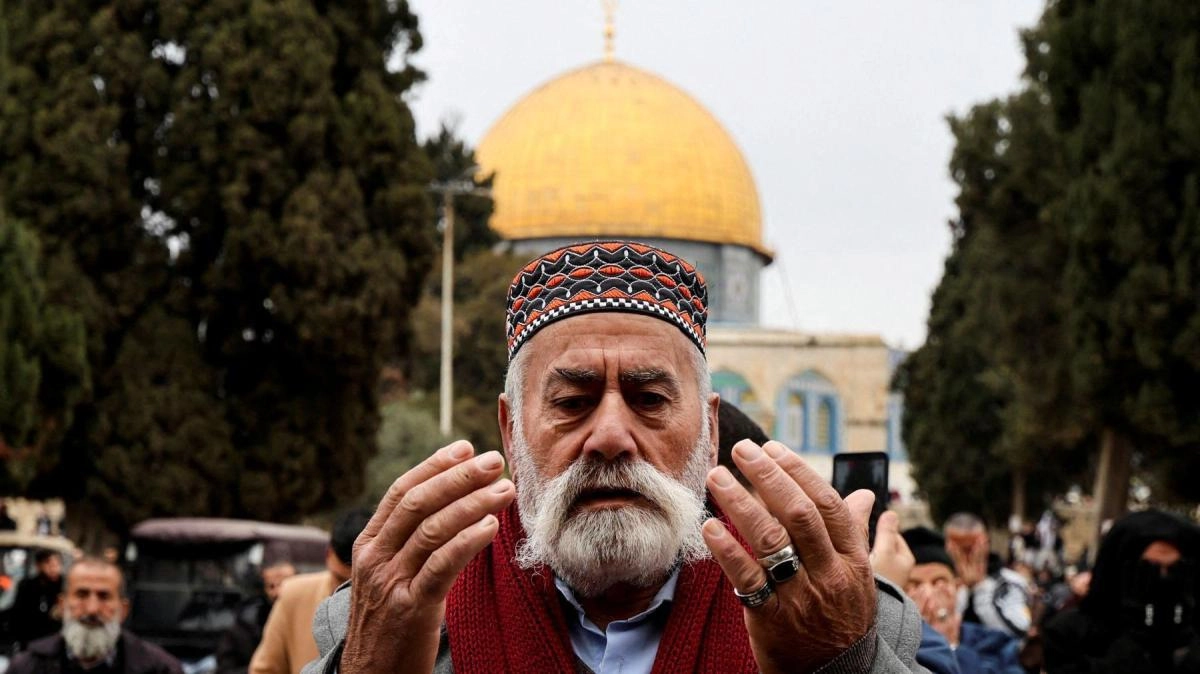
The Dome of the Rock, covered in gold, dominates the 35 hectares of the site and can be seen from miles away. Al Aqsa is mentioned in the Quran, and Muslims believe that the Prophet Muhammad ascended to heaven from there. It is also a space reserved exclusively for Muslim prayer… but is this about to change?
The site is also the most important place in Judaism. Below the enclosure, next to the Western Wall that supports it, Jews pray and mourn the destruction perpetrated by the Romans 2,000 years ago of the Jewish Temple that stood on the upper platform.
According to what is known as the “Statu Quo”, an agreement in force for decades, the custody of the Al Aqsa compound corresponds to an Islamic institution administered by Jordan: the Waqf.
Non-Muslims can visit Al Aqsa, but are not allowed to pray or perform religious rites there. The Chief Rabbinate of Israel and most ultra-Orthodox rabbis also prohibit Jewish prayer at the site for halakhic (related to Jewish law) reasons.
Those are the rules and resolutions that Feiglin and others now openly flout.
“A multi-denominational center”
Recent reports and claims that Israeli and American officials are working together to abandon the status quo have caused widespread alarm.
The Middle East Eye media outlet indicated, citing various sources, that a new body created by the Israeli government would declare the Al Aqsa compound a “multi-faith center.”
When recently asked about those reports at a congressional hearing, US Secretary of State Marco Rubio said he had “no knowledge of them,” although US Ambassador to Israel Mike Huckabee, a figure close to President Donald Trump, has frequently spoken about Jewish ties to holy sites in Jerusalem and the occupied West Bank.
Other reports suggest that large-scale Jewish prayer would be allowed at the site and that Israel would gradually take over all aspects of its management.
Israel captured East Jerusalem, including the Old City and its holy sites, along with the rest of the West Bank, from Jordan in the 1967 Middle East war, and subsequently annexed it in a move that most countries do not recognize.
The Israeli Prime Minister's office has reiterated on several occasions that there has been no change to the Status Quo.
“It's not going to happen,” warns Dr. Mustafa Abu Sway, deputy director of the Waqf Council.
From a high point in the Old City, he recognizes that control of Al Aqsa is a sensitive issue in which Israeli actors now feel reinforced.
He also fears that any formal change to the status quo could easily provoke a new explosion of tensions between Jews and Muslims.
"Not leaving Al Aqsa Mosque alone is simply opening Pandora's box. It endangers peace in the region and pits everyone against everyone," says Abu Sway, a respected Palestinian expert in Islamic studies and regional history.
International concern
Jordan, the Gulf countries and Egypt have expressed alarm and concern over the recent erosion of Islamic authority in Al Aqsa. The British government has also stated that “the historic agreements of the Status Quo in the holy sites of Jerusalem must be respected.”
But some Israeli nationalists who are no longer hiding believe that now is their time.
"The Temple Mount is ours! It's in our hands!" shouted Israel's National Security Minister, the far-right Itamar Ben-Gvir, in a widely circulated video of last month's Jerusalem Day march.
Ben-Gvir led a group of flag-waving Israeli nationalists through East Jerusalem, including the Muslim quarter of the Old City, all the way to the Al Aqsa compound.
The controversial member of Prime Minister Benjamin Netanyahu's coalition government is a regular visitor to Al Aqsa.
In the video, he sings songs and displays an Israeli flag in open contravention of the status quo.
But for Ben-Gvir, who has already used his ministerial position to allow Jewish prayer and singing in parts of the compound, this is just the beginning of greater Jewish and Israeli control over the site.
More than 25 years ago, in September 2000, right-wing Israeli nationalist politician Ariel Sharon did something that was then unthinkable. Accompanied by hundreds of armed Israeli police officers, the leader of the opposition Likud party toured the Old City and climbed the Al Aqsa compound.
This gesture was seen by many as deliberately provocative and inflammatory, and as one of the sparks that sparked the second Palestinian intifada, the uprising also known as the Al Aqsa intifada. In the five years that followed, more than 4,000 people were killed in violence in Israel and the occupied West Bank and Gaza Strip.
Al Aqsa is the most politically sensitive terrain on the planet, and both its history and current tensions fuel fears of an equally disastrous outcome.