

Carl’s Jr. workers in Los Angeles report more than $110,000 in wage theft
Harshad Dharod, owner of 45 fast food chain franchises, files for bankruptcy
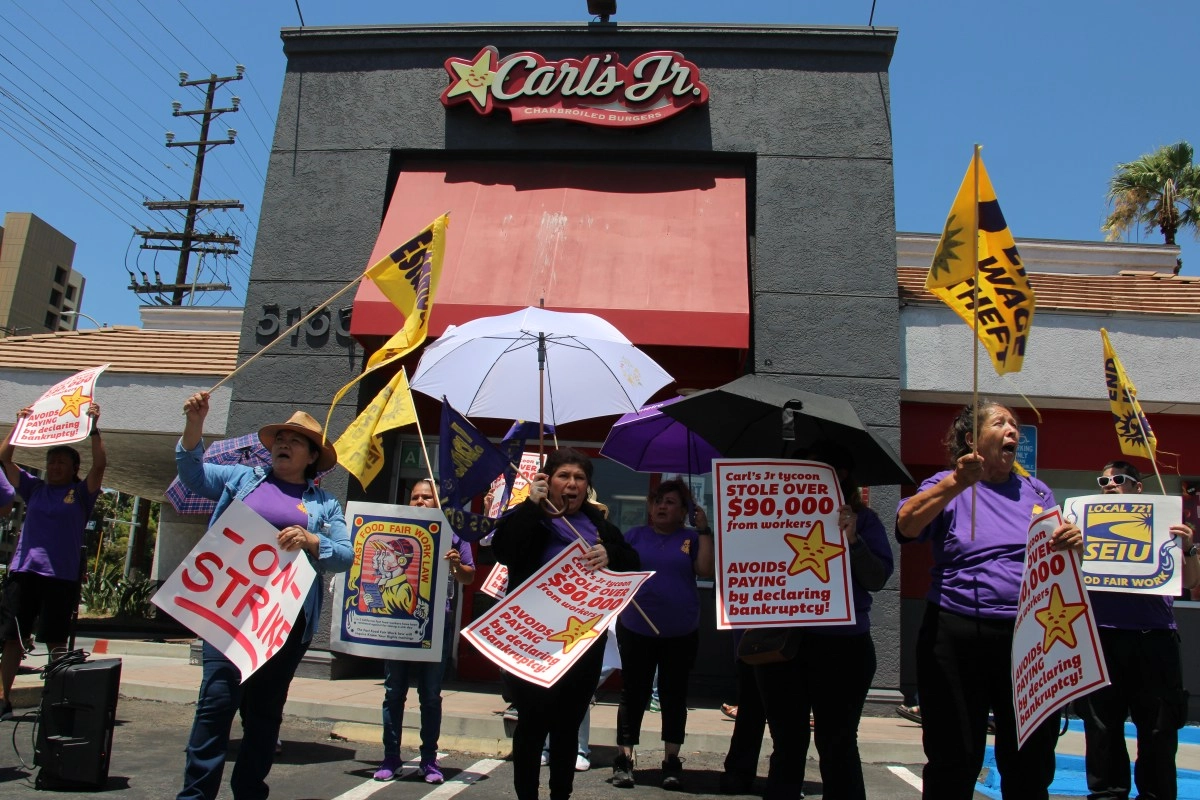

Cooks and cashiers from different Carl's Jr. franchises in Southern California left their workplaces and demonstrated against Harshad Dharod, owner of 45 fast food businesses who declared bankruptcy, and whom they denounced as allegedly responsible for the theft of wages of more than $110,000.
In front of the Carl's Jr. store, located at 5166 Vineland Ave. in North Hollywood, dozens of people protested and claimed that Harshad Dharod, owner of Friendly Franchisees Corporation, based at 1 Centerpointe Dr. Suite 400, La Palma, California, tried to avoid paying employees through bankruptcy.
The workers have already filed a notice with the United States bankruptcy court to demand justice. They allege that Friendly Franchisees Corporation — one of the largest Carl's Jr. operators globally — has abused the bankruptcy process to avoid its responsibility to pay employees or maintain safe and healthy establishments.
“Yesterday we filed a notice with the bankruptcy court to fight their attempts to wash their hands of it, as if the damage to the lives of the workers had not occurred,” said an unidentified activist, “What this man wants to do is evade all the responsibilities he has for everything he owes these workers for wage theft and many other things.”
Amid the scorching midday heat, workers raised slogans demanding justice.
“There are many workers with potential cases and thousands of dollars in stolen wages,” said the activist, without presenting specific data about her complaint. “He is not going to get away with this without a fight, and we are willing to do whatever it takes to win.”
Teresa Ayahuaca is one of those allegedly affected by “all the atrocities that this man [Harshad Dharod] has committed,” said the activist.
“I have been working [at Carl’s Jr.] for more than 20 years,” Ayahuaca said. “We are here to defend our rights.”
He repeated that the owner of the 45 Carl's Jr. franchises declared bankruptcy to not pay them vacations or back wages.
She reported that when her brother - also an employee at Carl's Jr. - got sick they did not “respect his illness” and that she was not paid for the sick days she did not take, as required by law.
“United workers will never be defeated!” “Silent workers will never be heard!” Carl's Jr. listens. "We are in the fight!" "We are here and we are not leaving. And if they kick us out, we will return!" they sang and shouted outside the fast food business, under the impatient gaze of a security guard.
Both before and after the bankruptcy, workers claim that Friendly Franchisees has denied them sick leave, violated meal break laws, forced them to work outside their official hours, and retaliated against those who report these problems or attempt to exercise their rights. Employees have filed more than a dozen complaints against Friendly Franchisees that have not yet been resolved.
“Workers at establishments operated by the debtor companies continue to work there, but their paid time off and sick leave balances have been taken away from them, leaving them without the ability to recover lost wages or obtain compensation for abuses suffered during their employment,” states the letter addressed to the United States Bankruptcy Court. In this way, debtor companies have left low-paid workers to bear the consequences of their own mismanagement.”
In early April, Friendly Franchisees Corporation, an operator of Carl's Jr., filed for Chapter 11 bankruptcy protection in the United States Bankruptcy Court for the Central District of California. The company filed through several subsidiaries, including Senior Classic Leasing, DFG Restaurants and Second Star Holdings.
The company operates several Carl's Jr. restaurants in California and, according to its website, also invests in and manages multifamily real estate properties. Court documents did not indicate whether problems in the operator's real estate operations or restaurants were the cause of the bankruptcy.
FFC is owned by its CEO and founder, Harshad Dharod, who acquired Carl's Jr. restaurants in 2000. The company says on its website that, within a few years, it managed to raise profits and sales "well above the brand average."
Dharod did not respond to La Opinión how he would resolve the complaints of his employees, some of whom have worked for him for two decades, and on his website he states that FCC's success is based on a simple operating concept: "hire people who want to work, challenge them to overcome their own limits and provide them with the necessary tools to achieve the goals they have set for themselves. Our success lies in our people."
With more than 630,000 workers in approximately 49,000 locations, the fast food industry in California stands out as one of the largest and fastest-growing low-wage sectors in the state. About 80 percent of workers in this sector in California are people of color; more than 60 percent are Latino and two-thirds are women. This industry employs the second largest group of low-wage workers in the state.
Furthermore, the fast food industry in California is characterized by a “race to the bottom” business model, in which establishments operate on very tight margins at the expense of safety, wages, training, scheduling and staffing, among other aspects.
800 supermarket pharmacists authorize a strike
Hundreds of pharmacists at Ralphs, Albertsons, Vons and Pavilions overwhelmingly authorized a strike over alleged unfair labor practices.
The decision by members of the UFCW union came after four months of alleged illegal conduct by the companies during negotiations of an expired contract.
Pharmacists represented by local UFCW chapters claim that throughout the negotiations, Ralphs and Albertsons have refused to present a fair contract proposal, allegedly engaging in conduct that has interfered with the negotiation process; among them, making unilateral changes without negotiating, illegally monitoring members participating in the contract campaign and not providing the information necessary for negotiation.
The UFCW Pharmacist Negotiating Committee stated the following:
“The vote sends a clear message to Ralphs and Albertsons: we have had enough of their illegal union-busting tactics, which hurt pharmacists and silence our voices.”
"For four months, we have continued to care for our patients while negotiating under an expired contract. Instead of negotiating a fair agreement, the companies have refused to present a fair offer, while making unilateral changes without negotiating, illegally surveilling active members in our contract campaign, and failing to provide information necessary for negotiation.
"These unfair labor practices are intended to intimidate us and make it difficult to get the settlement we deserve. We demand that Ralphs and Albertsons stop violating workers' rights, negotiate in good faith, and present a fair contract that reflects the value of the essential health services that pharmacists provide every day."
The UFCW says pharmacists are seeking wages that keep pace with inflation and better staffing to avoid fatigue, distractions and unsafe working conditions.
The union is also asking for an additional wage increase of $9.95 over the next two years, while supermarket chains are offering a $5 increase over three years.
Until March 2026, supermarkets offered compensation of $74.10 per hour to a pharmacist and $75.10 per hour to a pharmacy manager.
According to information from the UFCW, CVS pharmacists have a maximum wage rate of $82.55 per hour. The UFCW seeks compensation comparable to CVS and other retail chains.
The companies have assured that they are negotiating “in good faith.”