

This is how Trump plans to win the November election: 15 orders, tricks, conspiracies, and lies
A partial list of the main ways Trump is trying to win the November election, even against the will of the voters

Every day, in the barrage of news this administration wants to accustom us to, the rapid development of methods President Donald Trump uses to try to interfere in the November 3rd national elections to prevent voters from giving the Democrats the Control of the House of Representatives and the Senate.
It is difficult to overstate the importance of these elections. For the President's opponents, it is a unique and unrepeatable opportunity to stop the national chaos we are experiencing these days.
On that day, state legislatures will be up for election; generally, all of their lower houses and one-third of their upper houses (Nebraska is the only state with a single legislative chamber).
Across the country, approximately one hundred positions, including governor, secretary of state, and attorney general, will be up for election. I emphasize these positions because these will be the officials in charge of administering the 2028 elections, when the country will elect a new President. Trump wants them on his side.
That we see multiple ominous signs makes sense. It has happened before, and it happened when Trump did not have state power in his hands. Now he does, and he uses it, and he will continue to use it. But what follows is not deduction or probability analysis, but confirmation of facts, of plans already in motion.
As we know, back in 2020 Trump falsely claimed that his electoral defeat was not real, that millions of voters were defrauded, and refused until the very last moment to hand over the reins of power to the winner, Joe Biden, culminating in the attack and attempted coup of January 6, 2021.
Even after his landslide victory in 2024, which included all eight key states against the odds, Trump claimed without evidence that millions of Democratic votes belonged to undocumented immigrants or deceased individuals.
What will he do now?
The rule is easy to remember: if Trump loses,He will claim fraud and refuse to acknowledge the results. If he wins, he will also claim fraud and insist his victory should be absolute.
Historically, this is an attempt to federalize the US elections to rig the votes in his favor. He cares little that he doesn't deserve the results. When the Nobel Peace Prize winner presented him with the medal, he considered it normal and declared himself the winner. The media doesn't matter. The truth matters even less.
The Grim Reaper: Deployment of Federal Troops
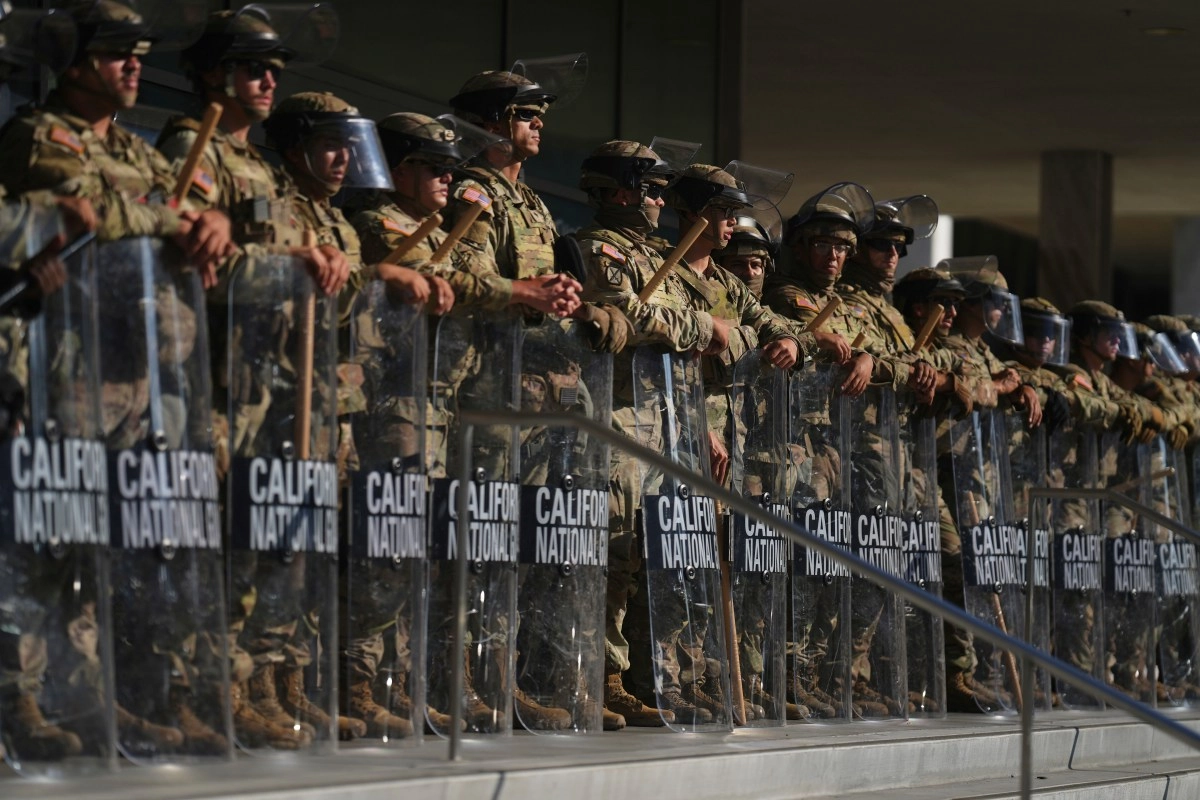
Of all the alternatives available to him, the most dramatic and likely violent is the deployment of troops – starting with the ICE units already swarming in cities with high immigrant populations, followed by entire battalions of the National Guard from Republican-controlled states, which would be deployed in Democratic states, and the Army or directly the Marines. The violence these units are unleashing in Minneapolis is an indication of what's to come. With each passing day, it becomes increasingly clear that this invasion of states with Democratic majorities has already begun, that the government is studying the situations and moving pieces to cause more chaos, more drama, and more confrontations. Because chaos is their ally. The other day, ICE agents arrested a five-year-old boy, and the Vice President justified it. The other day, they shot and killed a man who was already subdued and on the ground, and they argue about whether it was seven or ten bullets, and yes, they justify this barbarity. From all this, it's not hard to deduce that on November 3rd we could see ICE raids reaching polling places. If that happens, it would be an extension of ICE's paramilitary operations under the guise of hunting down undocumented immigrants.
If they are showing up now, hooded, anonymous, armed, and violent, at hospitals, schools, administrative centers, and even immigration courts, why isn't it possible that in November—or earlier—they will be there at polling places, checking paperwork, detaining suspected voters, and controlling the process?
Seizure of Voter Registrations
The other dramatic option is for the federal government to seize voter registration records—or voting machines—by wresting them from the states and determining the election results itself. Some claim that Trump wanted to do this in 2020, but the more level-headed voices within his team dissuaded him. Those sane voices have long since abandoned the MAGA ship. This remains a nightmare scenario that we should not dismiss.
The government might issue the order if it anticipates a decisive defeat for the Republican Party in November.The excuse would be that the elections were rigged and fraudulent, and those results should be declared null and void. Reports of electoral fraud, backed by his Department of Justice, would be cited to justify this action. If this happens, it will be very soon after the polls close: just enough time for the major networks to broadcast the preliminary results. If Trump were to obtain the documents, the challenges would fall to the federal government, not the states, not their election commissions or legislatures, and certainly not our weakened Congress. What will he do with what is seized? Given the Department of Justice's conduct to date, the manipulation or loss of evidence cannot be ruled out. It is no coincidence that today a federal judge ordered the government to preserve evidence in cases of violence. There must be a reason for that. In this nightmare scenario, which we should consider, narratives of fraud are fueled, and distrust in the electoral system is generated.
Changing How Voting Works
Elections are organized by the states, and only they, through their secretaries of state or their legislatures, determine registration procedures, as well as issues such as early voting, mail-in voting, and identification requirements. They, and only they, establish and fund polling places and ballot boxes and train those who will staff the polling stations.
The Constitution grants Congress an important role.
Article 1, Section 4, Clause 1 states: “The times, places, and manner of holding elections for senators and representatives shall be determined in each state by its respective legislature; but Congress may at any time, by law, make or alter such regulations, except in respect of the places of election of senators.” Who else? County or municipal election officials are in charge of implementing state laws and administering elections as directed by their state legislatures. Finally, judges decide disputed cases by interpreting the laws of Congress and the Constitution. Who else? No one. But what about the President? The President, nothing. He is out of the process. Below is a partial list of the main additional ways Trump could try to steal the election against the will of the voters. In some cases, the measures are already in place. Together, they undermine the civic participation of millions of citizens and could ensure the current President's continued hold on power. This is not speculation.
Voter Purge
In itself,Voter purging is a necessary process to clean up voter registration lists by removing outdated records and the names of those who cannot vote. But according to the Brennan Center, voter purges have transformed since 2016 into yet another tool for manipulating election results. The Election Assistance Commission says that between 2020 and 2022, 19 million voters were removed, 21% more than between 2014 and 2016. But that same list was already 33% smaller than the one for the period between 2006 and 2008. One factor in this increase in purges is the intensity with which conservative organizations have filed appeals regarding the presence of millions of names found on the registers, in order to have them removed and thus prevent them from voting. In many states, the law allows organizations access to voter lists and to challenge the eligibility of other voters. To do this, they cross-reference voter registration data with databases such as property tax records or address change records.
These organizations include, for example, the Election Integrity Network (EIN), True the Vote, and Judicial Watch, among others. Their work results in the purging of voters from ethnic minorities and low-income backgrounds. Now, however, their activity has been appropriated by the federal government, which has far more resources at its disposal and far fewer legal constraints.
Seizing State Voter Registration Lists
Indeed, following an executive order issued last August by Trump, the Departments of Justice and Homeland Security began examining federal immigration databases in order to purge them… of whomever they want to purge in order not to lose the election.
To this end, they initially requested data from 19 states: send us the state voter registration records. The pretext was to investigate alleged cases of voter fraud; The goal is to "cleanse" voter rolls of Democrats, immigrant citizens, and opposition figures. Ultimately, it's about intimidating voters into feeling like they're under the watchful eye of Big Brother. They're not hiding it. It's obvious. The offensive to obtain these records—which dozens of states have deemed illegal and refused to provide—now extends to 44 states and Washington, D.C. Federal authorities are requesting personal and sensitive information: participants' identities, including their driver's license number, date of birth, place of residence, and the last four digits of their Social Security number. They are also adding population registry and economic records. According to the Brennen Justice Center,So far, eight of the 27 states governed by Republicans have complied with the federal request, and two more have announced they will do so shortly. Most of the rest have simply refused to comply. Consequently, the federal government has sued 20 states. In June, a federal judge declared parts of the order illegal. But not all of it.
Trump's insistence on receiving the lists is behind his orders to withhold federal aid—which is due to each state government by law—from states that refuse. And it is also part of his fierce invasion of Minneapolis, Minnesota.
The executive order that mandates this attack on states' rights withholds federal election funds intended for organizing elections from states that are unwilling to comply. But federal election funds are meager. For example, HR 1968, the law intended to fund election expenses, distributes a paltry $16 million among the 50 states.
Intimidation and Distrust
As a method of voter suppression, the Departments of Justice and Homeland Security seek to generate distrust in our electoral systems, discourage people from registering to vote, and thus reduce voter turnout.
Once they have these provided lists, what will they do with the names? The federal government already has a system of cooperation between the Department of Justice and the Department of Homeland Security to find undocumented immigrants or those who were fraudulently naturalized on the lists in order to deport them.
Now, they are expanding it to include ordinary citizens. This is the SAVE list: Systematic Alien Verification for Entitlements, which, as of mid-January, included 49.5 million people in the country.
The system has existed for several years, but it was not designed for the type of use the government intends to give it.
Now the administration wants to expand the program to include the entire voter registry. To do this, it has contributed names from Social Security records, which until now have remained independent, to the list.
There is a problem these lists do not overcome: up to 35% of the cases flagged by the system are recently naturalized citizens not yet registered in the databases that feed the national list.
As reported by the New York Times on January 14, of the 49.5 million, the government referred 10,000 for further investigation by Homeland Security Investigations, 0.01% of the total, something that could refute Trump's claim of massive voter fraud by immigrants if Trump were interested in the results and the numbers.
Thus,For example, in the state of Louisiana, out of three million registered voters, the system flagged 403 as non-citizens, 0.01%, of whom 83 had supposedly already voted. Appearing on the list may mean that the person registered, but it doesn't say whether they voted or not. Preventing citizens from voting if they receive government assistance. Another executive order from Trump, regardless of its legality, determined that state governments must "assess" the citizenship of people receiving public assistance before providing a voter registration form to those who request it, which is an unconditional right. Federal Judge Denise Casper of Massachusetts blocked this provision. Show me your papers. On March 25, Trump signed the executive order "Preserving and Protecting the Integrity of the U.S. Elections." It established, among other measures that would limit the right to vote, a requirement for proof of citizenship and a reform of voting machine standards. The "show me your papers" rule stands out, conditioning voter registration on the presentation of a passport or similar document. It did not pass judicial review. In August, Trump insisted: he published a long, convoluted, and complicated text on his private social media platform, Truth, asserting that "I will lead a movement to eliminate mail-in voting." "ELECTIONS CAN NEVER BE HONEST ABOUT MAIL-IN BALLOTS/VOTES, and everybody, PARTICULARLY THE DEMOCRATS, KNOWS IT," the President of the United States wrote. "We're going to start with an executive order that is being drafted right now by the best lawyers in the country to end mail-in voting, because it is a corrupt system," he said at a press conference at the time. The order didn't last long: 24 hours later, a White House spokesperson backtracked on behalf of Trump, acknowledging that any changes would have to come from Congress. However, last September, the president once again announced on social media that he would sign an executive order to cancel mail-in voting. His offensive continues. Suppressing Mail-In Voting Contrary to what the President says, mail-in voting exists in 33 nations for all voters and partially in an additional 21 countries, according to the International Institute for Democracy and Electoral Assistance (IDEA.int). Trump's opposition to mail-in voting stems from the fact that those who use this method vote more for Democrats than for Republicans. Of the more than 88 million Americans who required a mail-in ballot in the last national election,44% were registered as Democrats and 29% as Republicans.
As for the non-citizen vote, which Trump portrays as decisive, planned, and overwhelmingly Democratic, it is already illegal. Anyone who votes without the right to do so will suffer severe legal penalties, including imprisonment and loss of residency.
Throughout American history, repeated audits and investigations have shown that this phenomenon is extremely rare. The truth is, there are very few cases.
An analysis of one billion votes between 1980 and 2024 yields between 70 and 85 cases of proven voter fraud. A minuscule percentage. And the authors of the analysis are the Heritage Foundation, a conservative institution if ever there was one.
Disable Late Votes
In 18 states, the District of Columbia (Washington, D.C.), Puerto Rico, and the Virgin Islands (residents of the latter two cannot vote for President unless they move to one of the 50 states, but they do vote in the primaries and elect a delegate to Congress), mail-in ballots that arrive at the collection center after Election Day are considered valid—the limits are five or 10 days, provided the postmark shows they were sent before the end of the election.
NCSL, the National Conference of State Legislatures, provides a detailed list of the regulations in the different states and the changes they are preparing for the next election. It is available at ncsl.org.
An executive order by Trump had stipulated that these votes would not be counted—a further attempt to reduce voter turnout—which was blocked by the courts. This is the court document.
Replacing electronic voting machines with paper ballot boxes
In the same “Truth” post on his social media site last August, Trump had added another of his plans: to eliminate voting machines. These marvels greatly expedite the voting process and make the counting almost instantaneous. They preserve the results accurately. However, Trump insists on returning to ballot boxes filled with paper ballots.
Voting machines are secure; the courts have reaffirmed this, and even Trump's media mouthpieces, such as Fox News and NewsMax, have had to acknowledge it. But Trump includes this demand in another executive order that includes the renewal of the federal election certification criteria, all of which could force some twenty states to dispose of existing machines, at a cost of millions of dollars.
Redesigning electoral districts
The term that until now carried negative connotations, of backroom deals and negotiations, is gerrymandering. It alludes to Elbridge Gerry,A governor (later vice president) in 1812 was the first to use the practice: designing electoral districts so absurd, with the purpose of winning at all costs and changing the constitution of its voters to do so, that the new map resembles a salamander. The name originated from this combination. And this is precisely what Donald Trump ordered Republican-majority legislatures to establish: changing electoral districts in such a way as to ensure a victory in the November elections. Of course, electoral districts change and their maps are redrawed every ten years, as a result of the federal population censuses. This design, by law, by custom, by decency, must have a logic or at least not be conspicuous by its lack thereof. But Trump forced a redistribution of electoral districts mid-decade, with no other motive than to distort the will of the voters. The trick (used by both parties at different times) consisted of grouping Democratic voters in such a way that they wouldn't have a majority in the districts, even if they came close. This time, Texas started the practice. The change gave Republicans—on paper, because the elections haven't been held yet and the gambit could backfire—five additional seats in the House of Representatives, enough to maintain a Republican majority nationally. But California did the same. To obtain five electoral districts with a Democratic majority, it had to change a law that created independent, nonpartisan district-dividing committees. And since the law had been established by popular vote as an amendment to the state constitution, another popular vote was required to amend the constitution again.
It was done under Proposition 50, which allows for a return to the anti-democratic practices that once thrived in our state, as in any other, but only for ten years.
Proposition 50 – the Election Manipulation Response Act – passed in the November 2025 election with nearly 65% ??of the vote.
Thus, California neutralized Texas. North Carolina and Missouri, two more states that sided with Trump's anti-democratic initiative, gained a couple of seats – potential seats – for Republicans, but Virginia, a Democratic-leaning state, also neutralized them and awarded the same number to the Democrats. And although Trump continues to push, Ohio Republicans have already rejected his demand. In Florida, they could still act, but their legislature is in limbo. The measure is unpopular, to say the least.
Empty the Election Assistance Commission
The United States Election Assistance Commission (USThe Election Assistance Commission (USEAC) is a bipartisan, independent agency, led by two Republicans and two Democrats, established in 2002 to help states comply with their regulations regarding the electoral process. It is an important entity, a response to the 2000 Florida presidential election scandal, when ballots with incomplete perforations captured the nation's attention. It is difficult to forget the spectacle of groups of election officials trying to determine with a magnifying glass whether or not the ballot was perforated in the correct place. The Supreme Court then halted the count and awarded the presidency to George W. Bush by a margin of only 578 votes over Al Gore. The USEAC prevents a repeat of this scandal by modernizing voting equipment and systems. Its $2.8 billion budget goes to the states. Among other functions, it certifies voting systems in terms of security and accessibility. It also manages and audits the HAVA funds division – the Help America Vote Act – which the federal government provides to states to improve the physical conditions of the election; it maintains the national voter registration form by mail (established in 1993) to provide results, statistics, and recommendations. In the aforementioned executive order of March 25, Trump instructed the USEAC – because it is an independent agency created and funded by Congress – to “take appropriate steps within 30 days to require the submission of documentary proof of citizenship on the national voter registration form.” Like other attempts by the president, this one did not pass judicial review. Today, the Trump administration ignores this organization. For him, the USEAC does not exist. Trump thus determines that election decisions belong to the Executive Branch, sidelining this independent institution and concentrating power in the White House and directly in himself.
Challenging the Results
If all else fails and the Democrats gain a majority in either chamber of Congress, the events of 2020 will likely repeat themselves, with the added complication that Trump is now the President. If he deems it necessary to take military, police, or other repressive action to remain in power, he will do so. Trump will continue to claim fraud, that millions of undocumented immigrants voted, that the results were rigged, and that election officials were complicit in this scheme. He has already done so.
He will exploit real tabulation errors that would involve a few dozen votes being inflated into millions.
He and his people have been preparing for this for years: to prevent people from voting in general, and African Americans and Latinos in particular.
If the Democrats were to win Congress, the federal government would distort the results. If all else fails, there is Speaker of the House Mike Johnson, who will refuse to swear in the new Democratic members of Congress—and in doing so, prevent his own replacement. He already showed he is capable of this by ignoring his obligation to swear in new members of Congress last year.
Declaring Martial Law
Numerous political commentators—including James Carville—agree that the Trump administration is deliberately exacerbating internal divisions to cause a chaotic wave of violent protests that would allow it to intervene militarily in states, preventing the normal course of the electoral process. The mechanism for military intervention in the elections would be to declare martial law.
However, the president does not have the right to cancel the elections. But he can—and is likely to do so in cities with a Democratic majority—interfere in the voting.
The last thing, which is difficult to imagine even with Trump, is the use of the Armed Forces to overturn the election results and seize power by force. And finally, a repeat of what happened on January 6, 2021, when thousands of protesters tried to storm the Capitol to prevent the counting of electoral votes, only this time there will be more of them and they will be armed.