

The heartbreaking photo of a mother in Ecuador who was given the body of her baby in a cardboard box
Ecuador's health system is in crisis and analysts estimate that it had a lot to do with the electoral defeat of President Daniel Noboa
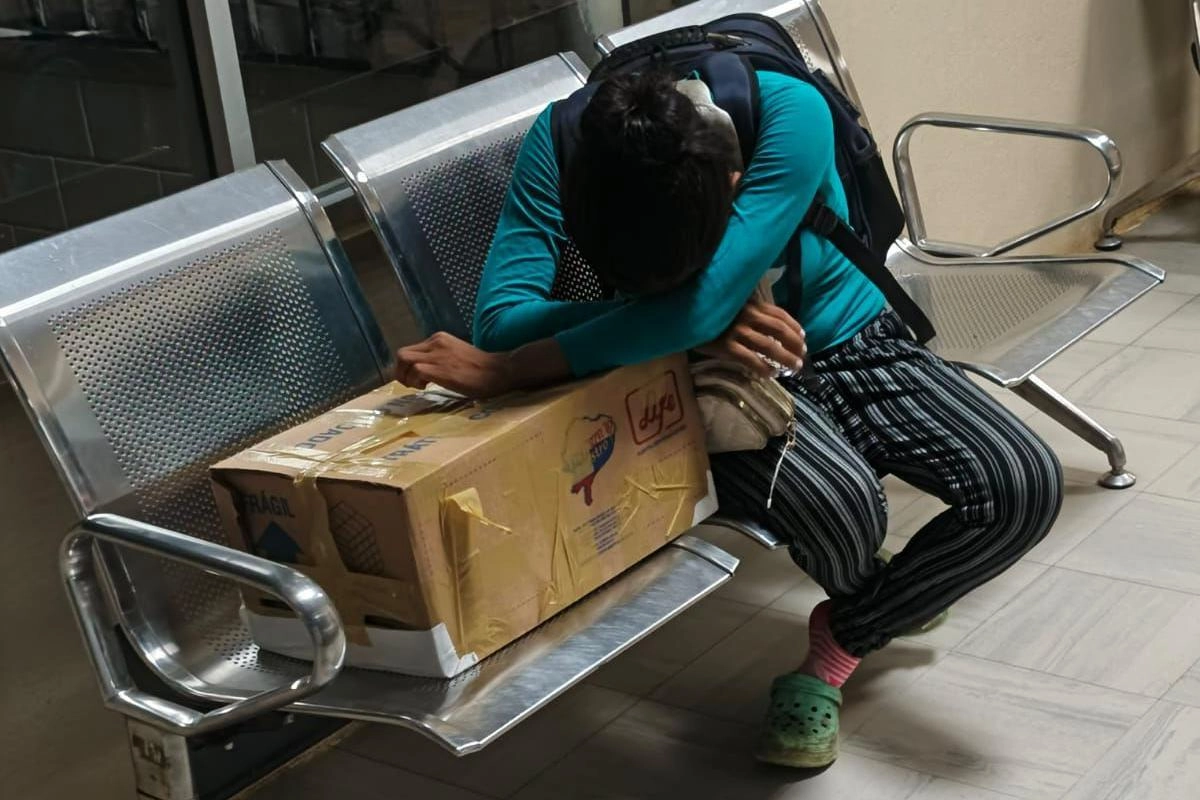

Yawa Sumpa Puar Alexandra, from the Achuar indigenous community, was given the body of her baby in a cardboard box on November 29. The one-month-old baby girl had been admitted the previous night to the General Hospital of Macas, in the Ecuadorian province of Morona Santiago, with a respiratory problem, and died within a few hours. The medical staff recommended that the mother find a coffin, but alone, hundreds of kilometers from her community, and without speaking Spanish well, her situation was one of complete helplessness. Although she went out in search of help, since she had no money, she had to return to the hospital. There she found the makeshift coffin that she had to carry first to the main park in Macas, where the trucks and buses depart for Taisha, and then the three-hour journey to that city, from where small plans take off for the area where her community lives, deep in the Ecuadorian Amazon. "How is it possible that they let her leave like that, with a dead baby in a cardboard box? It's painful to see the way the doctors treat us. It's outrageous and very sad because we are human beings," the member of the Achuar community of Kaiptach who initially helped the mother and took the photograph told BBC News Mundo. It was the municipality of Taisha that finally helped her with a coffin and a flight back to her community. "It's the family who has to bring the coffin. The hospital doesn't provide it. That's how it is everywhere." country. But it is true that they are responsible for managing the process of requesting donations from municipalities or prefectures. And for that, hospitals have a social work department,” Christian Sanchez Mendieta, a journalist with the newspaper El Mercurio, told BBC Mundo.
This newspaper's team had traveled to Morona Santiago last April after 10 children died from leptospirosis, a disease transmitted through the feces and urine of rodents, but with a favorable prognosis for the patient if antibiotics are administered.
“These are populations with completely different customs and who live in unsanitary conditions, but I feel there is a kind of racism against them,” adds Sanchez Mendieta.
“Given the seriousness of this incident, the corresponding procedures have been initiated to sanction the personnel involved in this irregularity,” reported the Ministry of Public Health after the photo of the mother and the box containing her daughter's body was made public.
But the image taken in Taisha, which sparked a wave of outrage throughout Ecuador, became a dramatic example of a situation that transcends the borders of the province of Morona Santiago: the crisis in Ecuadorian public health.
A Political Issue
On November 16, 13 days before the death of this girl in Macas, a referendum was held in which President Daniel Noboa posed four questions to Ecuadorians. In all four questions—ranging from agreeing to a Constituent Assembly to the return of foreign military bases to the country—people said “No.”
Noboa's setback was surprising because the president enjoyed a 52.7% approval rating, according to a Cedatos poll in October, and because eight months earlier he had won reelection in a runoff election with more than 55% of the vote.
Another surprise was one of the reasons cited within Ecuador to explain this defeat: in a country managed almost exclusively to discuss the security crisis and violent deaths, the health crisis was mentioned.
The shortage of medicines and all kinds of medical supplies had reached critical levels by the end of September, affecting even essential medications such as insulin, morphine, amoxicillin, and cancer drugs.
The situation forced Noboa's government to declare a state of emergency in the The Ecuadorian Social Security Institute (IESS)—used by workers who contribute their salaries to the public system—and the Ministry of Health. In the last 20 months alone, the country has had five Ministers of Health, and after this unusual rotation, the portfolio now falls to the Vice President of the Republic, Maria Jose Pinto. One of the main complaints of the president of the National Federation of Physicians of Ecuador, Santiago Carrasco, is precisely the lack of technical leadership and the poor management stemming from the leaders' lack of knowledge of the sector. BBC Mundo contacted Diana Blacio, president of the Commission on the Right to Health and Sport of the National Assembly of Ecuador, from the ruling party, but received no response. “The health budget has suffered significant cuts: from US$3,219 billion in 2023 it dropped to US$2,959 billion in 2024 and US$2,798 billion in 2025,” Maria Veronica Iniguez Gallardo, assemblywoman for the province of Loja, explained to BBC Mundo. According to World Bank data, in 2021 and 2022 the amount allocated to resources related to the operation and maintenance of the health system was also reduced. This includes staff salaries, the purchase of medicines and supplies, basic services (electricity,water), facility maintenance, and administration.
In other words, the costs for hospitals, clinics, and health programs to function on a daily basis, not including large investments in new infrastructure.
But for Iniguez Gallardo, the most alarming thing is the execution of these funds: “As of July 2025, only 34.6% of the investment budget had been used, which means that hospitals and health centers are operating with minimal resources.”
Almost empty shelves
The assemblywoman from Revolucion Ciudadana, the main opposition party led by former president Rafael Correa, indicates that "the shortage of supplies and medicines is widespread throughout the country. In September, public hospitals reported barely 45% of their medicine supplies."
Iniguez Gallardo indicates that, for example, in the Monte Sinai hospitals And in Guasmo, the two largest health centers in Guayaquil, the country's economic capital, the lack of essential supplies reached 80%.
“In another Guayaquil hospital, the University Hospital, 18 newborns died after contracting healthcare-associated infections due to the reuse of contaminated cannulas, supplies whose cost is minimal (approximately US$1),” the assemblywoman recalls.
Juan, a pseudonym for a specialist at Monte Sinai General Hospital who does not wish to be identified, describes the precarious conditions under which they have been working for a year:
“If someone "We can't even get lab tests or blood work done; these services are practically nonexistent due to lack of payment," she said. tells BBC Mundo, adding: "Because many medicines are lacking, families are forced to go to loan sharks and borrow money at extremely high and exorbitant interest rates. It's either that or their family member dies. The health crisis extends to the entire social fabric. It goes beyond healthcare."
BBC Mundo tried to contact the Ministry of Public Health through official channels but was also unable to get a response to these accusations.
Other patients suffering from the current shortage of medications are those who need dialysis or those with diabetes who require a daily dose of insulin.
In Guayaquil, on November 28, there was a demonstration to denounce the insulin shortage, which, according to various associations, has worsened since 2023 and affects both private and public pharmacies.
“If you ask me how we got to this situation,I think it's perhaps due to poor management by the government in the procurement process,” explains Lucia Mantilla, president of the Juvenile Diabetes Foundation of Ecuador.
“Diabetics need insulin every day. It's not something you can take every other day. And right now, members of the association tell us they have to go to several pharmacies to find a vial, which sometimes they can't even get.” "They distribute it over two or three days."
"When a diabetic patient doesn't inject insulin, this can lead to high glucose levels, which can develop into ketoacidosis. Ketoacidosis requires hospital intervention, and if left untreated, in extreme cases, patients can fall into a diabetic coma," he adds.
Since the pandemic
According to several experts consulted, the COVID-19 pandemic—which hit Guayaquil particularly hard—accelerated the collapse of the system.
"There were layoffs of thousands of healthcare professionals, and several cases of corruption in the purchase of medical supplies came to light," says Iniguez Gallardo.
"The pandemic had a huge impact on Ecuador. Just remember the coffins in the streets. The country implemented a system that reserved public hospitals to treat COVID and outsourced the care of other illnesses to the private sector," says Marcelo. Bortman, former World Bank health specialist.
The formula involved transferring funds from public services to private clinics to pay the bill.
“For a health system to be strong, it needs adequate human resources, infrastructure, and sufficient funding. Obviously, hospitals need equipment, and that is becoming increasingly expensive due to technology,” Bortman explains, adding:
“Most health sector budgets worldwide are generally allocated to operating expenses, but there isn't enough for maintenance or improvements. And over time, if these investments are lacking, services deteriorate, and so do capacities.”
Discharged without surgery
The newspaper El Mercurio recently reported the story of a 22-year-old patient admitted to the Jose Carrasco Arteaga Hospital in Cuenca more than 20 days ago. the medical report, he has, among other things, polytrauma, meaning many broken bones—including three vertebrae—and a pneumothorax (a collapsed lung).
“There are very few first aid posts and general medicine clinics in rural areas. You have to walk four hours through the jungle. They are wooden structures that barely have the basic necessities,” describes journalist Sanchez Mendieta.
To this we must add that the doctors in remote areas “are almost always recent university graduates who are doing a year of community medicine,” explains Pablo Ponce, director of the Violin Rojo collective, an association that works with indigenous communities in Ecuador. Specifically, Ponce has been living with the Achuar people for five years.
“But what's needed is to have doctors on staff, specialists, a general practitioner, a pediatrician. At the local health posts, there's no way to get blood tests done. There's no guarantee of electricity,” she argues.
This system, which leaves rural areas far from supply distribution points or keeps specialists away, was the reason Yawa Sumpa had to take her baby to the Macas Hospital.
And when she thought medical attention would save her daughter, she encountered a systemic crisis that left her with nothing but a cardboard box.