

Asymmetric warfare: cheap drones challenge Israel
Inexpensive and highly effective: Low-cost drones put Israel's high-tech defense systems under pressure

Images from a video that could not be more symbolic: a drone with explosives hits a battery of the Israeli Iron Dome air defense system. Israel's famous defense system, worth billions of dollars, is attacked by a device that costs little more than a few hundred euros. The images have not yet been definitively verified, but experts believe they are authentic.
The video was spread on social networks a week ago by the pro-Iranian militia Hezbollah, classified as a terrorist organization by Germany, the United States and several Sunni Arab States, among others. For the Houthis, the event represents a huge propaganda victory. And the Israeli Army seems more vulnerable than ever.
Fiber optic drones as a secret weapon
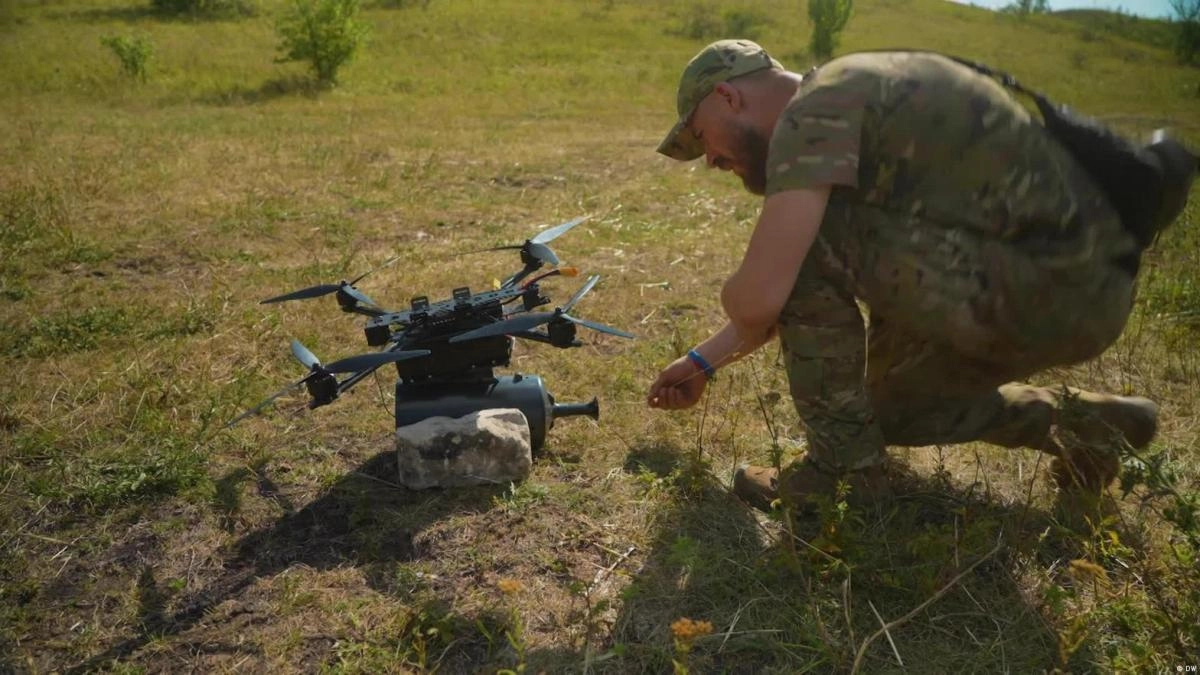
Since March 2026, Hezbollah has increasingly turned to FPV (First Person View), which gives pilots a real-time image of their target. Several Israeli soldiers have been killed in the attacks and many more have been wounded.
What especially worries experts is that, increasingly, these drones are not controlled by radio, but rather by fiber optic cables. Their signals are transmitted to the pilots through thin cables that uncoil from a coil. Thus, both locating drones and interfering with their communications (jamming) are practically impossible with traditional electronic warfare methods.
In the Ukrainian war, these fiber optic drones have been used massively since 2024, both by Ukraine and Russia. Many of the measures to combat them still seem quite improvised. In addition to installing protective nets, simple mechanical methods are often used, such as cutting cables or firing shotguns. Both sides seem helpless in the face of the fundamental problem that these drones are technically almost impossible to locate.
The Government of Israel asks for patience
Given the development of events in recent years, many observers are surprised that the Israeli military does not appear better prepared. "Armies that are prepared for major wars are suddenly faced with completely new challenges," drone expert Neri Zin told DW.
According to the CEO of the Israeli defense company Axon Vision, it is not easy, especially for major military powers, to adapt their war strategy quickly enough: “A tank that costs tens of millions of dollars can now suddenly be attacked by an FPV drone that can be bought for $400 on Alibaba.”
Ukraine's ambassador to Israel, Yevhen Korniichuk, has criticized Israel for not relying more on Ukraine's experiences in seeking solutions. “Unfortunately, we do not see much interest in this issue from the Israeli leadership,” the diplomat told the Israeli news portal Ynet News. And he added that, in this way, the country is losing an important opportunity.
A spokesperson for the Israel Defense Forces (IDF) assures DW that they are also closely monitoring the challenges in other conflict zones worldwide. The Israeli Armed Forces are “at the forefront of seeking measures to counter this threat.”
Meanwhile, the problem puts more pressure on Benjamin Netanyahu's government. The prime minister told Israeli media that he had ordered the creation of a special project to address the drone threat. At the same time, he asked for patience: “This will take time,” Netanyahu said. The possible technical solutions that are being considered are diverse. They range from early visual and acoustic detection of drones to the destruction of their electronic components using microwave and laser technology, all based on artificial intelligence.
Solutions must be economical
“Above all, we need simple solutions, and we need them now,” emphasizes drone expert Neri Zin. “We can't wait years to develop something.” His startup is already working on solutions to defend against drone attacks with fiber optics. It focuses on systems designed to protect smaller vehicle-mounted units. The idea: visual and thermal cameras record the environment. The data is immediately analyzed by specially trained AI systems. Finally, target information is transmitted to the weapon systems.
Zin emphasizes that a human being is always involved in the decision-making process. However, in particularly hostile environments, autonomous actions may be pre-authorized for certain periods.
According to Zin, his company already has clients in numerous countries, including Europe. For him, war with drones always involves an economic conflict. The solutions must above all be profitable, otherwise absurd situations will arise, he points out. "Yesterday I saw a general from the United Arab Emirates talking about the cost of the war with Iran in the past month. They were fighting Shahed drones with interceptor missiles that cost eight million dollars each."