

Theia: the planet that our Earth could have devoured to create the Moon
Scientists currently believe that a mysterious Mars-sized planet collided with a young Earth 4.5 billion years ago
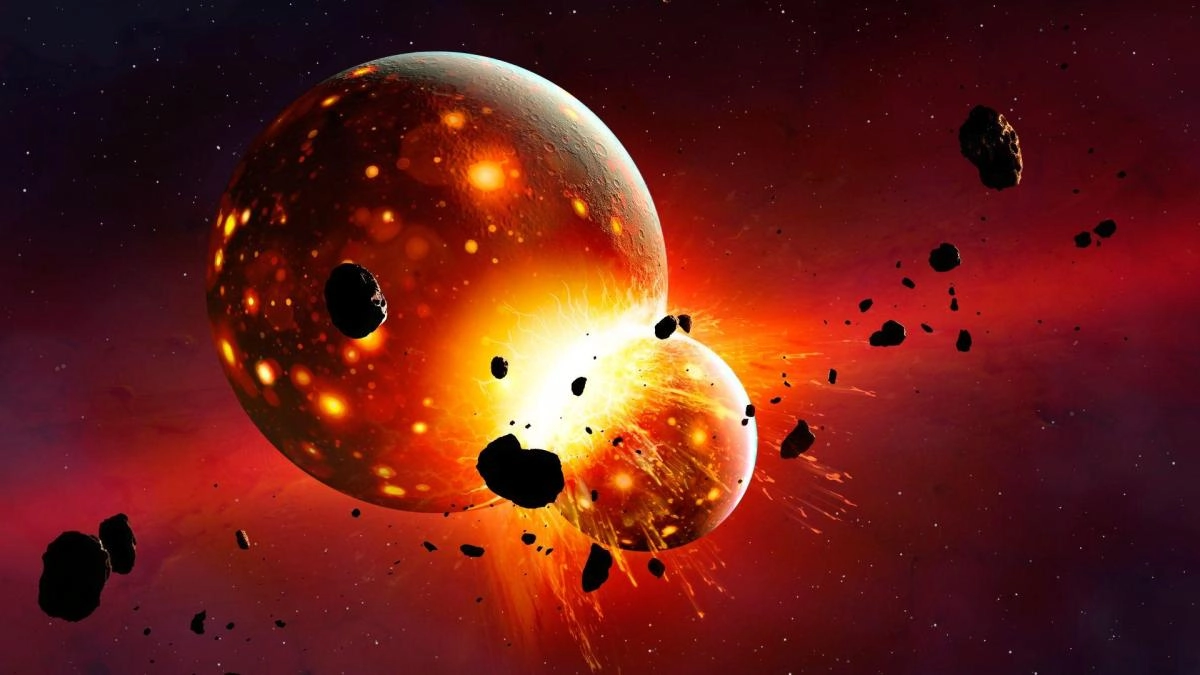

The next time you look at the full moon, think about Theia.
That's the name scientists gave to a hypothetical planet that could have collided with the young Earth 4.5 billion years ago, releasing a piece of debris that would become our Moon.
According to this theory, without the Without Theia's "cosmic sacrifice," we wouldn't have our permanent natural satellite, nor would you be reading this article.
A collision of cosmic proportions
Scientists currently believe that a massive collision between early Earth and something the size of Mars released enough material to eventually coalesce and create the Moon.
Known as the giant-impact hypothesis, this event also initiated a relationship whose importance to life as we know it is undeniable.
Among other things, the Moon maintains a gravitational tug-of-war with our planet that, for billions of years, stabilized Earth as it rotated on its axis, contributing to climate stability.
"Without climate stability, we would have much more extreme weather and climate conditions, which would not be conducive to the development of life," explains Professor Thorsten Kleine, a planetary scientist at the Max Planck Institute for Solar System Research, in Germany.
Kleine was part of an international team of researchers who, last November, attempted to shed more light on Earth's momentous and mysterious encounter with the Moon.
In an article published in the journal Science, the team analyzed the chemical composition of samples from Earth and the Moon, and reinforced theories that Theia and our planet were what we might call awkward neighbors during a chaotic time in the formation of the Solar System.
One Moon, Many Theories
But we haven't always taken Theia into account.
Before humans set foot on the lunar surface in 1969, there were three other main hypotheses about the origin of the Moon.
According to the fission theory, the Moon formed when a rapidly spinning, early Earth ejected a chunk of its material into space.
The capture theory proposed that the Moon formed elsewhere in the Solar System and was captured by Earth's gravity as it passed nearby.
Finally, the co-formation theory, according to which the Earth and Moon originated and stabilized side by side.
Instead of shedding light on which of these theories was most likely, it turned out that NASA's Apollo missions pointed to an entirely new one.
Chemical Similarities
While the feats of Neil Armstrong and other astronauts who landed on the Moon often dominate the narrative, a crucial achievement of the Apollo missions lies, for example, in the material mementos of the journey.
“The Apollo astronauts brought back samples of lunar rocks, and by analyzing them, Scientists discovered that lunar rocks showed remarkable chemical similarities to terrestrial ones,” says Professor Raman Prinja, an astronomer at University College London and author of the children’s science book “Wonders of the Moon.”
This suggested that the Moon could have originated from the Earth.
Prinja also says that the rocks show signs of having formed under extreme heat, suggesting they originated from a massive impact.
They also appear to have lost much of the elements that readily vaporize when heated, indicating that the Moon was molten when it formed.
Sarah Valencia, a lunar geologist at NASA, adds that the clues provided by the samples are just the tip of the iceberg.
Technological advances in recent decades, especially in computer modeling, have strengthened the giant-impact hypothesis.
There are even theories that the tilt of Earth’s axis is a consequence of the collision with Theia.
“The giant-impact theory remains the best model to explain the chemistry and relationship between the Earth and the Moon,” argues Valencia.
Could Earth have “eaten” Theia?
This is one of the remaining mysteries.
Unlike the infamous asteroid that struck Earth 65 million years ago, wiping out the dinosaurs and leaving a massive crater on the Yucatan Peninsula in Mexico, Theia didn't seem to leave any visible traces.
Why? Kleine says Theia was about 10% the mass of Earth, and that difference means it would have fragmented on impact and been largely absorbed by our planet.Fragments of it could also have been part of the mixture that gave rise to the Moon. “This would be the natural result of such a collision. But we would expect to see a compositional signature of Theia in the Moon, something we haven’t found so far,” the scientist states. “One explanation is that Earth and Theia were very similar because they formed in the same region of the Solar System,” he adds, and were therefore difficult to distinguish. Likewise, we know that our planet shares many traits with two of its closest neighbors, Venus and Mars. Venus is even sometimes called “Earth’s evil twin.” “But, just as Theia’s origin is not known for certain, neither is its fate,” Valencia cautions. However, there are some clues. A 2023 study revealed that two continent-sized areas deep within the Earth were remnants of Theia.
Return to the Moon
There is still much to learn about how our planet and the Moon became a duo, which is why scientists are so excited about NASA's current Artemis missions and the return of humans to the Moon.
In addition to more advanced experiments than were possible in the Apollo era, the most recent missions will explore new regions of the Moon, such as its South Pole.
The lunar samples brought back to Earth by Apollo came from a relatively small area of ??the Moon: the equatorial region of the near side.
“If we only visited six places on Earth, could we say that we have explored the entire Earth and understood its evolution? Of course not! The Moon has inexhaustible scientific potential,” argues Valencia.
But for now, with what we have already learned, it is fair to say that we could be very grateful to Theia for her sacrifice.