

Thousands are training to defend the community from ICE
La Union del Barrio is the community group that has conducted the most training in Southern California, not just in Los Angeles
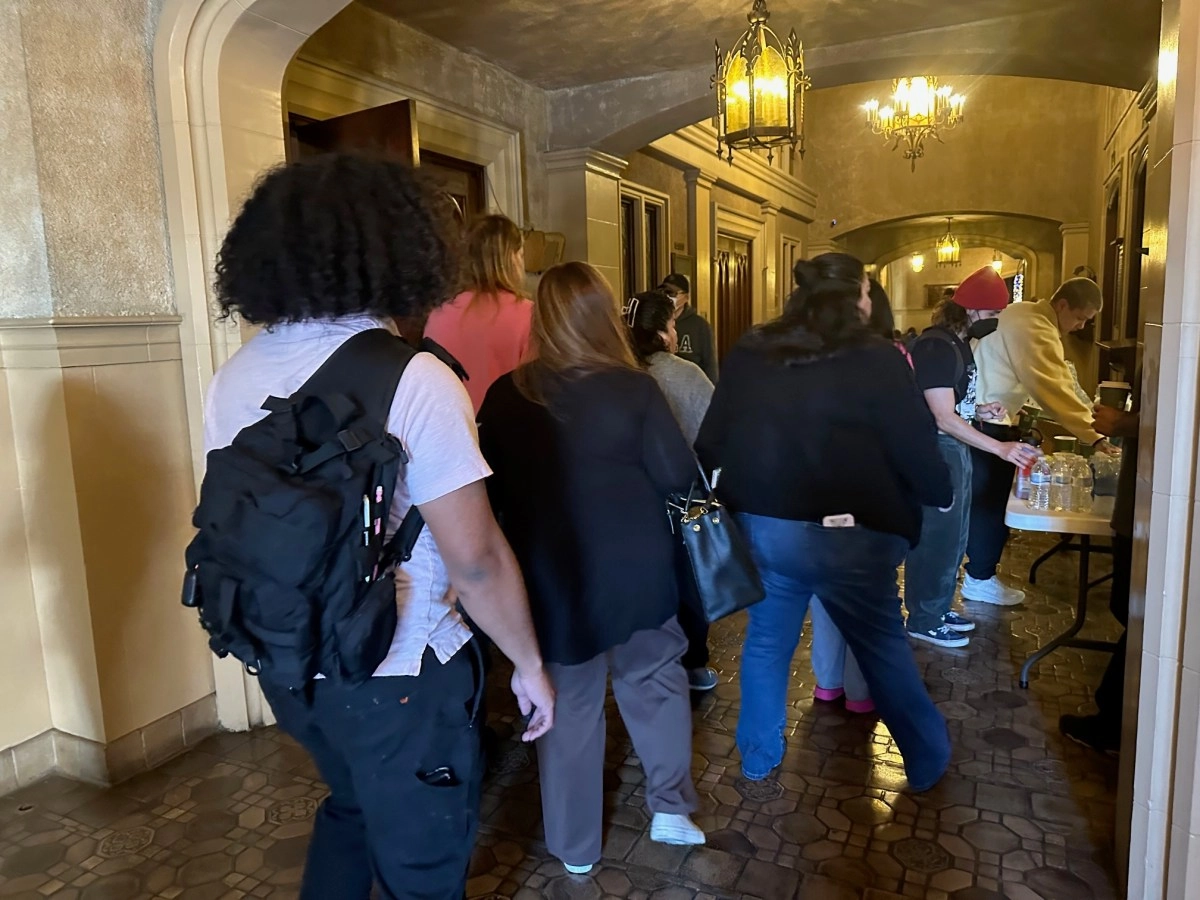

More than 300 Angelenos, mostly white, gathered at a church on Wilshire Boulevard in Los Angeles to train in community patrolling against federal immigration agents and to defend the community, their friends, and neighbors.
“We have been training thousands of people for more than six months; two weeks ago, in one weekend, we trained more than 2,000. “Many people want to participate in this community defense movement to confront ICE (Immigration and Citizenship Service) attacks in the community,” said Ron Gochez, leader of Union del Barrio, the community group that leads the community patrols in Los Angeles. He said that if we see many more white people in the training, it's because many have the immigration status to do the patrols. “It's important that those of us who have papers do this work to defend the community,” he said. He noted that we've seen this surge of white Americans training to defend immigrants because they want to show that not all of them are Trump supporters and that they stand in solidarity with the community. “The plan by Trump and ICE was to instill terror and intimidation, and that has had the opposite impact; “more people want to participate and help.” He commented that the Barrio Union welcomes all those who want to organize and be trained “We are holding in-person training sessions in different locations, and via Zoom. We held a virtual one for teachers that was attended by 1,000 people, and we couldn't accommodate more because that was the limit they imposed. “We're going to hold another one tomorrow.”
Gochez said they are not the only ones providing self-defense training; other organizations in Los Angeles are also doing so.
“There are thousands and thousands of people participating in a movement that was started by Union del Barrio.”
A Risky Job
The community leader clarified that patrolling the streets of Los Angeles to protect the community from ICE terror involves risks.
“In the training, everything we recommend is legal.We have a team of lawyers advising us. But just because our work is legal doesn't mean the agents will do their job within the law. That's why our work is risky,but we're not going to stop.”
During the training, attendees receive information about what they can and cannot do when they come face-to-face with federal immigration agents.
“Many people have been arrested, fined, and killed, so it's important that they know what to do and what not to do so they don't put themselves in danger.”
Another very important point, Gochez said, is that street patrols must be done in groups, and she recalled that Renee Good was alone in Minneapolis when she was killed by ICE agents.
“The first thing we tell them is that they can't drive, document, and alert the community alone. It's very risky. They have to go out in groups; And if they're not part of an organization, we suggest they join one so they can do the work as a group,” Gochez noted. He added that it's very encouraging to see more and more people joining in, so now they have eyes and ears in every corner of the city. “Right now, there can't be a single raid in Southern California without the Barrio Union knowing about it in less than five minutes.” People call us, or those on patrol, or anyone who sees someone from ICE, sends us messages on Facebook or WhatsApp.”
Since the Union del Barrio network has grown much larger, it responds much faster.
“We are the only network that answers calls 24 hours a day, at 3, 5 in the morning, to warn of operations in the early morning.”
He said that for Union del Barrio, answering alert calls is a priority.
“There are other groups that also answer calls, but only from Monday to Friday, during business hours. We "Even though I was born and raised here, I'm also afraid of being asked for my papers, and there are family members who feel the same way. lives in Huntington Park and is buying groceries for her neighbors who are afraid to go out, and she's taking her kids to school.”
So she said she's just trying to do something for the community until they can get rid of the current administration.
She commented that she feels like everyone's rights are being taken away.
“My father was an immigrant. My brother-in-law is an immigrant. So it's a little scary not knowing who will be targeted next.The other day I was in a neighborhood on my way to Northgate and I heard there was a raid on the street. It's scary not knowing what's going to happen, that the plainclothes police will come and take people away.They might even break into people's cars, smash the windows, and drag them out by force.”
Ghazelle, an artist of Jordanian, Palestinian, and Armenian descent, was encouraged to attend the training workshop because she feels her community and neighbors are under attack.
“We have to protect each other. And it's good to have all the information, no matter what the situation is. So I just want to be prepared to do whatever is necessary for my neighbors.”
Tomas, a Latino man who works for a non-profit food organization, attended the training driven by the need to protect his community and his family.
“I just want to make sure people feel protected and safe on the streets. No one should be harassed, kidnapped, or detained.”
“So I'm excited to come and learn about the networks that exist and how to provide support,” Tomas said. He added that although he has patrolled his neighborhood, he wants to learn how to be a more active member of the community in Los Angeles. A social work student, who declined to be identified, confessed that she attended the workshop because she believes it is very important to be informed about how to protect the community. “I have many clients who have been impacted at high levels.” levels by the federal administration. That's why I want to be active and see what I can do. “I feel very motivated by my community.” Another attendee, who only gave the letter “D,” said that while ICE continues to terrorize the community, we must understand that no one is going to come and save us. “We have to learn to defend ourselves and unite.” That's why many of us are here now.
Another warning was that ICE almost always operates in the early morning hours, but they can appear at any time, day or night; they have patrol lights in the sun visor, grille, and fender area.
There is almost always an agent in the vehicles, and two or more agents always operate together.
They advise that if you see these types of vehicles or an operation, call 213-444-6562 in Los Angeles, California.
The Border Patrol
They said it has unique power, greater than the rest of the agencies; and thanks to a Trump order, they can operate within a 100-mile radius of the borders.
“That means that, without a warrant, without having to justify it, if you are within this 100-mile border radius, they can stop you and ask for your documents, ask your name and if you are a citizen.”