

What is holding back the second phase of the US-driven ceasefire between Israel and Hamas?
Two months after Israel and Hamas agreed to the first phase of a ceasefire, progress toward a second phase remains stalled

Israel and Hamas agreed last October to a first phase of a ceasefire, backed by the United States, which raised hopes for a possible path to ending the armed conflict in the territory.
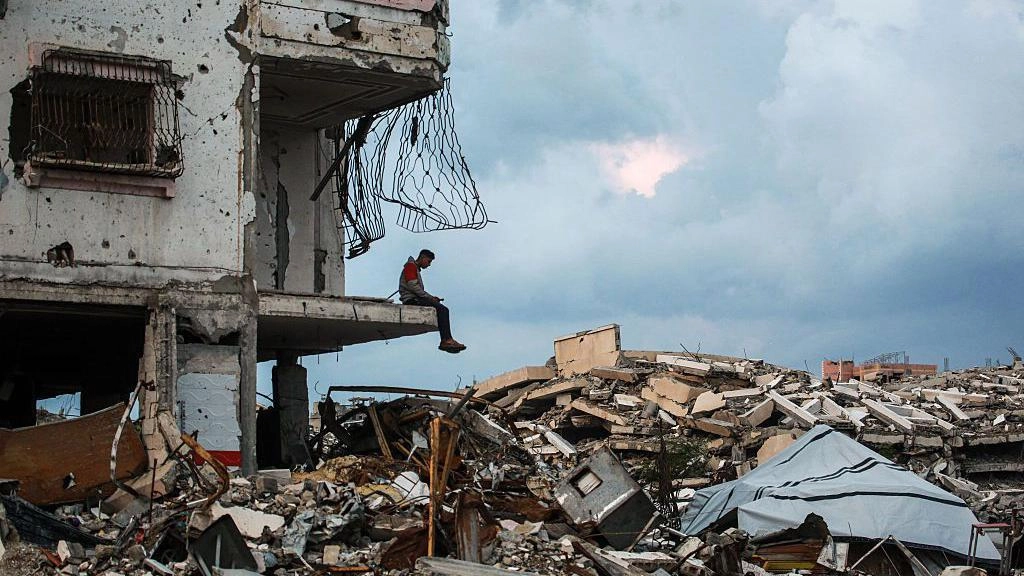
Two months later, Gaza remains stuck in the first phase phase. It is divided in two, with its population displaced and living among ruins.
Under the second phase of the ceasefire proposed by US President Donald Trump, both Israel and Hamas face difficult decisions.
Hamas needs to surrender its weapons, and Israel must withdraw its troops from Gaza and transfer security responsibilities to an international force.
Forming a government to administer Gaza is another challenge to resolve, as is Israel's search for the last remaining hostage, Ran Gvili.
Where is the last hostage?
Gvili, an Israeli police officer, was kidnapped by Hamas during the attack on October 7, 2023. Hamas has said that the search through the rubble of Gaza has yielded no results regarding his whereabouts.
Israeli Prime Minister Benjamin Netanyahu has insisted that Hamas must return all hostages—dead or alive—before that the agreement can move to its next phase.
Gvili's parents, Talik and Itzik, were told last year that the agent had not survived.
“They stole our son, they stole him,” his mother told the BBC. “They know where he is. They are just trying to hide him or keep him. They are playing with us,” the father noted.
The couple believes Hamas wants to hold their son as collateral for future negotiations, after the return of all the other hostages.
Hamas officials, for their part, told the BBC that these accusations are false and that Israel was trying to avoid implementing the agreement.
But the US wants to move toward the second phase of the ceasefire,According to the Israeli newspapers Haaretz and The Times.
In an interview with the BBC, Gershon Baskin, a former Israeli hostage negotiator—particularly in the 2011 agreement for soldier Gilad Shalit—notes that Israel “doesn’t have many options” to postpone the second phase of the Gaza agreement.
Baskin says Trump has been “very clear about his decision” and will tell Netanyahu that “there is no room for procrastination.”
The former negotiator, who has played a significant role in communication between Israel and Hamas, adds that the issue of the hostage’s body not being returned “is not sufficient reason” to delay the start of a second phase of the agreement.
Who will disarm Hamas?
Disarming Hamas in a way that is acceptable to both sides is by far the biggest barrier to moving forward with the ceasefire into its next phase.
Turkey has insistently requested to be part of the International Stabilization Force (ISF), which will be responsible for disarming the Islamist group, according to the Israeli media outlet Hayom.
Netanyahu has been clear in his intention to prevent this from happening and has the support of the US, the outlet notes.
So far, no country has formally announced that it will join the ISF.
According to Baskin, Hamas may agree to “store its weapons” and possibly hand them over to a Palestinian government or a third party, but not to Israel or the US.
He adds that the US knows that the disarmament of Hamas is linked to the complete withdrawal of Israeli forces from Gaza and that this will be difficult to achieve while Israeli forces remain inside the Strip.
When will Israeli forces withdraw?
At this time, Israel controls approximately 53% of the Gaza Strip.
Under the first phase of the ceasefire agreement, Israel agreed to a partial troop withdrawal from northern, southern, and eastern Gaza. The established boundary became known as the “Yellow Line.”
The second phase requires a mutual agreement on a further Israeli military withdrawal, disarmament mechanisms, reconstruction, and arrangements for international monitoring.
These issues are considered sensitive because they directly affect the security of Israeli settlements on the Gaza border and the future of the Israeli presence in what is known as the Philadelphia Corridor, a strip of land along Gaza’s border with Egypt, which includes the Rafah crossing.
According to General Israel Ziv, a former Israeli military expert on operations, both Hamas and Israel are hesitant to rush the move toward the second phase.
“Hamas doesn’t want to lose control, and the Israeli side, for political reasons, also wants to stay in Gaza,” Ziv told the BBC.
According to the military officer, Trump is the only person who can force both sides, but time is running out.
“By waiting, I think we’ve lost the opportunity, because Hamas is reorganizing and regaining strength,” he added.
Who will govern Gaza?
How to form the transitional administrative body that will govern Gaza in the next phase is another major obstacle.
Although the proposed plan calls for the formation of an independent Palestinian technocratic government, separate from both Hamas and the Palestinian Authority (PA), Israel suspects that the participation of representatives from both groups will be inevitable.
The Israeli government is concerned that this could enable Hamas to retain its influence in the new governing institutions, or lead to the PA’s return to Gaza.
Previously, the PA exercised limited control over parts of Gaza and the West Bank, but since Hamas took control of Gaza in 2007, it has only governed parts of the Israeli-occupied West Bank.
The Netanyahu government rejects any participation by the PA or Hamas and instead demands a “neutral Palestinian entity” to govern the territory.
The Israeli government is also concerned that the second phase could mean “the real beginning of the establishment of a Palestinian state alongside Israel,” according to Baskin.
What will Netanyahu and Trump discuss?
These key issues are expected to be addressed at a meeting between Netanyahu and Trump in Florida later this month.
The US president, who brokered the ceasefire in Gaza, is scheduled to announce the composition of the newly created Gaza Peace Council early next year.
In In his meeting with Trump, Netanyahu is expected to push for Hamas's disarmament, block its participation in any future administration of Gaza, ensure the deployment of the Israeli army in the so-called buffer zone, and prevent the deployment of Turkish forces in the Strip, according to Israeli media. Trump, on the other hand, could pressure Netanyahu to "put an end to Israeli violations of the ceasefire agreement," Baskin notes. He adds: "Israel has broken the ceasefire more than Hamas." Since the October 10 agreement, nearly 400 Palestinians have been killed and more than 1,000 wounded in Gaza, according to figures from the Hamas-run Ministry of Health. The death toll in Gaza since the start of the war on October 7, 2023, stands at 70,665, according to the agency.