

What was the latest life rescue after an earthquake?
From Haiti to Türkiye, these are some of the most surprising rescues of people who survived for days under the rubble after an earthquake
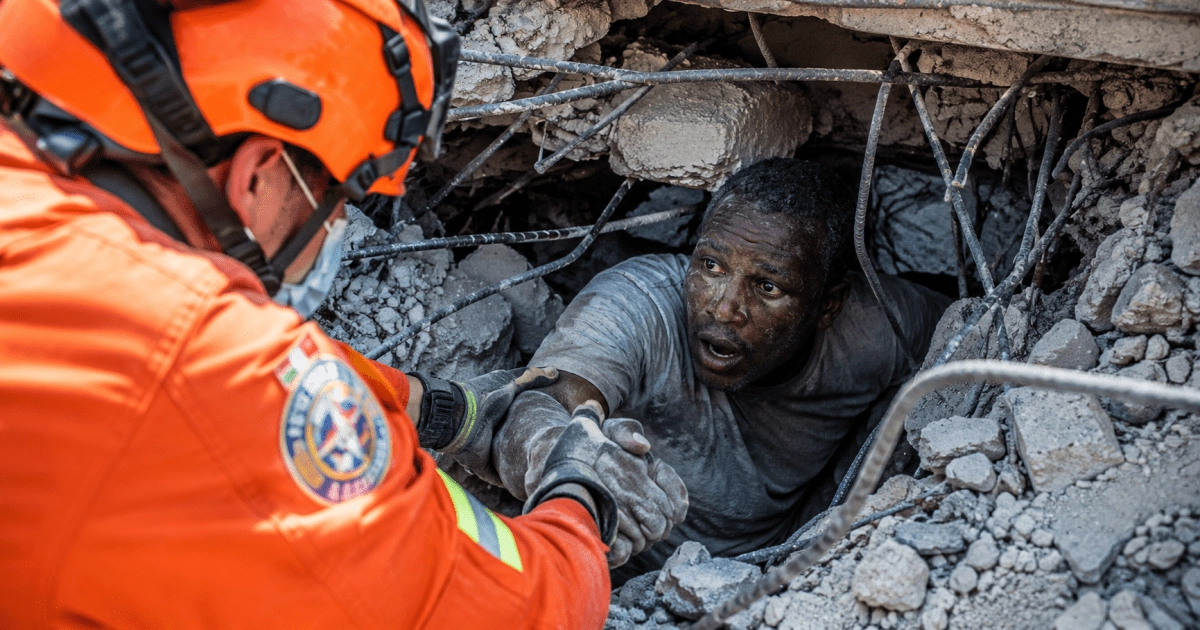

After an earthquake, the first 72 hours usually concentrate most of the hope. It is the period in which emergency teams work against the clock, listening for knocks under the rubble, turning off machines to detect voices and looking for any minimal sign of life.
But every once in a while, something happens that challenges that rule. One of the most extraordinary cases documented was that of Evan Muncie, a 28-year-old Haitian rice seller who was found alive 27 days after the earthquake that devastated Port-au-Prince on January 12, 2010. He was found in the remains of a collapsed market, dehydrated, malnourished and confused, but alive.
The story seems impossible. And, precisely for this reason, it continues to be cited every time an earthquake leaves people trapped under collapsed buildings.
Muncie survived in extreme conditions. According to reports at the time, he was very weakened when he was transferred to a field hospital operated by the United States. He had not been found during the main search and rescue phase, which had already ended days earlier.
Dr. Mike Connelly, one of the doctors who treated him, described his condition: "He was emaciated. He hadn't eaten in a long time and he had open wounds on both feet." Even so, he did not have serious life-threatening injuries.
You can see: 5 urgent things you should do in case of an earthquake
Other rescues that also seemed impossible
Haiti is not the only case that remains in memory. In the Philippines, after the 1990 Luzon earthquake, cook Pedrito Dy was rescued alive 14 days after being trapped in the basement of the Hyatt Terraces Hotel in Baguio. His survival was considered one of the longest recorded until then.
More recently, after the 2023 Turkey-Syria earthquake, there were rescues that went around the world: people found alive after more than 200 hours under the rubble. AP even reported the case of a couple rescued 296 hours after the earthquake; His son was also taken out alive, although he later died in the hospital.
In Japan, a woman over 90 years old was found alive 124 hours after the earthquake on the Noto Peninsula, in 2024. For rescuers, every hour that passes drastically reduces the possibilities, but that case once again showed that miracles, although rare, exist.
Why do some people manage to survive so many days?
There is no single explanation. Survival depends on a very fragile combination of factors: that there is an air pocket, that the person does not have fatal injuries, that they are not completely crushed, that they can access some water or humidity, and that the temperature is not extreme.
Water is usually the main difference. The human body can last a long time without food, but much less without hydration. Therefore, prolonged cases are usually linked to small leaks, rain, broken pipes or some minimal access to liquid.
The exact place where the person was trapped also plays a role. A gap between columns, furniture or cement slabs can become a kind of accidental shelter.
You can see: When was the last big earthquake in Venezuela and how many deaths it left
Hope after 72 hours
Experts usually talk about a “critical window” of three days, but that does not mean that there can be no survivors afterwards. It means the odds go down a lot.
For families, that difference is difficult to accept. As long as there is silence under the rubble, there is also waiting. And, as long as there are teams looking, there is a chance.
For this reason, stories like that of Evan Muncie, Pedrito Dy or the survivors of Türkiye are repeated over and over again. Not because they are the norm, but because they remember that, even when everything seems lost, a voice, a knock, a hand can still appear. And sometimes, against all calculations, a life.