

Donald Trump eliminates incentives and complicates things for Slate Auto
Donald Trump has eliminated tax credits for electric cars, putting Jeff Bezos’ company Slate Auto project at risk
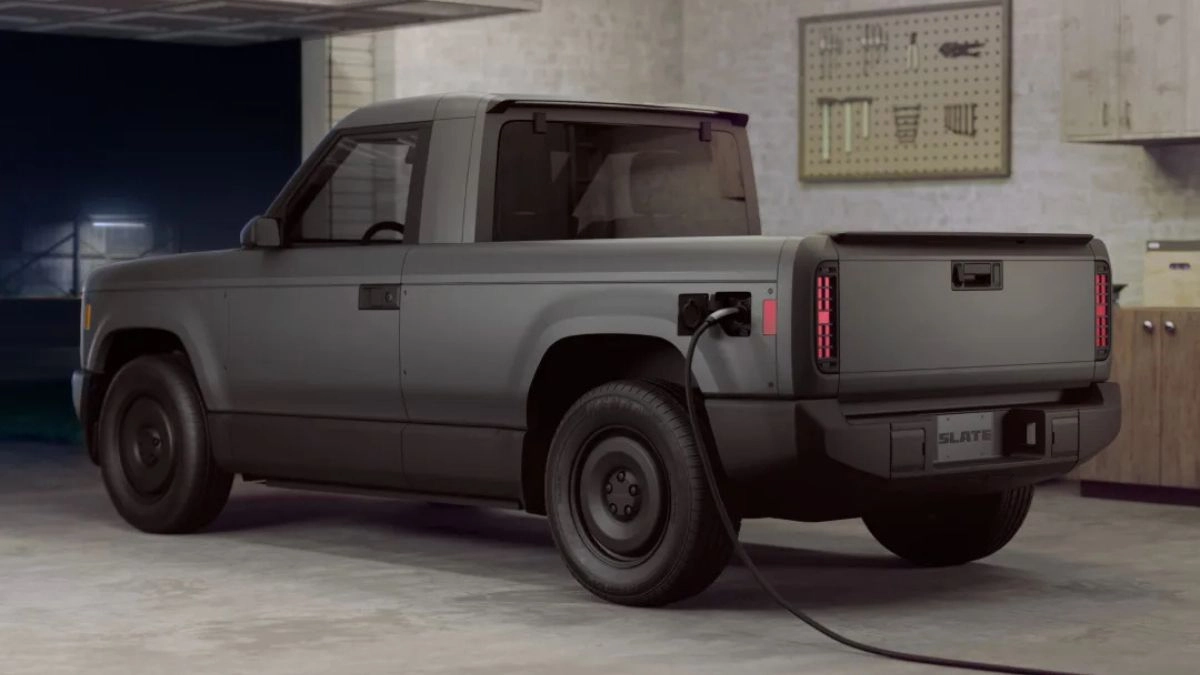

The rise of the electric car has opened the door to new companies determined to compete outside the traditional domain. Tesla was a pioneer, but now other players are emerging with their own proposals.
Among them is Slate Auto, backed by Jeff Bezos, who had already invested in Rivian, another electric startup. However, the goal of launching an affordable vehicle for $20,000 is now under threat due to the change in national policy.
You can read: Volkswagen ID. Buzz embarks on a global odyssey without gasoline
In April 2025, Tesla experienced a 52% drop in sales in Europe, a sign of the general cooling of the market. Meanwhile, Slate Auto announced a few months ago that it had more than 100,000 pre-reservations for its structurally modular electric pickup truck.
With a minimalist approach and aimed at functional work—a "cushion" that allows modules such as a closed box or seats to be added as needed—the project aimed to become an affordable and efficient alternative. However, its viability depends largely on public incentives that have now been removed.
President Donald Trump recently implemented what he called the “Great and Beautiful Act,” which among its measures includes the elimination of tax credits for electric vehicles.
A decision backed by his clear preference for the conventional energy industry and, according to him, the fight against what he calls “social destabilization” caused by the transition to electromobility. The immediate result: Slate Auto faces an even harder cost to reduce to reach its promised price of $20,000.
This policy comes at a time when battery prices have fallen between 10% and 15% in the last year, a trend that could favor Slate Auto. But analysts warn that without state fiscal aid,The savings will not be enough to offset the increase in tariff taxes and specific regulations imposed by Trump in his global trade war.
Jeff Bezos and the decision he must make
Jeff Bezos, known for his commitment to innovation and his search for technological advantages, is facing a new challenge. Slate Auto was already accumulating capital thanks to reservations and investment rounds, but without purchase incentives, many could reconsider their confidence in the project.
In fact, several investors have already internally expressed their concern about a possible delay or price increase.
Furthermore, Tesla and Rivian have a strategic advantage: despite the global reduction in sales, both companies have already successfully overcome the development phase and have powerful infrastructures in the United States.
Future manufacturers like Slate Auto, without a proven track record, will need more time to consolidate their mass production.
Several companies are affected
Trump's decision does not only affect Slate Auto: companies like Rivian or Ford, which have recently launched models with electric or hybrid systems, are also affected.
The withdrawal of incentives weakens the support structure for the electric vehicle and increases the cost for the consumer, which could slow mass adoption.
Before Given this scenario, industry experts and automotive industry representatives have asked the US administration to reconsider the measure. According to them, eliminating tax breaks "not only hinders sustainable mobility, but also the competitiveness of the United States compared to China and the European Union, which continue to be committed to an electric, emissions-free future." China produces more electric vehicles today than the United States and leads the global market for batteries and drones. The Morgan Stanley report puts the electromobility and drone market at more than $9 trillion over the next decade. If Slate Auto manages to integrate advanced systems, its proposal could cut across the board. Without incentives, however, it faces a barrier that is difficult to overcome.