

Sheinbaum drives “Olinia”, the first Mexican electric vehicle that will cost $8,600 dollars
Olinia, the Mexican electric car, will begin to be sold in the summer of 2027 and will have a speed of up to 50 kilometers per hour
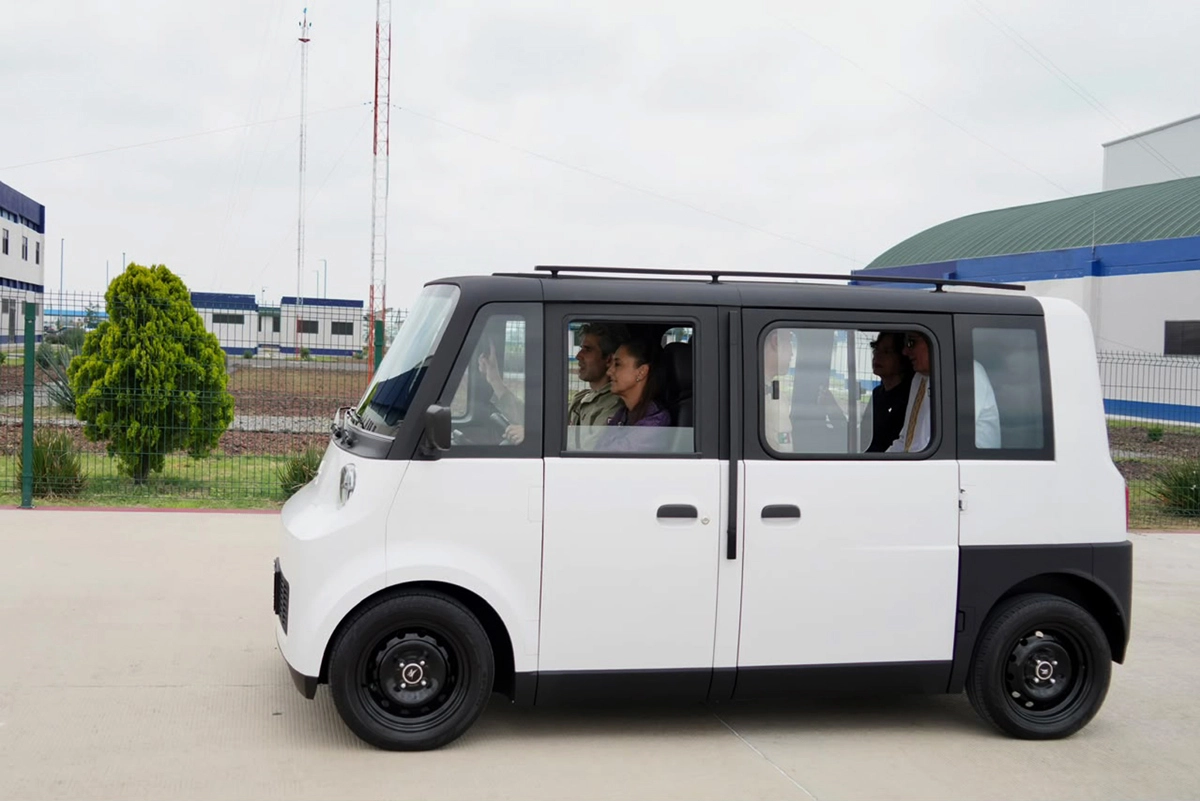

President Claudia Sheinbaum presented and drove this Sunday the first Mexican electric vehicle called “Olinia 1”, which has now entered the production phase, will sell from $150,000 Mexican pesos (about $8,600 dollars per unit) and will enter circulation in the summer of 2027.
The presentation of the vehicle occurred in one of the hangars of the Santa Lucía Military Air Base, in the State of Mexico, where Sheinbaum was behind the wheel of the car, a compact car with capacity for up to six passengers and adapted to transport people in wheelchairs.
"Olinia represents much more than an electric vehicle. It is the vision of a Mexico that takes advantage of the intelligence and creativity of its young people to fully incorporate the digital and technological development that is transforming the world based on our own path," said Sheinbaum during the presentation of the vehicle.
“It shows that Mexico can go beyond being a simple recipient of investments, it can generate knowledge, develop technology, design solutions, create value from our own capabilities and that is powerful,” he added.
The president explained that this day Mexico “shows innovation in and around electromobility.
He noted that the vehicle “represents much more than an electric car, it is the seed of an industry at the country level that can grow from below, driven by the knowledge, creativity and work of thousands of Mexican men and women.”
“It is the seed of a mixed economy in which universities, research centers, the State and the creative initiative of society collaborate to develop new technologies, solutions and capabilities at the country level.
It was explained that the vehicle has a 14.7 kilowatt battery, a range of more than 125 kilometers per charge, a top speed of 50 kilometers and an operating cost of $49 cents ($0.028 dollars) per kilometer, five times less than a gasoline car. Which represents a saving of up to $50,000 pesos (about $2,850 dollars) in gasoline per year.
“Mission accomplished,” Sheinbaum told Roberto Capuano Tripp, coordinator of the Olinia Project, who announced that “next month, at the end of the World Cup, we will present Olinia Cargo, designed for the transportation of goods.”
The project is currently being developed at the Olinia design center, located at the Technological Institute of Puebla, where more than 100 people work on the development of the cars.
In August 2025, the Mexican Government assured that the first fleet of Olinia, the first Mexican manufacturer of electric mini-vehicles, would be ready by June 2026, with two models that are focused on being safer, more comfortable and profitable work tools, and that would not exceed $150,000 pesos ($8,600 dollars) in cost.
In January 2025, the Mexican Government formed a team of researchers from the National Polytechnic Institute (IPN) and the National Technological Institute of Mexico, who had a budget of $25 million pesos (1.43 million dollars) to develop the model.
The Mexican idea of building electric vehicles arises because 70% of the Mexican population is urban and, of that, 80% have daily mobility needs of less than 30 kilometers.
With the project, Mexico seeks to boost the automobile industry, which represents almost 4% of the national GDP and 20.5% of manufacturing GDP, more than any other sector. EFE