

The people of Peru to whom the Vatican asked for forgiveness on their knees for the dispossession of land attributed to
A group of indigenous farmers from the north of the country has been accusing companies linked to the religious organization of threats and criminalization for years.
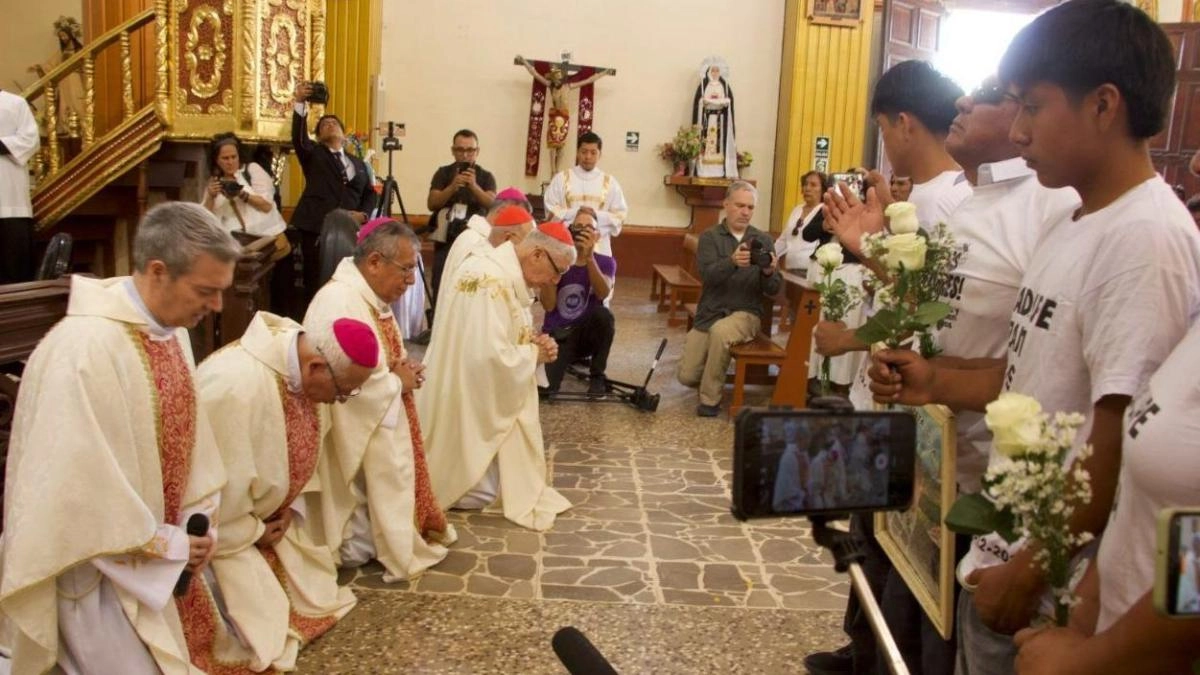

On your knees. With this unusual gesture, representatives of the Catholic Church asked for forgiveness on Saturday, May 23, from the peasant communities heirs of the Tallán indigenous people in Peru.
For years they denounced the dispossession of their lands and persecution by companies linked to the Sodalicio de Vida Cristiana, the ultra-conservative religious group founded in 1971 by Fernando Figari and which was suppressed by order of Pope Francis in April 2025.
The decision of the late pontiff came after the investigation of complaints of sexual abuse and corruption that the Sodalicio faced in the South American country.
"We are here to ask for your forgiveness in the name of the church. We have arrived late, we should have arrived 20 years ago, and we are truly sorry," said Monsignor Jordi Bertomeu, special envoy of the Vatican for the phase of dissolution of the social group in Peru, at the mass celebrated in the city of Catacaos, in the northwest of Peru.
In conversation with BBC Mundo, Bertomeu assured that it was an emotional moment in which he felt a historic weight on his shoulders.
“It was moving to be next to a representation of the ecclesial authorities of Peru on their knees in front of those very poor people, who have never had institutional support from anyone,” he stated.
"I felt sorry for having arrived twenty years late and above all shame for what church people have sometimes done and not wanted to assume... The Sodalitium has been an abusive structure that Francis suppressed for the good of the victims. Leo XIV wants us to learn from the mistake, because this cannot be repeated," he added.
Holding white flowers, members of the San Juan Bautista de Catacaos community witnessed the gesture that they described as an act of justice.
“They are angels sent by God to hear the voices of our community members, who have cried out for help and justice,” said Percy Maza, a community member who claims to have been persecuted and criminalized for defending his land.
“They have done what they wanted with us because we are poor, we are from the countryside, we don't know the laws,” said Paula Sandoval, 58 years old and mother of Percy Maza.
"That the little parents, from so far away, have come to ask for our forgiveness moved us. Thank God, divine justice has arrived," he added to BBC Mundo.
A dubious transfer
Community members, lawyers and journalists who have investigated the case explain to BBC Mundo that the alleged dispossession of the lands of the San Juan Bautista de Catacaos community dates back to 1998.
Their territorial rights, as claimed by their members, come from communal recognitions from the time of the Viceroyalty of Peru and even pre-colonial times.
They allude to the fact that the properties belonged to them collectively as heirs of the Tallán, considered one of the oldest indigenous peoples in northern Peru.
Since they did not have individual property titles, on December 18, 1998, an allegedly fraudulent transfer of those territories was recorded in public records.
The community members denounced that, through an alleged assembly, the community had decided to transfer almost 10,000 hectares of their lands in favor of 100 community members.
The striking thing - they say - is that the peasants themselves were unaware of the holding of that assembly.
Upon having access to the records and comparing them, they noticed that several of the community members who supposedly participated were dead at the time of the transfer or indicated that they had not signed the minutes.
The lands were transferred in later years by those 100 community members in the form of a capital contribution to the Pampa Loma Vega company, which successively transferred them to other companies, among them to the San Juan Bautista Civil Association, linked to the Sodalicio de Vida Cristiana.
"At that time, no one linked everything that was happening in Piura to the Sodalicio. It was not known that there was such a clear link between economic and religious power," journalist Paola Ugaz, who has investigated the economic links of the religious organization in Peru for years, tells BBC Mundo.
The San Juan Bautista Civil Association was founded by one of the historical leaders of the Sodalicio in Peru and former archbishop of Piura, José Antonio Eguren, who would later be expelled from the organization by decision of the Vatican.
And although Eguren resigned from the company's board of directors once he assumed ecclesiastical functions, those who know how the company operated assure that the religious movement continued to exert a broad influence on its decisions.
Eguren denied in 2024 that he was “a character in a land trafficking plot in Piura.”
Consulted by BBC Mundo after the Vatican apologized, the San Juan Bautista Civil Association (ACSJB) denied having participated in any type of illicit transfer of those lands.
“Land acquisitions in the Catacaos area were carried out in 2012 through sales to owners who appeared as legitimate owners in Public Registries, in accordance with the legal framework in force in Peru.”
“These operations were carried out within the legal circuit, with registry traceability, and are part of a process of prior transfers between individuals,” said the firm's spokesperson and lawyer, Percy García Cavero.
"The ACSJB categorically rejects the accusations of land dispossession. A narrative has been built around this case that seeks to attribute responsibilities to the ACSJB without legal support or verification of the facts."
“This narrative has been publicly promoted by Mr. Jordi Bertomeu, despite the fact that the ACSJB has responded expressly, documented and successively to said accusations in our communications since 2024,” the company added.
The turning point
The transfer of the land in 1998 did not have a tangible impact on the communities.
But that changed in December 2011.
That month the community members say that they were surprised to see several groups of strangers installing fences on land they considered their own.
Carlos Rodríguez, who legally advised the Catacaos community from the Human Rights Coordinator, assured that in response to this “they grouped together and tore down the fence.”
But the outsiders raised it again. “And when the groups noticed this and confronted them, what they received was gunshots in response,” says Rodríguez.
It is in that incident where the death of community member Guadalupe Zapata Sosa was reported.
His wife was one of those present at the mass on Saturday, May 23 in Catacaos. He came with his two children.
Zapata was recognized by the Vatican as one of the “indigenous leaders who died after actively opposing land trafficking linked to Sodalicio companies,” as stated in the statement they issued after the homily on their official press site.
There are still no firm judicial rulings that prove this.
“Don't let the land be stolen”
The recent kneeling apology continued the message that Pope Francis issued in April 2024 to the community of Catacaos.
"I know what happened to you. Defend the land, don't let it be stolen," said the highest pontiff on that occasion.
A year earlier, the community had reported to Bertomeu that companies linked to Sodalicio were persecuting them.
The decision to dissolve the Sodalitium of Christian Life in 2025 was supported by the Vatican, among other reasons, due to alleged abuse in the administration of ecclesiastical assets, abuse of authority and cover-up of crimes.
Bertomeu assures that, after two years of investigations, "the suspicion has emerged in the Vatican, based on the analysis of the economic documentation that Sodalicio himself sent us, that this group would have operated behind a legal screen, making economic decisions through intermediaries or front men."
Journalist Paula Ugaz explains that, according to her investigations, Sodalicio deployed a sophisticated mechanism to enrich itself in Peru.
"They are like a large holding company that has lucrative companies such as real estate, construction, agro-exporting companies and, at the same time, non-profit companies, such as universities, schools and cemeteries. But between them they have business with each other," says the reporter.
And he adds that the religious movement took advantage of the concordat that exempted it from paying taxes to increase its profits in triangulation operations. This has also been denied by companies linked to Sodalicio.
The judicial edge
According to the Human Rights Coordinator, in 2022 all the cases against the community members of Catacaos for trying to recover the lands were archived.
But last May the communities suffered a judicial setback.
The Peruvian justice system rejected an appeal for constitutional protection that sought, among other measures, the restitution of the almost 10,000 hectares that had been taken from them.
In its resolution, the Fifth Civil Court of Piura declared the claim inadmissible without admitting it for processing. The decision was appealed, but the Second Civil Chamber of Piura confirmed the ruling.
According to the defense of the community members, the Chamber justified its decision in that the case is related to an “alleged illicit act of community members in collusion with a private company,” thus being a controversy of “legal and not constitutional relevance.”
But Rodríguez assures that civil action is not an alternative since crimes in that area would be statute-barred.
“What is alleged in the amparo is that this is an indigenous community and as such has constitutional protection and also ILO Convention 169, which guarantees that indigenous peoples are consulted for the transfer of their territories,” he adds.
Recently the San Juan Bautista de Catacaos Community was incorporated into the Indigenous Peoples Database of the Ministry of Culture of Peru.
Now, the community members say, they only have to turn to the country's Constitutional Court, a court in which they do not have much hope either.
For Ugaz - who was also sued by the leadership of Sodalicio after publishing, together with journalist Pedro Salinas, the book in which they revealed the abuses of power and sexual commitments committed by its members, Half monks, half soldiers -, Peruvian justice has failed the victims in this case.
“The commercial, economic and political power of the Sodalicio is alive and well, even though they have been suppressed by the Catholic Church,” he says.
Bertomeu agreed that the Peruvian justice system must do more.
"We have detected a country with a serious institutional crisis and this means that the complaint of the community members of Catacaos, like that of other indigenous peoples, may have a ring of reality. The vulnerability of the indigenous communities to the greed of some businessmen should be taken with more consideration by the political and judicial authorities of Peru," he stated.
BBC Mundo contacted both the Peruvian Prosecutor's Office and the Judiciary to ask them for a version of the communities' accusations in this case. As of the publication of this article, they have not yet given a response.
If they do not obtain a favorable verdict in the pending internal proceedings, the families say they are considering turning to international organizations.
But for now they are left with the Vatican's apology and hope for an eventual visit by Pope Leo XIV to Peru at the end of this year.
The Vatican has promised them a path of reparation not only symbolic, but also economic.
Bertomeu explained that the liquidation of the economic assets owned by the Sodalicio is still pending, with which the Holy See seeks to compensate the victims who have presented their claim.
“With the assets of the Sodalicio we must compensate its victims because they are the ones who caused the damage,” he said.