

The electoral authority of Peru confirms that Keiko Fujimori and Roberto Sánchez will contest the presidency of..
The election will be held in a country marked by political fragmentation, years of institutional instability and citizen security
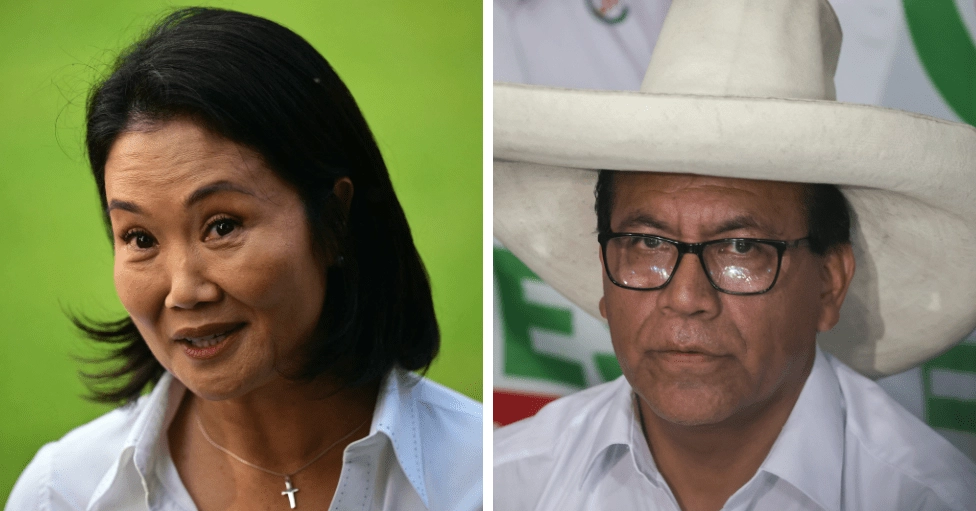

After more than a month of counting, the National Election Jury of Peru (JNE) announced that Keiko Fujimori and Roberto Sánchez will compete on June 7 for the presidency of the country.
The right-wing Fujimori obtained 2,877,678 votes (17.92%), while the left-wing Sánchez reached 2,015,114 votes (12.039%),
Conservative Rafael López Aliaga was left out by a narrow margin, having obtained 1,993,904 votes (11.90%).
The president of the JNE, Roberto Burneo, said that “the decisions have already been made and are unappealable, any request regarding the decisions that we have already taken as a plenary session will not change in any way.”
The election day of Sunday, April 12, presented delays in the installation of tables and logistical problems that forced voting to be extended in some centers until Monday the 13th.
The first round of the presidential elections was marked by the fragmentation of the vote, with more than 30 candidates in the running, none of which exceeded 20%.
The new president will inherit a country marked by growing distrust of institutions after years of political instability that has led to nine presidents in the last ten years and by citizen insecurity derived from the increase in organized crime, extortion and urban violence.
The new leader will have to deal with a Congress that is once again bicameral after the application of the constitutional reform approved in 2024 and retains the power to remove him through the figure of a presidential vacancy if the necessary support is gathered.
This scenario anticipates governance difficulties for the next president of Peru, whoever it may be.
We tell you who are the two candidates who will compete for power.
Keiko Fujimori, the heiress of Fujimori who seeks the presidency for the fourth time
Many things can be discussed with Keiko Fujimori, but not her insistence: after three defeats, the Fuerza Popular candidate went to the second round for the fourth consecutive time.
Keiko has become one of the few lasting presences in a Peruvian politics that in recent years devoured leaders at the frenetic pace at which corruption scandals followed one another.
She also had hers: money laundering within the framework of the Odebrecht case. But after even going to jail, the Constitutional Court finally closed the case. The ruling allowed her to be a candidate again just in time for this election.
To seduce voters tired of corruption and insecurity, Fujimori did not hesitate to claim the legacy of his father, who died in 2024 and spent around 16 years in prison after being convicted of crimes against humanity.
With the electoral slogan of “order returns,” he tried to associate his image with that of Alberto Fujimori's admirers: a determined leader who stabilized a country hit by the economic crisis and the violence of the Shining Path in the 1990s.
However, his father remains a divisive figure in Peru and many also remember the human rights violations that occurred under his command, as well as the harsh cuts resulting from his economic reforms.
His last name is his great political asset, but also his main hindrance. In fact, Keiko's figure has always gone hand in hand with that of her father.
Born in 1975 and the first-born of four siblings, it fell to her to assume the institutional role of first lady of Peru when her parents' marriage broke up.
It was then that Peruvians met a young Keiko as her father's companion on public events and state trips.
After studying Business Administration in the United States, he returned to Peru and dedicated himself fully to politics.
In 2006, with her father already detained in Chile, she was elected congresswoman for the first time.
Five years later she ran for president. He tried again in 2016 and 2021, losing each time against politicians who did not see the end of their terms.
Even so, he maintained undisputed leadership within Fujimorism, for which he fought even at the cost of stopping his father's release from prison (which he later requested) and deteriorating relations with his brother Kenji.
In 2022 she separated from American businessman Mark Vito, with whom she had two daughters and who is now part of the world of Peruvian television and entertainment.
This is the first time that Keiko Fujimori is a candidate for president after the death of her father. During the campaign he tried to make even more profitable this political capital and the feeling of many Peruvians that the country is experiencing an exceptional situation that requires a strong hand like the one he knew how to apply.
Among its proposals is the construction of maximum security megaprisons and removing Peru from the Inter-American Court of Human Rights.
In the 2026 presidential elections he once again entered the second round. In a few weeks we will know if she once again fell short or finally achieves her dream of becoming president.
Roberto Sánchez, the survivor of the Castillo era
It seemed difficult to survive a shipwreck like that of the government of former president Pedro Castillo, imprisoned and prosecuted for several crimes, but Roberto Sánchez Palomino has managed to do it.
Although a few days before the vote, the Together for Peru candidate appeared far behind in the polls, he managed to concentrate votes in a short time and, benefiting from the fragmented Peruvian electoral landscape, is now emerging as the candidate who will compete in the second presidential round with Keiko Fujimori.
Born in 1969 in Huaral, an eminently agricultural town about 80 km from Lima, and a psychologist by training, Sánchez managed to turn his closeness to Castillo—as head of Tourism and Foreign Trade, he was the only minister who survived his constant cabinet changes—into a political asset when for all the experts it seemed like a liability.
The candidate did not hesitate to claim his membership in the Castillo government and even dared to appear in the debates wearing the same peasant hat with which the former president made himself known to Peruvians and which became a symbol of rural and mountain Peru.
Thanks to this, he managed to gain the support of some of the sectors that brought Castillo to the presidency, especially in the south of the country, the hardest hit by the violence in the repression of the protests that followed the fall of the former president and where resentment towards the politicians of Lima is widespread.
With his soft manners and calm tone in the midst of the permanent political tension in the country, Sánchez knew how to maneuver skillfully and, unlike other members of the cabinet, he did not have to respond judicially for Castillo's failed attempt to dissolve Congress that ended up causing his dismissal and imprisonment in December 2022.
The then Minister Sánchez announced his resignation shortly after Castillo appeared on television announcing his exceptional measures with a trembling hand and abstained from the vote in Congress that ended up dismissing the president, which many interpreted as an attempt not to go down with him.
Castillo does not seem to hold a grudge against him. In one of his last court appearances he asked for the vote for him. And the candidate has known how to exploit the discontent of broad sectors of rural Peru with the fate of the former president.
Ramiro Escobar, a political analyst at the Pontifical Political University of Peru, told BBC Mundo that Sánchez's passage to the second round "shows that political circles in Lima still do not understand the magnitude of the unrest in the regions."