

Salvadoran diaspora will have direct representation in the Legislative Assembly
They will elect six deputies in the 2027 elections; L.A. residents They advocate the end of Bukele's emergency regime
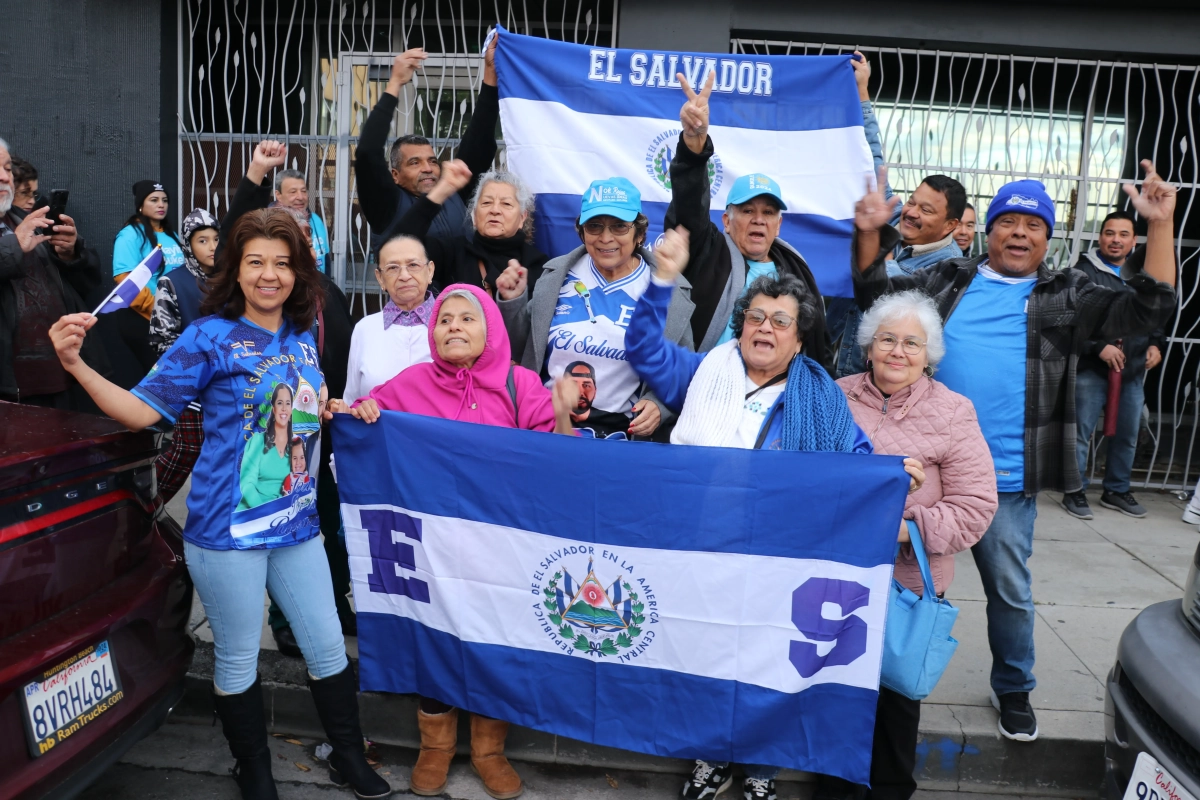

Less than a year before the presidential elections of February 27, 2027, where a third consecutive term for President Nayib Bukele is practically guaranteed, the novelty will be the election of six representatives of the Salvadoran diaspora to the Legislative Assembly.
In the 107th plenary session of the Legislative Assembly of El Salvador, Bukele asked parliamentarians in April to reform article 79 of the Constitution of the Republic, in order to integrate residents abroad, who will be able to elect their deputies, specifically for their representation. This article deals with the bases of the electoral system and determines constituencies or territories established by law.
“The diaspora will have deputies chosen specifically for their representation… instead of their votes being assigned to the department of San Salvador, as has been the case until now,” read a statement released by the Presidential House.
It is estimated that more than 2.5 million citizens of Salvadoran origin reside in the United States alone. Of this figure, around 1.4 million are people born in Salvadoran territory: 700,000 congregate in the Los Angeles, California area, and another 300,000 in Houston, Texas, while New York is home to 200,000 Salvadorans and their descendants, mainly in Long Island and Queens.
The Los Angeles district is symbolically known as “Department 15” of El Salvador. The other 14 departments are: Ahuachapán, Santa Ana and Sonsonate, in the western zone; La Libertad, Chalatenango, Cuscatlán, San Salvador, La Paz, Cabañas and San Vicente, in the central zone, and Usulután, San Miguel, Morazán and La Unión, in the eastern zone.
According to data from the National Registry of Natural Persons, there are currently more than 962 thousand people who have a Single Identity Document with an address abroad, a figure that will serve as the basis for forming the new electoral registry of the diaspora.
The representative of Nuevas Ideas, Raúl Chamagua, explained that the importance of this reform lies in the fact that Salvadorans abroad will be able to fully exercise their political rights and have, for the first time, their own representatives within the Legislative Body.
“The importance of this constituency is that it supports a political right that Salvadoran citizens have,” said Chamagua, in a statement from the Legislative Assembly.
He added that the Constitution does not establish the loss of citizen rights for residing abroad.
The legislator also stated that many compatriots left the country due to different circumstances, but that does not mean that they have stopped belonging to El Salvador.
One of them, Francisco Rivera, 75 years old, who emigrated from Suchitoto, Department of Cuscatlán when the Civil War was developing in El Salvador (1979-1992), considered the opportunity to vote for representatives from abroad "historical", because it opens a window to be able to legislate directly on the economic and social development of the Central American nation.
“And it is more important because the Salvadoran diaspora is not only recognized for sending millions of dollars in remittances, but for the contribution it can make in terms of investment for the development of the country,” he said.
During the first quarter of 2026, Salvadorans abroad sent $2,435.59 million in family remittances, according to official data from the Central Reserve Bank of El Salvador (BCR). This figure represents a growth of 7.3% compared to the same period of the previous year, maintaining this flow as one of the most important pillars of the “Little Thumb of America” economy.
Rivera, being part of the Association of Salvadorans in the World, was one of the main promoters of the vote of his compatriots from abroad, before the governments of Mauricio Funes and Salvador Sánchez Cerén. The vote had certain restrictions, until the arrival of Nayib Bukele in command of the country.
The veteran activist recalled that other residents in the United States who had the desire for representation and had the privilege of voting from abroad were Ecuadorian and Mexican citizens.
“In El Salvador, in the New Ideas style of government, it is the executive branch [Bukele] that has considered most of the laws to govern the country,” he said.
The politician's bet
However, he stressed that he has hope that El Salvador will head towards a democratic path and not towards a perfect dictatorship, in addition to establishing a process for the defense of the human rights of all, and ending the emergency regime that keeps tens of thousands of Salvadorans imprisoned in the CECOT bunker.
“Because of the way it has been raised, the issue that has been raised is that people who reside outside the country have representation and have a voice in the Legislative Assembly, in their terms of support for the national economy with family remittances and their investments,” declared Salvador Sanabria, executive director of El Rescate.
Sanabria believes that President Nayib Bukele's commitment to the election of the six deputies from the diaspora are related to him and are members of his political party, Nuevas Ideas.
“That is the bet of any politician who wants to be in power,” he said.
So, do you think Bukele and his family want to remain in power in El Salvador?
"The already reformed Constitution allows him at this moment to be re-elected as many times as he wants. That is not an obstacle," Sanabria responded.
Could it not be that El Salvador is already heading towards a dictatorship like the one that existed in Mexico with Porfirio Díaz for more than 30 years in power?
“We would have to see the result of the 2027 elections to be able to have a more objective and precise evaluation of that situation,” he said. Sanabria. “Today, at least there are still opposition parties.”
More than a decade ago, Sanabria was one of the proponents before the Supreme Court of Justice of El Salvador to reform the electoral law in the country and allow Salvadorans abroad to have the right to vote and be voted for.
Said protection was admitted by the court. This forced the political parties represented at that time in the Legislative Assembly to reform the law.
In 2013, 10,337 Salvadorans registered to vote by mail, however, in the second round of elections, votes from abroad were only 2,722. 68% of the votes went to Sánchez Cerén, of the FMLN, winner of the presidency, on March 9, 2014.
'A cool dictator'
Jocelyn Duarte, executive director of the Salvadoran-American Leadership and Education Fund (SALEF), highlighted the importance of direct representation of the diaspora in the parliament of the homeland of her mother, originally from Planes de Renderos, in the Salvadoran capital.
“First of all, it is very important that people have the right to participate in what is happening in El Salvador at all levels, and not simply be seen as the distant brother,” said Duarte, also a professor of Central American studies.
Duarte indicated that the Salvadoran has always been seen as the person who had to emigrate, whether in the 1980s, after Hurricane Mitch (1998) that caused 11,374 fatalities in Central America or the earthquakes of 1986 and 2001, or part of the migratory flows, starting in 2000.
“It is a contradiction to see people who maintain a fifth of the Gross Domestic Producer (GDP) with their remittances,” he said. “So, the fact that the president [Nayib Bukele] has made the decision to represent the diaspora is important, but a critical position must also be maintained regarding the situation that El Salvador faces at this moment.”
He emphasized that he should not forget “that civil rights have been suspended and that [tens of thousands of gang members] are still under the emergency regime,” he said. “So, it is interesting what he [Bukele] is doing, although he does not need representatives of the diaspora because in his hands he basically has the three branches of government: executive, legislative and judicial.”
Nayib Bukele, President of El Salvador, Nayib Bukele has notably referred to himself as the “coolest dictator in the world.”