

Scientists create a special suit so that cockroaches can breathe underwater
Can remote-controlled cockroaches become underwater rescue allies?
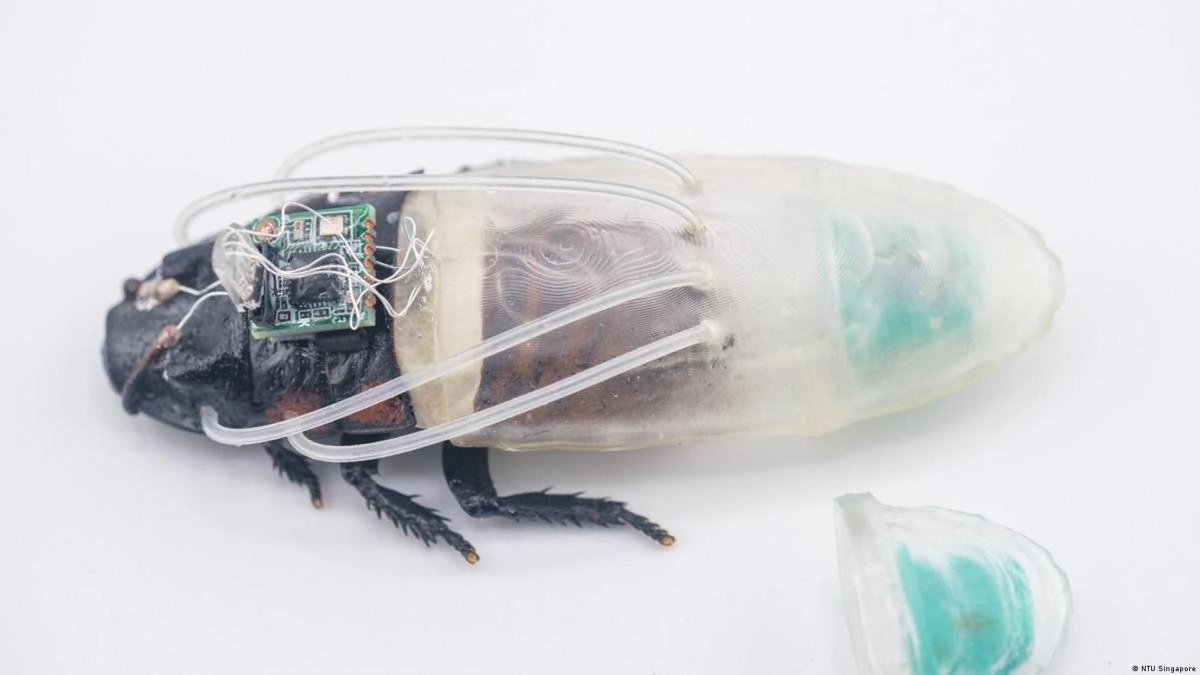

It may sound like a bad joke, but the truth is that one day, in an emergency, we could have an ally as unexpected as it is unlikely: the cockroach.
And it's hard to imagine this insect equipped with a kind of diving suit, making its way through the rubble. However, that is exactly what a team from Nanyang Technological University (NTU) in Singapore, together with Waseda University in Tokyo, has devised: a system that allows these insects to be converted into amphibious cyborgs capable of moving and breathing underwater.
Cyborg cockroaches: a proven technology
As extravagant as it may sound, cyborg insects are nothing new. For more than a decade, scientists have anesthetized insects, implanted electrodes in their brains and sensory organs, and then controlled them remotely with a simple command.
Compared to conventional robots, their usefulness lies in the fact that they take advantage of the animal's own muscles, as explained by NTU Singapore, so they consume much less energy and do not need motors to move. Additionally, they retain some autonomy, as they are only pushed when they stray from the path or stop, allowing them to naturally avoid obstacles.
The big drawback, until now, was water. Cockroaches breathe through spiracles, small openings connected to a network of internal tubes that stop receiving oxygen when the insect is submerged. In other words, no matter how obedient they were, they would end up suffocating.
A suit that works as an oxygen bottle
To overcome that obstacle, the researchers designed a flexible 3D-printed suit that, according to the authors themselves, works similar to an oxygen cylinder for divers. The system incorporates a small reservoir with a sponge coated with manganese dioxide.
By adding diluted hydrogen peroxide, a chemical reaction occurs that gradually releases oxygen. That oxygen travels through four silicone tubes connected to the cockroach's spiracles, allowing it to breathe while remaining underwater, according to NTU Singapore.
The set is surprisingly compact. Popular Science notes that the backpack measures just 10 by 10 millimeters – about the size of a small piece of gum – and is made from a plastic-like material using 3D printing. The design sought to add as little weight as possible so that the insect retained its natural mobility.
The tests were carried out with Madagascar hissing cockroaches, a species especially suitable for its large size, resistance and lack of wings. Equipped with the device, they remained active and were able to move underwater for up to three hours and at speeds only slightly lower than those they reach on land.
Search and rescue: the Myanmar precedent
Beyond the laboratory, this technology already has a concrete history. For example, cyborg cockroaches equipped with infrared cameras participated in real search and rescue operations after the 7.7 magnitude earthquake that struck Myanmar in March 2025. The information collected by the insects was reportedly processed using machine learning algorithms to help detect possible signs of life among the rubble.
Precisely for this reason, Professor Hirotaka Sato, from NTU and head of the study, believes that expanding their movement capacity to the aquatic environment could make them an even more useful tool in floods or landslides, where water can block access for conventional robots.
The big challenge, adds his colleague Shinjiro Umezu, from Waseda University, was finding the balance between generating enough oxygen and maintaining a system so light and flexible that it did not limit the insect's mobility.
From Mars to the oceans: the next steps
The team's ambitions, however, go far beyond the flooded areas. Sato, speaking to New Scientist, has even raised the possibility of adapting this technology to develop a kind of “space suit” for cyborg insects, with an eye toward future exploration missions on the surface of Mars.
The study, published in Nature Communications, also points out that the design could be adapted to other insects with similar respiratory systems, such as beetles or locusts. Of course, it is advisable to lower expectations. And, for now, the experiments have not gone beyond a few centimeters of water. There is still a long way to go before you see roach patrols exploring wrecks or reefs.