

NASA and a private company team up to rescue a telescope before it falls to Earth
Launched in 2004 and without its own propulsion system, the Swift observatory has fallen almost 200 kilometers in two decades
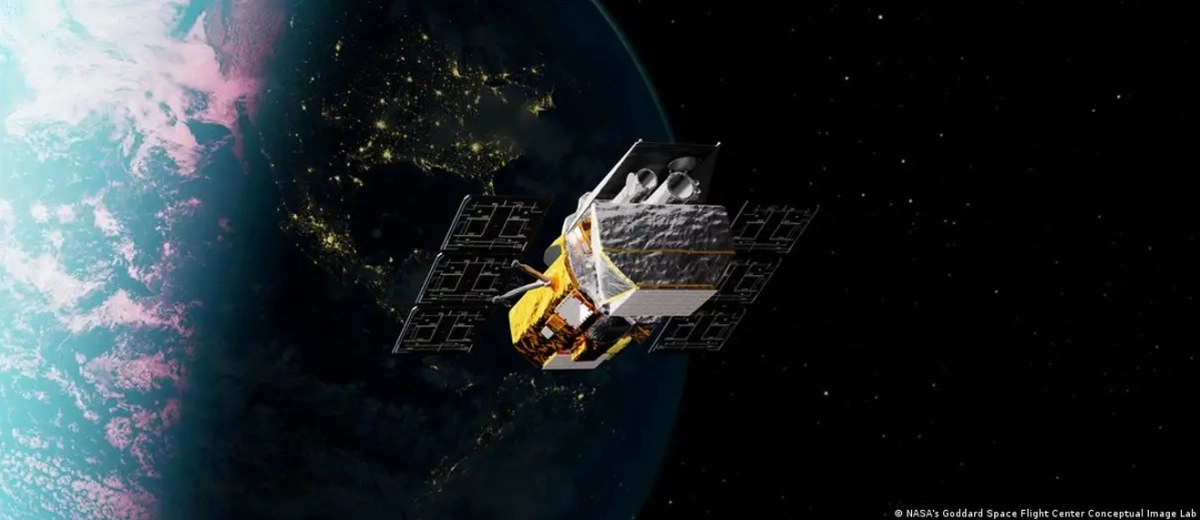

A robotic spacecraft will attempt to reach and save NASA's Swift space telescope, which is at risk of uncontrolled re-entry to Earth later this year due to its deteriorating orbit.
The mission foresees that a ship from the Katalyst Space company will approach the telescope, capture it autonomously and raise its orbit to prevent its loss, in what would be the first coupling of a commercial robotic vehicle with a government satellite not designed to be served in space.
NASA reported that the mission to raise the orbit of the Neil Gehrels Swift observatory will take off no earlier than Tuesday at 10:17 GMT from Kwajalein Atoll, in the Republic of the Marshall Islands.
A deteriorating orbit
The Swift, valued at about $500 million and launched in 2004, does not have a propulsion system and has progressively lost altitude due to atmospheric drag, descending from about 600 to about 400 kilometers.
Without intervention, the observatory would enter Earth's atmosphere and cease to be operational, ending two decades of gamma-ray burst observations.
The LINK robotic satellite
The company has described the operation as a demonstration of the ability to perform rapid responses in orbit, from identifying the problem to executing a docking mission in less than a year.
The project is also presented as a key step for the development of maintenance and life extension services for satellites in space, with future applications for both civil and national security.
The mission will use a robotic service satellite called LINK, developed by Katalyst Space, which will be launched into orbit aboard a Northrop Grumman Pegasus XL rocket.
Once in space, the spacecraft will approach the telescope, capture it and gradually raise its orbit over several months to prevent it from re-entering Earth's atmosphere before the end of this year.
Two decades observing the cosmos
Swift is NASA's multifunction tool for studying the cosmos, as explained by the US space agency.
Over the past two decades, the observatory has played a key role in studying transient phenomena such as gamma-ray bursts.