

Scientists discover that Apollo missions brought back extraordinary lunar rocks
Titanium hidden deep within the Moon generated a magnetic field stronger than Earth's, but only for a few decades.
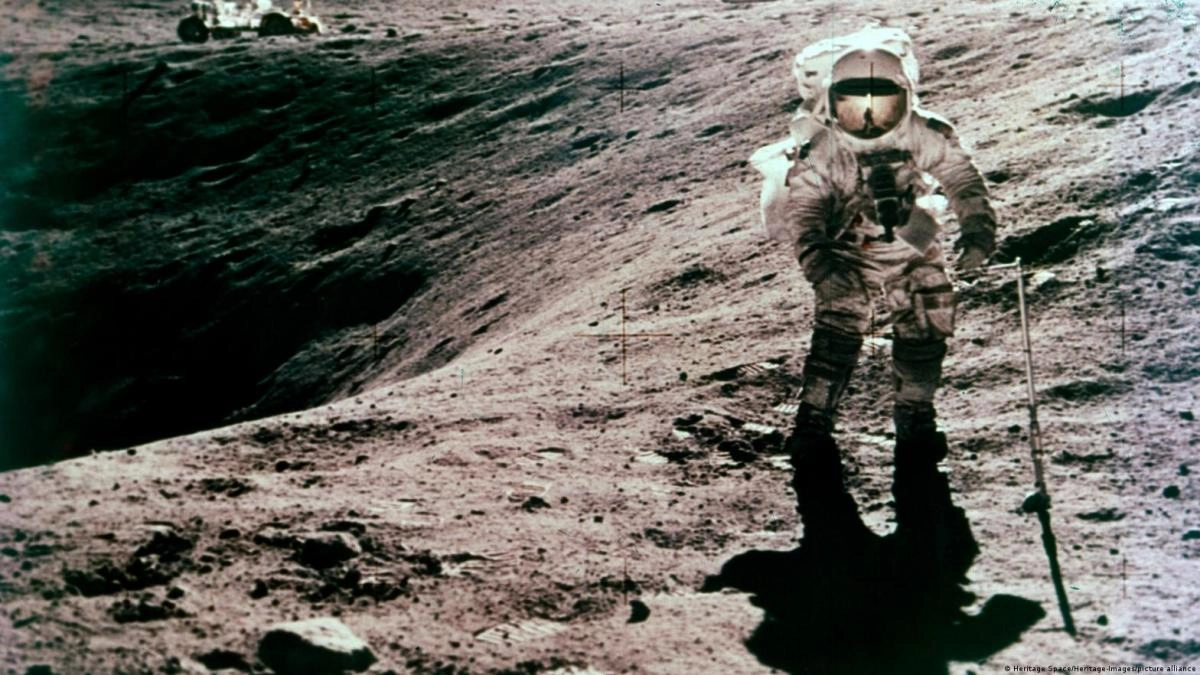

For decades, the scientific community has debated whether the Moon's magnetic field in its early history, 3.5 or 4 billion years ago, was strong or weak, but now a new study has shown that both sides were right.
By studying samples from the Apollo missions, scientists discovered that, at certain times, the Moon reached to have an extremely strong magnetic field – even stronger than Earth's. However, these periods were very brief and were the exception, since, most of the time, the Moon had a weak magnetic field.
Lunar Magnetic Field: Strong and Weak at the Same Time
The results of the research, carried out by scientists from the Department of Earth Sciences at the University of Oxford (UK) and published in Nature Geoscience, have put an end to a long-standing debate about the intensity of the Moon's magnetic field.
The authors of the study explain that for years the debate persisted because the Apollo missions landed in places with a high concentration of rocks that, by chance, captured these rare events of intense magnetism, leading to a misinterpretation of lunar history.
The study concludes that these samples gave a biased view of some “extremely rare” events, which lasted a few thousand years but were interpreted as if they were representative of 500 million years of lunar history, explains the lead author, Claire Nichols.
Despite Despite the strong magnetism of the Apollo lunar samples, Many scientists continued to think that the Moon could only have a weak or nonexistent magnetic field, because the relatively small size of the Moon's core would prevent it from generating a strong field. Titanium: Key to the Moon's Magnetism. But the new study proposes a mechanism capable of generating and temporarily maintaining a strong field. By studying the samples, they discovered that all those that had registered an intense magnetic field contained large amounts of titanium. While those containing less than 6% titanium by weight were associated with a weak magnetic field, titanium and the generation of a strong lunar magnetic field were therefore related.The authors suggest that the melting of titanium-rich material deep within the Moon acted as 'fuel,' temporarily generating a very strong but brief magnetic field. “We now believe that for most of the Moon's history, its magnetic field has been weak, but that for very short periods of time—possibly a few decades—the melting of titanium-rich rocks at the boundary between the Moon's core and mantle favored the generation of a very strong field,” Nichols explains. Apollo Missions: A Bias in Lunar Samples. But because the Apollo missions landed in flat areas rich in marine basalts, the astronauts collected titanium-rich rocks, which contain evidence of a strong magnetic field but are not representative of the reality of the entire surface. lunar.
“If we were aliens exploring Earth and had landed here only six times, we would probably have a similar sampling bias, especially if we selected a flat surface to land on,” reasons Jon Wade, co-author of the study and associate professor in the Department of Earth Sciences at Oxford.
But “it was a coincidence that the Apollo missions focused so much on the Mare region of the Moon; if they had landed elsewhere, we probably would have concluded that the Moon only had a weak magnetic field and completely overlooked this important part of early lunar history,” he asserts.
For Simon Stephenson, co-author and Wade's colleague at Oxford, the Artemis missions will be “an opportunity to test this hypothesis and delve deeper into the history of the lunar magnetic field.”