

6 facts about the fascinating history of the Louvre, the largest museum in the world
The Louvre Museum has seen thousands of works of art pass through its doors over hundreds of years of history. Here we review some events that have marked the museum.
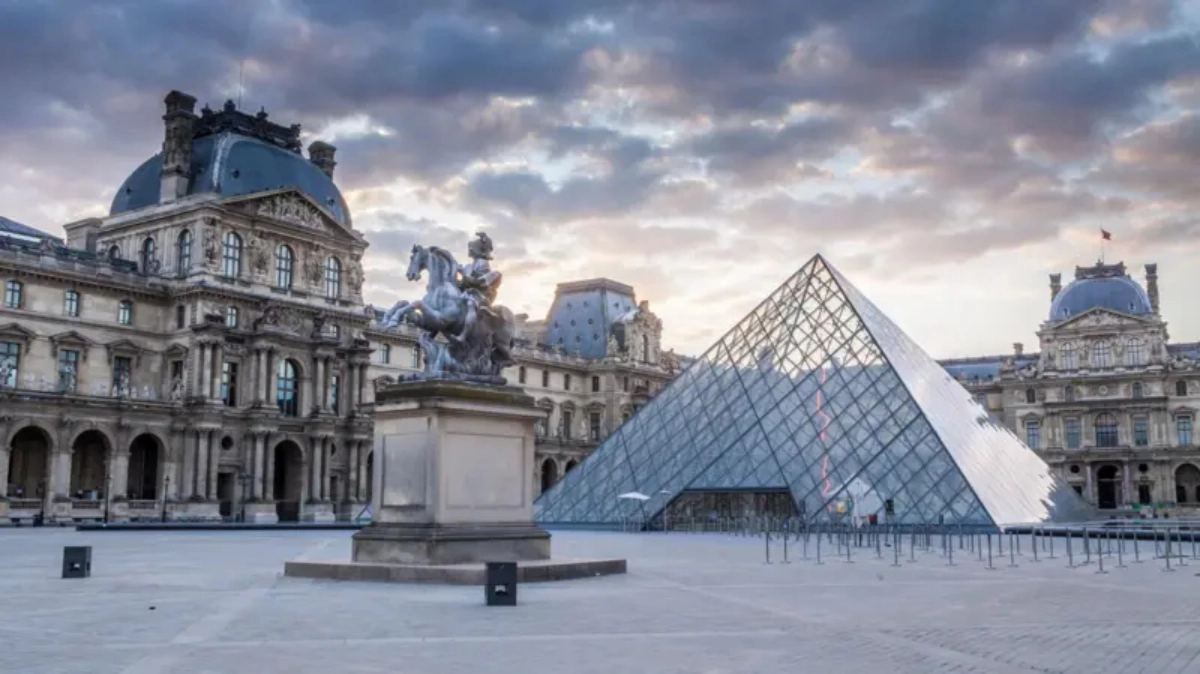

When the first stones of what is now the Louvre Museum were laid, the discovery of America was still three centuries away.
This is the ancient origin of what is now the most visited museum in the world, which has been built, expanded and rebuilt over hundreds of years. years and since it became an open museum in 1793, it has exhibited hundreds of thousands of pieces of world art.
But today it is in trouble: a group of four thieves carried out an incredible theft of eight pieces of jewelry, including royal crowns and precious stone necklaces, on October 19.
So far, authorities have not found the thieves of the objects whose historical value exceeds their monetary value, about $103 million.
As the museum director acknowledged, the very architecture and condition of the Louvre Palace make it difficult to implement modern security devices in a building that was not originally planned as a museum.
This can be explained by looking at its history, which has some extremely interesting moments.
1. From medieval fortress to museum
As a building, the Louvre’s history has seen centuries of political and social change in France.
But its original origins date back to the medieval period (around 1190), when King Philip II, known as “the Augustus” (1165-1223), built a quadrangular fortress as part of the protection of Paris along some walls near the Seine River.
Then King Charles V (1338-1380) converted the fortress into a castle, the first royal residence at that time. A few centuries later, King Henry II (1519-1559) designed the modern central palace, with the Renaissance architecture that has survived to this day.
Other monarchs added buildings to the centuries-long project.
Henry IV (1553-1610) created the south wing that runs along the Seine and which today houses important collections, such as Da Vinci's Mona Lisa,or the Galleria Apollo, which was the target of the robbery a few days ago. Louis XIV, the “Sun King” (1643-1715), continued the extensions up to the Tuileries Palace (which was demolished in the 1880s).
Following the triumph of the French Revolution (1798), the Grand Gallery of the Louvre was first opened as a museum in 1793.
With the restoration of the monarchy, Napoleon I built part of the north wing, and Napoleon III finally closed the complex and extended part of the wings.
It currently has 73,000 square meters of galleries and exhibition spaces for more than 500,000 pieces, according to official figures, making it the largest museum in the world.
2. Opening to the People
The monarchs who built the Louvre accumulated numerous works of art, both their own and imported from other parts of Europe and the world, over the centuries. But their exhibition was private.
That changed with the triumph of the French Revolution in 1789, which abolished the monarchy and gave rise to a political and social shift focused on the French people and the Enlightenment.
Without royalty, the Louvre was used as the seat of the French civil government, and on August 10, 1793, the Grand Gallery of the Louvre was opened to the public for the first time as a museum space for the great collection of monarchical and Catholic Church art.
It was called the Central Museum of Arts and initially had a collection of more than 500 works, mainly paintings.
3. The art looted by Napoleon
As a military leader and later emperor (Napoleon I), Napoleon Bonaparte (1769-1821) was one of the men who brought the most pieces of art to the Louvre Museum, obtained during his military campaigns in Europe and Africa.
In his battles, he put into effect the concept of “spoils of war,” by which the French army acquired paintings, pieces of jewelry, sculptures, and ancient relics in campaigns such as those in Austria, Italy, Prussia, Spain, and Egypt.
His revolutionary justification was that France, as a country of the Enlightenment, should be the guardian of world art. In fact, the museum changed its name to the Napoleon Museum for a few years, part of a cult of personality for the general, who was also portrayed in paintings, just like his battles.
But his fall at the Battle of Waterloo in 1815 also marked a setback for the museum's artistic collection, as the powers that had previously been defeated demanded the return of many pieces.
“They talked about a 'cultural Waterloo,'” history professor Beatrice de Graaf told The New York Times. “They wanted to inflict on the French not just a military defeat, but also a cultural one, one that would say, 'You have to give us back what we're owed.'”
After Napoleon fell, the museum also reverted to its former name, the Louvre.
And in a twist of fate, two of the pieces stolen on October 19 were, in fact, an emerald necklace and earrings that Napoleon Bonaparte had given to his second wife, Marie-Louise, as a wedding gift.
4. The controversial central pyramid
One of the Louvre’s great modern architectural projects was also one of its most controversial: the glass pyramid at the central entrance.
In a major renovation ordered by President Francois Mitterrand in the 1980s, Chinese-American architect Ieoh Ming Pei was commissioned to create a centerpiece for the visitor welcome area.
The architect said he wanted something “generous” and “luminous,” which could be a pyramid, a dome, an arch, or a cube. The final choice was the former.
But its design, which breaks with the Renaissance architecture of the building, was the subject of much criticism, which did not conceive that such an element would fit in with the surroundings. There was also criticism that the pyramid implied a natural association with Egyptian, rather than French, culture, but Pei maintained that it had “nothing to do” with North African culture and that a pyramid was “the most aesthetically pleasing thing to the eye.” Some French people called it an “atrocity,” and some “anti-pyramid” groups tried to change the project. The project continued, however, until the 21m high, 35m wide glass pyramid was inaugurated in March 1989. Since then, museum visitors have descended the pyramid steps into the main lobby. “IM Pei’s work was inspired by the Louvre’s long history of transformations. In his design, he respected the main lines and perspectives of the palace and its overall layout, while creating the most transparent, light, and luminous structure possible. It was a technical feat, brilliantly carried out,” says the Museum, which does not leave to acknowledge that the work was a moment of controversy.
5. The Theft of the Mona Lisa
The painting of La Gioconda, currently the most famous piece in the Louvre Museum, was stolen in 1911, although at that time Leonardo da Vinci's painting was not the most valuable or well-known work in the museum.
In the middle of the night in August of that year, the Italian Vincenzo Peruggia, who had worked at the museum a year earlier, took advantage of a security lapse and took the painting during the night. The caretakers did not realize the Mona Lista was missing until the next day.
The motives were never clear, although it was believed to be revenge by the former Louvre employee. "The truth is, we have no idea."It remains a mystery," Jerome Coignard, author of "A Woman Vanishes," told the BBC. The work was missing for more than two years, during which time he kept it stored in his home. It was recovered on December 10, 1913, when Peruggia was caught after giving the painting to Alfredo Geri, an antique dealer in Florence. "It was the most famous property theft in peacetime," Noah Charmey, author of "The Mona Lisa Thefts," told the BBC. It was this theft and the huge press coverage that made this painting one of the Louvre's most famous paintings ever since. Many people even visited the museum just to see the empty space while the piece was away, which further increased its fame. 6. The Mystery of the Venus de Milo The Greek sculpture of the Venus de Milo is considered by the museum to be "one of the three great ladies" from the Louvre, along with the painting of the Mona Lisa and the sculpture of the Winged Victory of Samothrace.
But the Venus is a piece that encompasses a mystery of origin: the absence of its arms.
The piece was found during an excavation in Greece in 1820 and taken to France by the Marquis de Riviere, then ambassador to that country, who gave it as a gift to King Louis XVIII (1755-1824). He lent it to the Louvre exhibition in March 1821.
Its arms were originally missing, according to one of the most accepted hypotheses by experts (others claim that they were fragmented).
“At the time of its arrival at the Louvre, it was proposed to restore the missing arms, but the idea was finally dismissed so as not to distort the work,” notes the Museum.
It is believed that during the restoration, some fragments of the arms were destroyed until remain in its current state.
But the lack of them has also contributed to their identification. In ancient Greece, these types of statues of the gods held objects called "attributes" in their hands that identified the deity they represented.
"At the time of her discovery, there was doubt about the identity of the goddess. Was she Amphitrite, goddess of the sea and, consequently, especially venerated on the island of Milos? Or perhaps Aphrodite, goddess of beauty, as might be inferred from her semi-nudity and the sensuality of her body?" the museum notes.
"The arms were sculpted separately and then attached to the torso, as evidenced by the fixing hole at the left shoulder," it adds.
Expert consensus leans toward Aphrodite, or Venus to the Romans.
But to date there is no conclusive proof. It is part of the mysteries surrounding the Louvre's history.
Click here to read more stories from BBC News Mundo.
Subscribe here to our new newsletter to receive a selection of our best content of the week every Friday.
You can also follow us on YouTube, Instagram, TikTok, X, Facebook, and our new WhatsApp channel.
And remember, you can receive notifications in our app. Download the latest version and activate them.