

Project Esther: the controversial plan to dismantle the pro-Palestinian movement in the USA
A document, promoted by The Heritage Foundation, proposes a plan to combat anti-Semitism that coincides with Trump’s policies
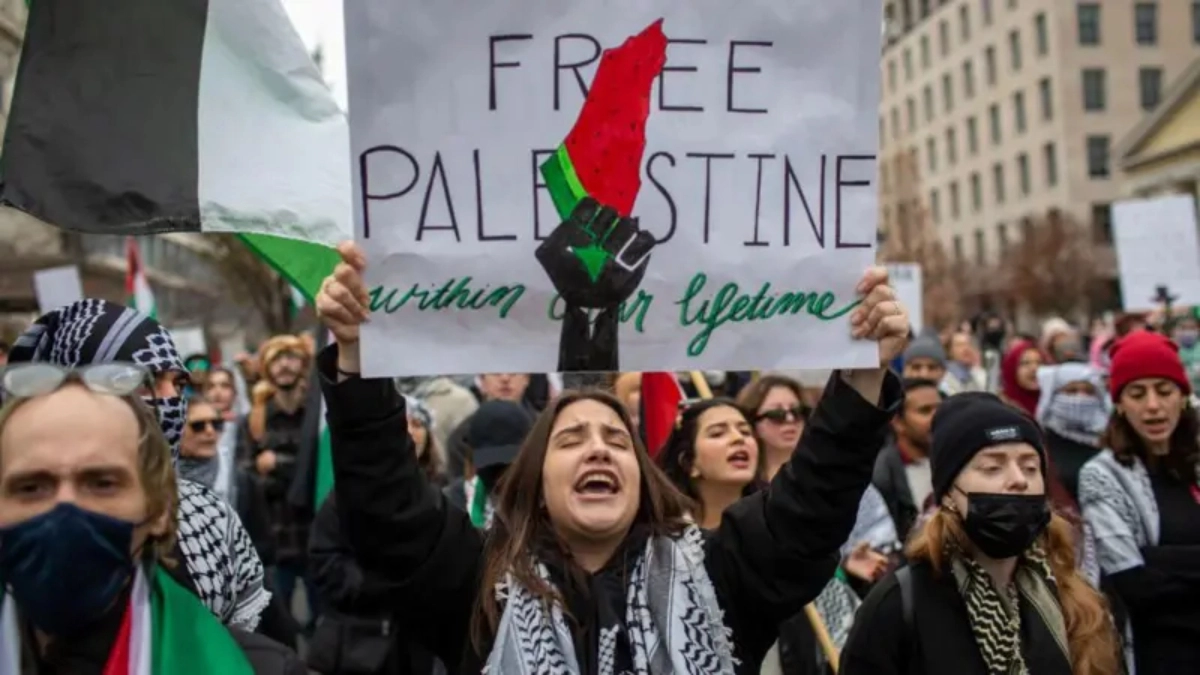

A 31-page document that seeks to "combat anti-Semitism" and dismantle "so-called pro-Palestinian activism in the United States" has been circulating on computers and desktops in Washington since October of last year.
This is Project Esther, a plan developed by conservative individuals and organizations, some of them close to President Trump, which proposes several measures that coincide with actions that his administration has been taking.
Named after the biblical story of a woman in the Persian Empire who saved Jews from extermination, the project lays out a detailed strategy to combat what it calls a “Hamas support network” in the United States.
“The virulently anti-Israel, anti-Zionist, and anti-American groups that make up the so-called pro-Palestinian movement within the United States are part of a global network of support for Hamas and, therefore, constitute in practice a network of support for terrorism,” the document says.
It is signed by a coalition of organizations — the National Task Force to Combat Antisemitism — organized and supported by The Heritage Foundation, the influential conservative think tank that made a lot of noise during the 2024 presidential campaign for being behind the controversial Project 2025.
The three co-authors of the Esther Project are linked to The Heritage Foundation.
In their own words, the project aims to “ensure that antisemitic movements are incapable of threatening American citizens with violence” and “dismantle the infrastructure of the Hamas support network throughout the United States” within 12 to 24 months.
Daniel Flesch, one of the co-authors, told BBC Mundo that this plan was created precisely to respond to this moment in which, according to him, “those who have been calling for “globalizing the intifada” for twenty years are carrying out their threat.”
For Flesch, this has been reflected in the recent attacks in Washington,where two Israeli embassy officials were killed, and in Boulder, Colorado, where 12 people were injured while participating in an event supporting the release of Israeli hostages held by Hamas in Gaza.
Flesch served as an advisor to Israel's permanent mission to the United Nations from 2018 to 2021.
Victoria Coates and Robert Greenway, the other two co-authors of the project, were officials in the first Trump administration. Both worked at the National Security Council on Middle East and North Africa issues.
What the document says
According to the Esther Project, the pro-Palestinian movement in the United States not only threatens the Jewish community, but threatens to destroy capitalism, democracy, and American values.
“Anti-Zionists and antisemites are attempting to assault our educational system, our political processes, and our government,” it reads.
The plan opposes what it calls a “Hamas support network” (HSN), which it says is made up of organizations that disguise under the label of pro-Palestinian activism their true intention of advancing the Hamas cause and detrimental to US interests and values.
The Esther Project was published one year after the October 7 attack, while Joe Biden was still President.
It accuses the Biden administration of “being on a path” to making antisemitism acceptable, eroding relations between Israel and the United States, and recognizing “a Palestinian entity to include Hamas.”
And it says that the “intention” of the Esther Project is that “when a favorable administration occupies the White House” public and private efforts will be coordinated to combat antisemitism.
The document was published at the height of the 2024 presidential campaign.
No Trump administration official has directly referred to the Esther Project.
BBC Mundo contacted the State Department to ask about the level of influence of the Esther Project on the policies of the current administration, but did not receive a response.
In any case, several of the plans defined in the document are similar to the actions that the Trump administration has taken, as celebrated by co-author Daniel Flesch.
“We are pleased that some of our recommendations, such as the deportation of those people who fail to comply with the requirements of their student visa are being pushed by the administration," he said in a statement to BBC Mundo.
The pro-Palestinian organizations that the Esther Project mentions by name, and which he accuses of being part of the support network for Hamas,These organizations have recently been subject to sanctions and suspensions by the universities where they operate. Harvard, for example, ordered the Harvard Undergraduate Palestine Solidarity Committee to “cease all activities” in April 2024. Columbia University, for its part, suspended Students for Justice in Palestine (SPJ) and Jewish Voice for Peace for violating university policies by organizing unauthorized on-campus protests. In May 2024, the Anti-Defamation League, an organization dedicated to combating antisemitism, reported that Columbia’s SPJ branch was posting on its Telegram channel a “fawning Resistance News Network guide to ‘the resistance,’ featuring designated foreign terrorist organizations such as Hamas and Jihad.” "Palestinian Islamic."
A profile of Sheikh Yassin, founder of Hamas, was published on the same channel in September 2024. “Even in death, his legacy of relentless resistance to oppression lives on. He lives on in his students, including current Hamas leader Yahya Sinwar [considered the architect of the October 7 attack on Israel], the man who deceived the Zionist entity, and in all the Palestinian fighters who embody the resolve that Yassin taught.” Tributes to Sinwar have also been posted there, as well as to the late leader of the Lebanese militia Hezbollah, Hassan Nasrallah, among many other members of Palestinian armed groups, including several who attempted or carried out actions against civilians in Israel, including hijacking buses with passengers and a failed attempt to detonate a bomb in a movie theater. Both Sinwar and Nasrallah were killed in attacks by Israeli forces. At least one message commemorating the October 7 attack on the which is described as a “strategic” and “anti-imperialist” action.
The Coincidences
The Esther Project coincides with the Trump administration’s approach especially regarding the role it believes college students (especially foreign ones) and academics play in the proliferation of antisemitism in the US.
Senior administration officials have noted that universities such as Harvard and Columbia have become fertile grounds for antisemitism and that educational institutions have not done enough to combat it.
Education Secretary Linda McMahon, for example, noted that Columbia “acted with deliberate indifference to the harassment of Jewish students.”
And Homeland Security Secretary Kristi Noem accused Harvard of “fomenting violence, anti-Semitism, and coordinating with the Chinese Communist Party.”
Those accusations, in fact, are part of the justification with which the government announced that it would prevent the university from enrolling foreign students. A few weeks earlier, it had frozen millions of dollars in federal funding earmarked for that institution.
The plans outlined in The Esther Project, published several months earlier, were along similar lines.
It notes that a group of foreign nationals who are part of Hamas’s support network have infiltrated the United States as students and have taken advantage of the rights and benefits the country offers.
“Organizations supporting Hamas have infiltrated their ideology into the United States education system. It is pervasive,” says the document, which also accuses dozens of universities of employing professors who defend Hamas-supporting organizations.
Based on this diagnosis, The Esther Project proposes a series of “desired effects,” including “that propaganda from Hamas-supporting organizations be eliminated from the curricula,” “that faculty who support those organizations be fired,” and “that foreign members of those organizations be denied access to campus.”
When describing how to achieve these ends, the plan explicitly includes revoking visas and deporting suspected members of Hamas-supporting organizations.
Since the start of Trump’s second term, the State Department has revoked hundreds of international student visas, and at least a dozen have been detained, some without warning or opportunity to appeal.
Many of those affected by these measures had in common that they had participated in some type of pro-Palestinian demonstration.
Perhaps the most emblematic case so far is that of Mahmoud Khalil, who was one of the key figures in the student protests in New York against the war in Gaza in 2024.
Khalil, a permanent resident of the US of Syrian nationality, was arrested in March and held for three months in an immigration detention center.
Trump has said that activists like him, whom he accuses of supporting Hamas, should be deported and called it “the first of many.”
Khalil was released on Friday, June 20, by order of a judge.
Secretary of State Marco Rubio has said that student visas are for studying and will be revoked if foreigners are deemed to have participated in “destabilizing” acts.
BBC Mundo asked both The Heritage Foundation and the State Department how they draw the line between pro-Palestinian activism and support for terrorism, but received no response.
Numerous lawyers and organizations have expressed that the arrests and threats of deportation of activists represent a serious risk to freedom of expression, enshrined in the First Amendment to the Constitution.
Trump and The Heritage Foundation
Before the Esther Project, the conservative think tank The Heritage Foundation was behind the 2025 Project.
This became a target of attacks on Donald Trump's campaign because it outlined a series of policies that, among other things, aimed to expand presidential power and impose strong restrictions on contraceptives.
Trump, then a Republican candidate, distanced himself, saying that he knew "nothing about the 2025 Project."
However, it already anticipated what would be some of his first decisions as president, such as freezing foreign aid (USAID) and ending diversity, equity, and inclusion programs in the government.
Some of the minds behind Project 2025 are still part of the government today, such as Russell Vought, director of the Office of Management and Budget, and John Ratcliffe, director of the CIA.
The people behind Project 2025 are not exactly the same as those behind Project Esther.
But several people who lead organizations that sign Project Esther have held positions close to Trump.
Among these are his former vice president Mike Pence and Christian pastor Mario Bramnick, one of the key figures in the Republican candidate's campaigns in 2016 and 2020 to attract the Latino vote.
Several of the organizations that make up the coalition that supports Project Esther are Christian, not Jewish.
“Project Esther was created by Christian nationalists who They pretend to care about the safety of Jews in order to promote an authoritarian agenda,” Beth Miller, leader of the Jewish organization Jewish Voice for Peace, which is mentioned in the document as part of the Hamas support network, told BBC Mundo. Miller called the accusations made by the Esther Project “extravagant and baseless” and a “pure fiction, fabricated (…) to defame and crush the peaceful movement in favor of Palestinian rights.” In addition to measures aimed at revoking visas and deporting activists, the plan includes, for example,to make social media platforms unwilling to host “organizations that support Hamas” and proposes to “marginalize” certain Democratic congressmen whom he accuses of being a “Hamas caucus” and of having an anti-Israel bias.
For now, there is no evidence that these proposals are being implemented by the government or others. The question remains whether they will be implemented in the future.
Click here to read more stories from BBC News Mundo.
Subscribe here to our new newsletter to receive a selection of our best content of the week every Friday.
You can also follow us on YouTube, Instagram, TikTok, X, Facebook and on our WhatsApp channel.
And remember that you can receive notifications in our app. Download the latest version and activate them.