

Who is Eduardo Bolsonaro and what role does the former president son have in the dispute between Brazil and the US?
Eduardo Bolsonaro holds talks from the US with officials from the Trump administration and Congress amid investigations into his father
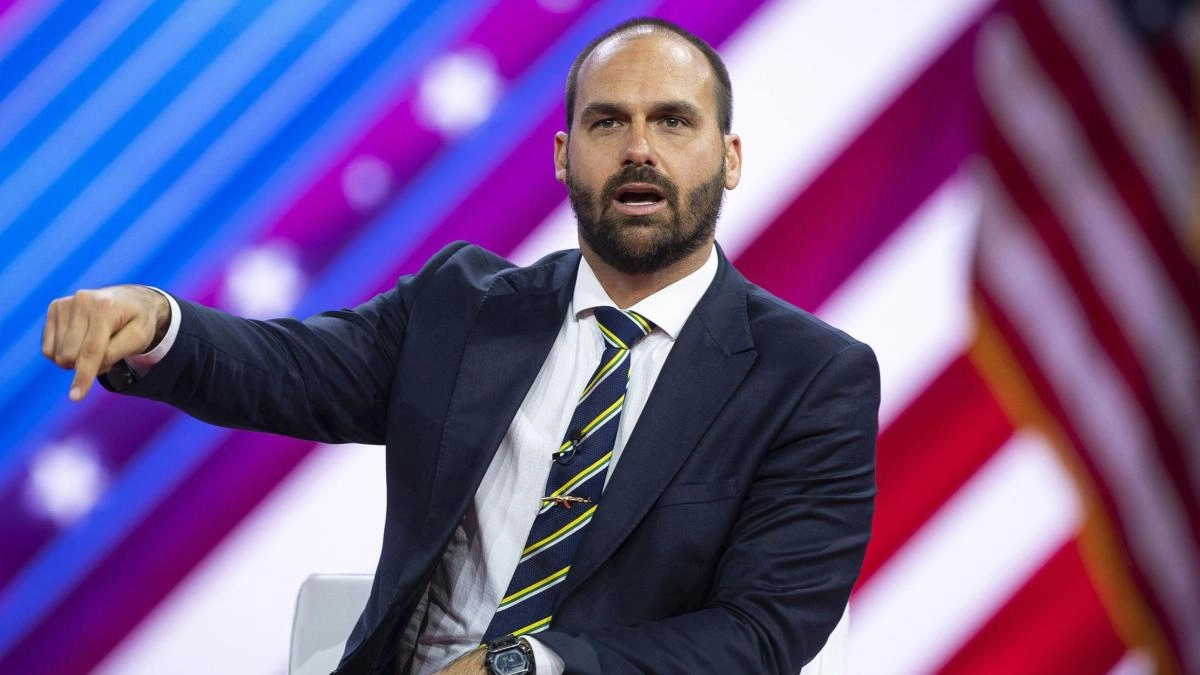

Amid Donald Trump's tariff pressure on Brazil, the figure of Eduardo Bolsonaro appears.
Jair Bolsonaro's third son is not only an ally of the president of the United States and a harsh critic of Luiz Inacio Lula da Silva, but has become the main political adversary of Supreme Court Justice Alexandre de Moraes.
Living in Texas since March 18, when he announced that he would take a leave of absence from his position as a congressman to live in the United States and build international support for his father, Eduardo presents himself as a key player in his family's ties to the Republican government.
In that sense, Trump based his threat of tariffs of up to 50% with Brazil, which is one of the few countries with which the United States enjoys a trade surplus, on criticism of the judicial investigation facing Jair Bolsonaro.
“This trial should not be happening. It is a witch hunt that must end IMMEDIATELY!” Trump questioned in the letter addressed to Lula da Silva, in which he exposes a harsh criticism of the Brazilian Justice system.
Two weeks before Trump's tariff announcement, Eduardo Bolsonaro called for “rescue of freedom and democracy” in his country in the face of a packed auditorium in South Florida.
“My role in the United States is to fight for freedom to rescue our democracy,” the congressman told BBC Mundo on the last Saturday of June at the first Latin American edition of the Conservative Political Action Conference (CPAC) in Hollywood, north of Miami.
Former President Bolsonaro has been disqualified by the Superior Electoral Court from competing in the elections until 2030 and is currently being investigated by the Supreme Court for attempted coup d'état in January 2023.
But in addition, Alexandre de Moraes is the one leading the case that analyzes the congressman's role in the alleged intimidation from abroad of judicial magistrates, according to the Attorney General's Office of Brazil.
For Anthony Pereira, director of the Kimberly Green Center for Latin America at Florida International University, the reason for Trump's announcement has little to do with trade or foreign policy.
"It's about defending a discredited political ally [Jair Bolsonaro] and attacking another country's judiciary," Pereira, who was director of the Brazil Institute at King's College London between 2010 and 2020, tells BBC Mundo.
Lula da Silva, who responded to Trump by saying that "Brazil is a sovereign country with independent institutions that will not accept being controlled by anyone," denounced Eduardo Bolsonaro's influence in the United States against the Brazilian government last month.
"It's regrettable that a Brazilian congressman, the son of a former president, is there asking the United States to interfere in Brazil's internal politics. That is serious. It is a terrorist and unpatriotic practice," the president said in a press conference at the beginning of June. of the press.
Who is Eduardo Bolsonaro
Eduardo Nantes Bolsonaro, 41, born in Rio de Janeiro, is the third of Jair Bolsonaro's five children and is the person in charge of building his father's international relations.
Although his brothers Flávio and Carlos also hold public office, Eduardo has a prominent place in his family and in Brazilian politics.
Especially after his father was prevented from competing in the 2026 elections for raising doubts about the reliability of the electoral system while he was president.
According to the latest polls by Parana Pesquisas, published by CNN Brasil, in a scenario where Jair Bolsonaro cannot run as a candidate, his son Eduardo appears in a technical tie with President Lula, only 2.5% below the current president.
“If my father cannot run for the reason whatever it is, I'll be there for you. If he tells me they need me to move forward, I'd be a candidate there," the lawmaker confirmed to BBC Mundo.
Graduated in Law in 2008, Eduardo passed a public exam that made him an officer in the Federal Police, a position he held until 2015, the year he fully entered politics.
The former president's third son was elected federal deputy for São Paulo in 2018, the year his father won the presidency, and re-elected in 2024 with more than 1,800,000 votes, making him the most voted-for deputy in the history of Brazil.
In 2022 he was re-elected for a third term, although with fewer votes than in the previous election, and since last March he has been on temporary leave from his role in Congress to focus on developing international support.
He made the decision to leave his country while he was in the United States, after a group of deputies from the Workers' Party (PT) asked the Supreme Court to retain his passport while the investigations against his father advance.
Although on March 18, the judge decided to reject the precautionary measures that sought to retain his passport, Eduardo Bolsonaro maintains that he is not in a position to return to Brazil.
"I am not in a position to return to Brazil today because Alexandre de Moraes threatened to take away my passport because I am speaking with authorities from the White House and Congress," he argues.
"We have to sanction Alexandre de Moraes, we have to stop him, to prevent the regime from consolidating. Right now, the economic sanctions that we are asking for may be effective, but tomorrow I don't know," he insisted from the CPAC stage days before Trump's tariff announcement.
What he does in U.S.
“My friend Eduardo Bolsonaro, thank you! Say hello to your father. Your family is wonderful,” President Donald Trump told Eduardo Bolsonaro on February 22 from the CPAC stage in Washington.
For the former president’s son, that was the moment when alarm bells went off in Brazil about the “good connections within the United States” that the former president’s son was building.
But that wasn’t the only gesture. On May 21, Secretary of State Marco Rubio assured the House of Representatives that there is a “high possibility” that Washington will sanction Judge Moraes.
Following these statements, five days later, the Brazilian Attorney General’s Office requested that the Supreme Court open a police investigation against Representative Bolsonaro.
According to the prosecutor’s office, Eduardo Bolsonaro is allegedly leading a campaign of intimidation and persecution against STF judges, prosecutors, and members of the Federal Police involved in investigations against allies of his father and the former president himself.
Since then, the representative has sought to have the United States financially sanction the magistrate of his country’s Supreme Court “for exercising his power to persecute the right.”
“Only then will we have a window of opportunity to resolve things, isolate Moraes, and restore normality in Brazil,” he told BBC Mundo.
In this context, Trump’s response has gone far beyond what Bolsonaro proposed.
Instead of sanctions imposed on specific individuals or entities, the president threatened to impose tariffs on a country's economy, which could affect dozens of Brazilian companies and complicate the former president's image at a delicate moment.
“This witch hunt – a term used by President Trump himself – is not just against me. It’s against millions of Brazilians who fight for freedom and refuse to live under the shadow of authoritarianism,” Jair Bolsonaro said on the Trump-owned social media platform Truth Social.
In his response, Lula maintained that “the judicial process against those who planned the coup is the sole responsibility of the Brazilian justice system.”
The link with Trump
Donald Trump, who in August 2023 was indicted for pressuring officials to reverse his 2020 electoral defeat, sees what is happening in Brazil as a repeat performance.
For Brian Winter, editor of Americas Quarterly magazine, an expert on Brazilian political affairs, Trump’s decision is a response to the political affinity between the presidents.
“I think it’s mainly about President Trump’s trauma from his trials and the similarities with the Bolsonaro family, which makes negotiation very difficult,” Winter wrote on the social network X.
“Trump is willing to harm this trade surplus and the American economic interests that sustain it in order to interfere in Brazil’s internal politics,” says Anthony Pereira of Florida International University.
But the United States’ threat to Brazil is not only a response to the political sympathy between Trump and Bolsonaro.
In addition, there is the annoyance that the American president has with the Brazilian justice system related to restrictions on the country’s technology companies in Brazil.
Moraes began a crusade to eliminate disinformation and conspiracy theories from Brazilian social networks, something that Trump considers an attack on freedom of expression that harms right-wing ideas.
After a recent ruling, technology companies became civilly liable in Brazil if they do not proactively regulate, before the judicial determination, “criminal and offensive messages published by its users."
In that sense, Eduardo Bolsonaro says that the United States should sanction Moraes because "the Brazilian justice system has begun to review the accounts of American citizens."
For Brian Winter, the way to resolve the crisis is for the United States justice system to declare the tariffs illegal or for the Bolsonaro family to ask Trump to replace the tariff strategy with sanctions against the judge, something he sees as less likely.
The trade dispute is also explained by the enormous clash of interests between President Trump and the justice system in Brazil, in which Eduardo Bolsonaro plays an influential role.