

Austin and San Antonio could be connected by train: the plan that seeks to alleviate traffic on I-35
Travis County is studying a train line between Austin and San Antonio to relieve traffic on I-35. What is known about the project.
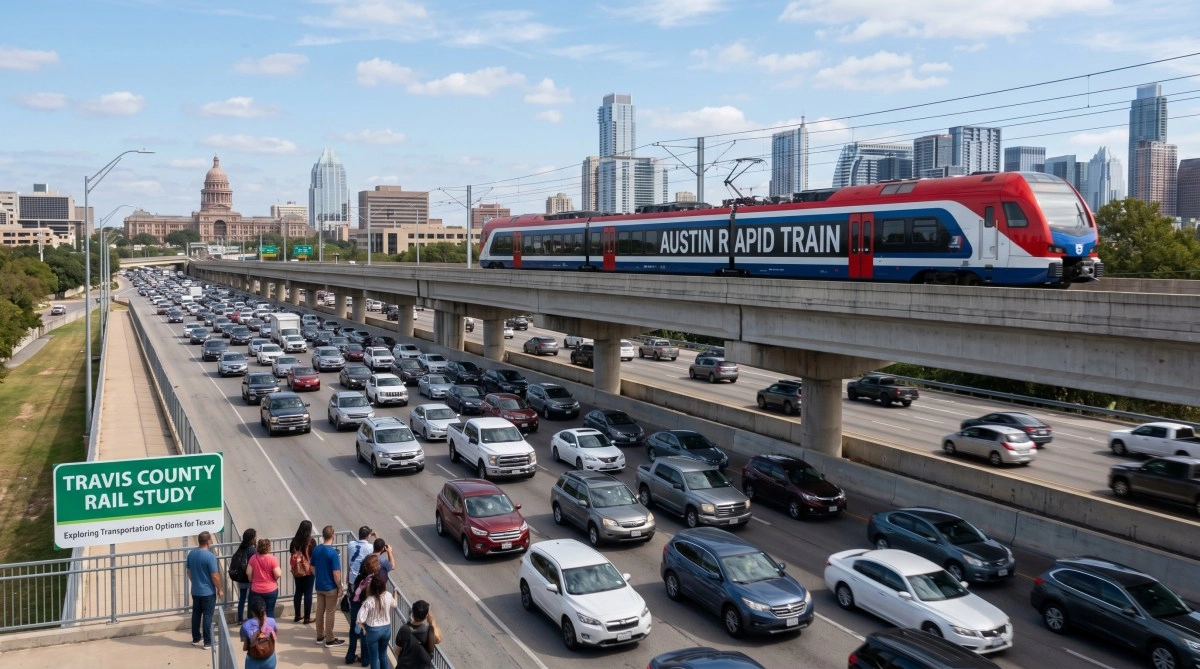

The possibility of traveling by train between Austin and San Antonio is gaining strength again in Texas. Travis County approved a feasibility study to analyze a passenger rail line of about 90 miles, intended as an alternative to traffic on I-35, one of the busiest and busiest corridors in the state.
The project still has no approved work, construction budget or opening date. For now, the concrete advance is a contract of almost $125,000 with the engineering firm HNTB Corp., which must study for six months if it is viable to build a connection between both cities using existing corridors, especially Texas 130 and Interstate 10.
The idea aims to solve a problem that thousands of drivers know well: the trip between Austin and San Antonio can become increasingly burdensome due to population growth, road work and the constant pressure on I-35. For Travis County, a passenger train could offer a different option for regional transportation, work trips, tourism, airport connections and events.
A route designed to avoid old blockages
The most interesting point about the new study is that it does not depend, at least at this stage, on the Union Pacific freight rail corridor, which, for years, was one of the obstacles to developing passenger service between Austin and San Antonio.
Instead, Travis County wants to evaluate an alternative route supported by existing public rights-of-way and road corridors. According to local reports, the route could continue from the Austin area towards SH 130 and then connect with I-10, before reaching San Antonio.
That approach seeks to reduce one of the big problems of any railway project: getting enough land to build. If the route can use public corridors, the initiative could be more viable than previous attempts.
You can see: Cheap vacations in Texas: accessible travel ideas for this summer
The north station would be near the Austin airport
Another relevant fact is that the proposed northern terminal would not be in downtown Austin, but near Austin-Bergstrom International Airport. That point could facilitate connections with flights and other regional trips, although it also opens up a practical question: how passengers would get from downtown Austin to the station.
For San Antonio, the study contemplates the connection with the existing railway infrastructure, although definitions on stations, frequencies, travel times, costs and operation are still missing.
What is needed for the train to become a reality?
The study will have to answer basic questions: how much it would cost to build the line, how much real demand it would have, what space is available, what type of service could operate and who would pay for a work of that magnitude.
Another analysis is also underway: TxDOT is studying the Austin-San Antonio corridor to evaluate what it would take to establish passenger rail service between both metropolitan areas. That report was scheduled for March 2026, according to Texas Rail Advocates.
Therefore, the news should be read with caution. Texas has not yet approved a fast train between Austin and San Antonio. What does exist is a new formal effort to study a rail connection in a region that is growing very fast and facing increasing pressure on its roads.
A bet on the future of Central Texas
The discussion comes at a key time for Central Texas. Austin and San Antonio are part of one of the fastest growing areas of the state, and car dependency is beginning to be a problem not only of mobility, but also of time, productivity and quality of life.
A train between both cities could change the way of moving in the region, but important decisions are still missing. If the study is favorable, next steps would include environmental reviews, seeking federal funding, agreements between counties and cities, and a structure to operate the service.
For now, the Austin-San Antonio train remains a possibility under study. But the fact that Travis County has put money on the table shows that the idea is no longer just a repeated promise: It is once again a concrete part of the conversation about how Texas should grow.