

Israel announces it resumes ceasefire after attacks that left at least 44 dead
Hamas said it was not aware of any developments or clashes in Rafah. It is unclear whether this will affect the ceasefire agreement.
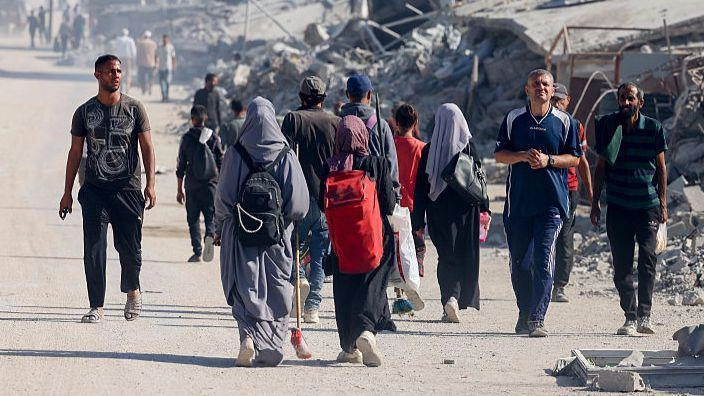

Israel says it has resumed the fire in Gaza, after carrying out a wave of attacks in Gaza on Sunday in response to what it called a “flagrant violation” of the agreement.
For its part, Hamas accused Israel of “violating the agreement and fabricating pretexts to justify its crimes,” but added that it remains committed to the deal.
The Israel Defense Forces (IDF) launched airstrikes in southern Gaza, claiming that “terrorists fired an anti-tank missile and firearms” at its troops.
The Israeli strikes left at least 44 people dead, sources in Gazan hospitals told BBC News. The military said two soldiers were killed.
Hamas said it was “not aware of any clashes taking place in the Rafah area, as these are red zones under the control of the occupation.”
Hours after the wave of attacks, the Israeli military announced it had resumed the cease-fire, but added that it “will respond firmly to any violation of it.”
Sunday's events come after an Israeli cease-fire agreement went into effect on October 10, as part of President Donald Trump's plan to end the Gaza war.
The first phase of the agreement, currently underway, saw the release of all living hostages and the return to Israel of 12 of the 28 who died.
Israel released 250 Palestinian prisoners from their jails and 1,718 detainees in Gaza, in addition to returning 15 bodies of Palestinians in exchange for the remains of all Israeli hostages.
The Israeli military launched a campaign in Gaza in response to the October 7, 2023, attack in which Hamas-led gunmen killed around 1,200 people in southern Israel and took 251 others hostage.
At least 68,000 people have been killed by Israeli attacks in Gaza since then, according to the Hamas-run Health Ministry, whose figures are considered reliable by the UN.
In a statement Sunday, the IDF said it “struck dozens of terrorists targets across the Gaza Strip, including weapons storage facilities and infrastructure used for terrorist activities.”
Prime Minister Benjamin Netanyahu's office said he had met with senior defense officials and instructed them “to act forcefully against terrorist targets in the Gaza Strip.”
Hamas's military wing denied knowledge of any clashes in the Rafah area.
In its statement, the al-Qassam Brigades said: “Contact with our remaining groups there has been cut off since the summary of the war in March of this year.”
“Therefore, we have no connection to what is happening in those areas and cannot communicate with any of our fighters there, if any of them are still alive.”
IDF forces still occupy and control just over 50 percent of the Strip of Gaza, having withdrawn to the agreed so-called yellow line.
Hamas, which has ruled the territory for 18 years, faces a challenge from armed groups, such as Yasser's Popular Forces Abu Shabab, gangs it says are being armed and supported by Israel.
It has called up around 7,000 members of its security forces to reassert control in Gaza, according to local sources.
Allegations
A local source familiar with Sunday's incident told BBC News that Hamas fighters attacked an Abu Shabab-affiliated group in southeastern Rafah, an area controlled by Israeli forces.
The militants were reportedly surprised by tank fire, leading to a brief exchange of fire before Israeli warplanes bombed the area.
Residents living south of the nearby European Hospital said the attacks were accompanied by artillery bombardment, with explosions that shook parts of Rafah.
Under Trump's 20-point ceasefire, Hamas must give up their weapons to no longer pose a threat to Israel.
Hamas has accused Israel of funding and arming rival gangs that it says have looted aid trucks. It claims Israel is deliberately empowering criminal gangs to challenge Hamas's authority and foment chaos.
Without a robust international force in Gaza, there is a real risk of further fighting between Palestinian factions.
The Rafah strikes came hours after the United States said it had “credible reports” that Hamas was planning an “imminent” attack on civilians in Gaza, which it said would be a “direct and serious” violation of the ceasefire agreement.
US Warnings
A planned attack on Palestinians “would undermine the important progress made through mediation efforts,” the State Department said.
The statement provided no further details.
Hamas has strongly denied any plans for an imminent attack.
The State Department said it had already informed other guarantors of the Gaza peace deal—which include Egypt, Qatar, and Turkey—and demanded that Hamas fulfill its side of the ceasefire terms.
“If Hamas proceeds with this attack, steps will be taken to protect the people of Gaza and preserve the integrity of the ceasefire,” the State Department said. fire,” the US statement said.
The ceasefire agreement also states that regional partners will ensure that “Hamas and the factions comply with their obligations and that New Gaza does not pose a threat to its neighbors or its people.”
Therefore, any instances or evidence of armed action by Hamas or other factions in Gaza would be considered a violation of the ceasefire.
Trump had previously warned Hamas against killing civilians.
“If Hamas continues to kill people in Gaza, which was not within the agreement, we will have no choice but to go in and kill them,” Trump said in a post on Truth Social earlier this week.
He later clarified that he would not send US troops to Gaza.
Last week, BBC Verify authenticated graphic videos showing a public execution carried out by Hamas gunmen in Gaza.
A week ago, fierce clashes broke out between the Hamas security forces and armed members of the Dughmush family in Gaza City.
Twenty-seven people were killed in what was one of the most violent internal clashes since the end of major Israeli operations in the enclave.