

The earthquake numbers in Venezuela: why it is already among the worst in its modern history
Dead, missing, affected and international aid: the figures that explain why the double earthquake in Venezuela is already a historical tragedy
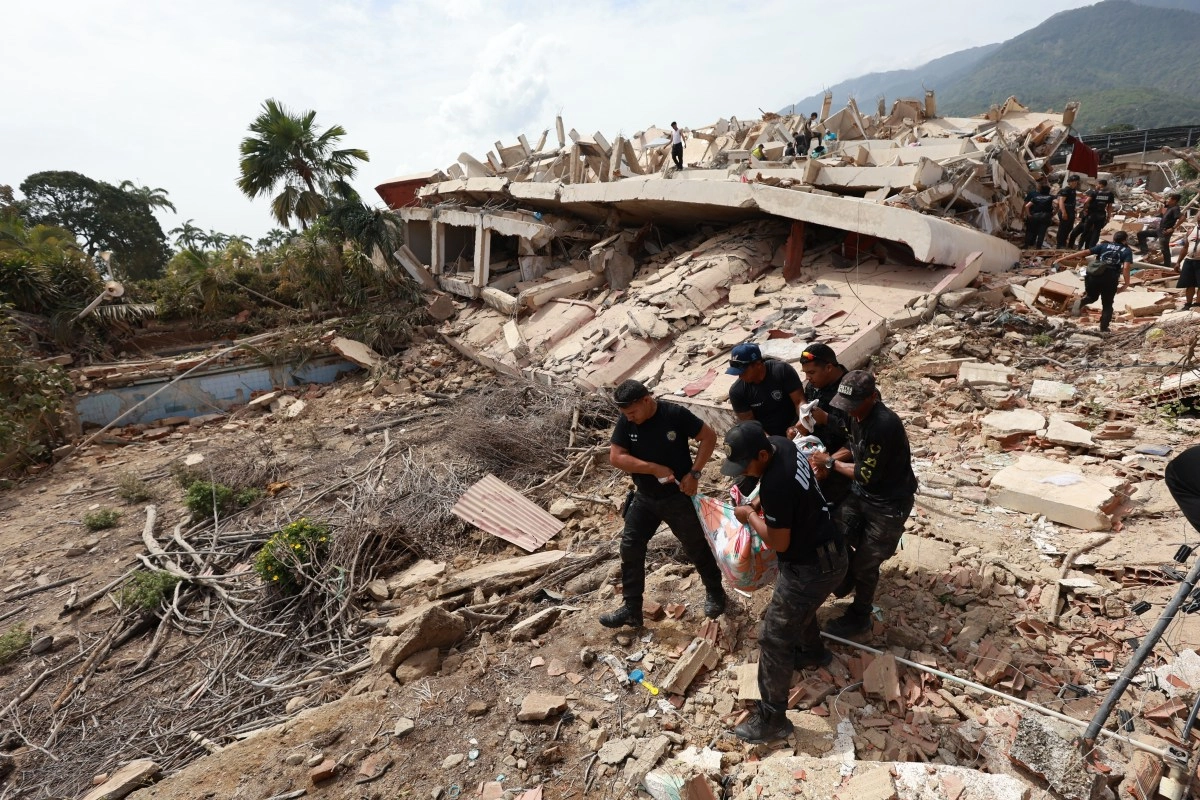

The double earthquake that shook Venezuela is already among the worst seismic tragedies in the country's modern history. Not because it can be said, yet, that it is the worst of all time, but because its initial numbers place it very close to surpassing the Caracas earthquake of 1967, which until now was considered the deadliest in Venezuela.
The balance continues to change with rescue tasks. There are areas with collapsed buildings, families isolated, hospitals damaged and thousands of people who have not yet been located. Therefore, more than a single figure, the dimension of the disaster is understood by looking at several numbers at the same time.
Two strong earthquakes in less than a minute
Venezuela was hit by two large earthquakes: one of 7.2 and another of 7.5. They occurred less than a minute apart and affected the north of the country, in an area near Caracas and the central coast.
That data explains part of the destruction. It was not a single movement followed by a minor aftershock, but a sequence of two very powerful impacts. The second earthquake, of greater magnitude, arrived when many structures could have already been weakened by the first.
In an earthquake, a few seconds can mean the difference between evacuating, protecting yourself, or being trapped. In this case, the margin practically did not exist.
At least 235 dead, with a toll that may continue to rise
The Venezuelan government confirmed 235 deaths, according to Reuters, but that figure is still preliminary. In large earthquakes, the count usually increases as rescuers manage to enter collapsed buildings, remove debris and reach unconnected areas.
The number already leaves the disaster on the verge of surpassing the 1967 earthquake, which left 240 dead and was considered the deadliest in modern Venezuelan history.
For now, the most devastating precedent remains the earthquake of 1812, with tens of thousands of deaths. But, with current data, this double earthquake can already be described as one of the worst in modern Venezuela.
Almost 50,000 people not located
One of the most distressing data is the number of people who have not yet appeared. According to Desaparecidos Terremoto Venezuela, a registry created to track people who are being searched, has (as of the morning of Friday, June 26), 49,951 people reported as not located.
That number does not automatically equate to deaths. It can include people without signal, displaced, evacuated, hospitalized, trapped or simply unable to communicate. But it marks the size of the uncertainty.
Up to 6.76 million people affected
The International Organization for Migration, a UN agency, estimated that up to 6.76 million people could have been affected by the earthquakes. The figure includes around 2 million people in Caracas.
That category doesn't mean everyone has lost their home or is injured. It includes people exposed to the impact of the earthquake, service outages, damage to infrastructure, risk of displacement, lack of water, electricity, transportation or medical care.
The data shows that the emergency is not limited to a city or a collapsed building. It is a national crisis, with urban, health and humanitarian impact.
You can see: 5 urgent things you should do in case of an earthquake
More than 250 buildings damaged or destroyed
Reuters reported that the government confirmed at least 250 buildings damaged or destroyed. In areas like La Guaira, one of the hardest hit, there were home collapses, severe damage and families spending the night on the street.
The problem is that structural damage is not always seen immediately. A façade can remain standing, but with compromised columns. A ladder may appear stable, but not withstand a replica. A building may become uninhabitable even if it has not completely collapsed.
For this reason, in the hours after a strong earthquake, authorities usually ask not to return to damaged homes until they are inspected. The aftershocks continue and, some, are being very strong.
Hospitals and services under pressure
The emergency also hit the health system. According to EFE, spokespersons for UN agencies indicated that around twenty emergency hospitals suffered damage in states such as La Guaira, Miranda, Aragua, Carabobo, Falcón, Zulia, Yaracuy and Lara, in addition to the district of Caracas.
This data is especially serious because it occurs just when hospitals, operating rooms, ambulances, supplies, water, electricity and medical personnel are most needed.
Venezuela asked the UN to deploy emergency medical teams with surgical capabilities, as well as supplies, medicines and equipment to address the crisis.
More than 1,000 international rescuers
The international response began to move quickly. The United Nations reported that some 16 countries sent search and rescue teams, with 25 teams totaling more than 1,000 rescuers.
These include specialized urban teams, search dogs, medical personnel and logistical support. Some have already arrived in the country and others were on their way.
The presence of foreign rescuers shows the magnitude of the disaster. In the first 72 hours after an earthquake, every hour counts: it is the most critical period for finding survivors under the rubble.
You can see: US Army sends aid to Venezuela in the face of the catastrophe generated by two earthquakes
The antecedent of 1967 and the shadow of 1812
To understand why this earthquake has already entered the modern history of Venezuela, we must look at the history.
Reuters recalls that the 1967 Caracas earthquake left 240 dead and was, until now, the deadliest in modern Venezuela. The current balance is already very close to that figure.
But. In the country's seismic history, there are much greater tragedies. The 1812 earthquake left about 26,000 dead and destroyed much of Caracas and other cities. The earthquake of 1797 is also remembered, with thousands of victims.
The USGS warns of a much more serious scenario
The United States Geological Survey also raised the alarm with its automatic PAGER model, which estimates possible victims and damage based on the magnitude, intensity of the movement, the exposed population and the vulnerability of the buildings.
That system does not offer an official count, but rather a projection. Even so, their estimates warn that the final balance could greatly exceed the numbers confirmed so far.
This is not data verified by authorities and hospitals, but rather the probable scenario calculated by technical models to guide the emergency response.
You can see: Earthquake in Venezuela: how to search for relatives from the US.
A tragedy measured in lives, buildings and families without an answer
The numbers help understand the scale, but they are not enough to tell the full tragedy. Behind each figure there are families looking for someone, people sleeping on the streets, damaged hospitals, buildings that no longer exist and entire communities waiting for help.
The earthquake in Venezuela is still developing as a humanitarian emergency. The next few hours will be decisive to know how many people are still trapped, how many can be rescued and how much the final balance will grow.