

Who were the millions of Europeans who emigrated to Latin America after Independence
Millions of Europeans arrived in Latin America from the mid-19th century and the first decades of the 20th century
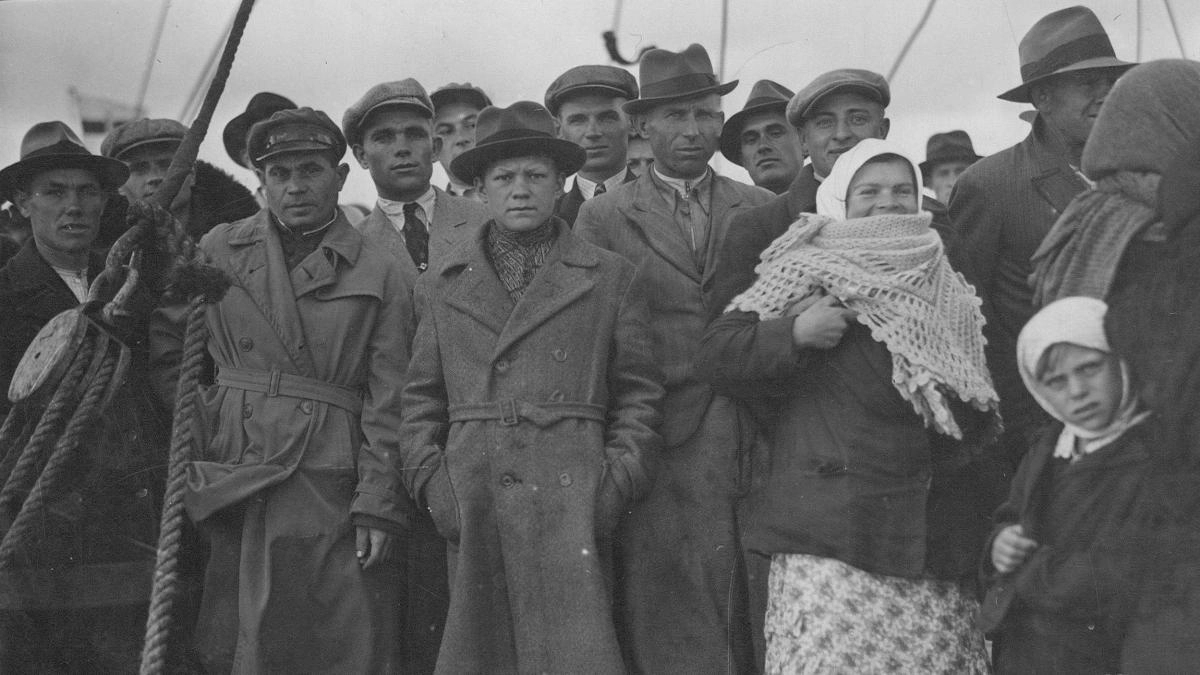

It is August 11, 1883, and the merchant ship 'Mendoza' is entering the port of Buenos Aires, Argentina. On board, hundreds of passengers read over the railings with a mixture of curiosity, fear, and hope.
They left Naples a month ago and, upon arrival at the port, they complete the relevant registration: Francesco Scola, 23, day laborer; Nicoleta Calafiori, 31, seamstress; Giovanni Quaranta, 27 years old, blacksmith,… and so on, an endless number of newcomers.
The data on Francesco, Nicoleta, and Giovanni, which we know thanks to the Center for Latin American Migration Studies (CEMLA), are just three examples of the hundreds of migrants arrived every week, for eight decades who, in the Argentine capital from the other side of the Atlantic.
But the case of Buenos Aires was not an isolated one, since, from the mid-19th century to the first decades of the 20th century, millions of Europeans crossed the ocean to a multitude of cities along the Latin American coast.
“The use of the passport as an instrument of border control came about in the wake of the First World War. Before, it was a world with great freedom of migration and movement,” Chiara Pagnotta, a historian at the University of Barcelona, ????tells BBC Mundo.
The first decades of the 19th century brought with them the formation of numerous republics throughout Latin America in territories that until then had been part of the Spanish and Portuguese.
Once established, these new states laid their political, economic, and social foundations. However, several of them faced an obstacle: they did not have enough population to realize their full growth potential.
“To govern is to populate”
In places like Argentina and Uruguay, which had the raw materials needed to become much more prosperous countries, there was not enough labor to do so. Therefore, the solution for these nascent countries was to import population.
An example is the famous expression “To govern is to populate,” by the intellectual, Argentine politician and diplomat Juan Bautista Alberdi,who was key in shaping the Argentine Constitution of 1853.
This is how, from the mid-19th century, countless ships like the 'Mendoza' began arriving at ports throughout Latin America loaded with migrants in search of a better future.
“There were great facilities for migrants from Europe to settle in these countries, but there were far fewer options and possibilities for migrants from neighboring countries, especially indigenous and mestizo people, to settle,” says Carlos Malamud, professor of American History at the UNED.
More specifically, the profile sought by most Latin American governments were migrants from Central and Northern Europe. That is, those from countries like France, Germany, or the United Kingdom, which were considered more advanced by the standards of the time.
However, precisely because of the better living conditions in those places, their citizens had less incentive to migrate. So the occupants of those ships that crossed the Atlantic ended up being mostly Southern Europeans... that is, Spanish, Italians, or Portuguese.
Although they were the most numerous, it was not only Europeans who arrived on the shores of Latin America during those decades. On the Pacific coast of the Americas, thousands of Chinese went to work on plantations, in mines, or in construction in countries like Peru, Chile, or Mexico.
Or thousands of Syrians or Lebanese, who until the First World War arrived in Latin America carrying Ottoman passports and who were commonly known as "Turks."
Young People and Swallows
Beyond nationalities, the profile of the newcomers had a common denominator: young people of working age, many of them single—although some also arrived with their entire families—and mostly of rural origin, basically peasants.
Given today's reality, it may surprise many that, for some eight decades, millions of people left Europe to seek a better life in Latin America. But there were reasons for this.
With the advance of the Industrial Revolution, the European peasantry became impoverished, especially in the countries of the South. In their search for better wages and working conditions, Latin America became a very attractive option for these farmers.
"Latin American countries entered the global system as primary countries, primarily for agricultural products, livestock-derived products..." explains Pagnotta. As Europe demanded these products, Latin America became an important exporting region.
The same industrial revolution that disadvantaged the European peasantry, however, facilitated their journey across the Atlantic. During that time, transportation developed enormously, which accelerated arrival times in Latin America.A merchant ship with passengers took just over a month to cross from Europe.
Some arrived with their families in tow, determined to settle in the nascent Latin American countries. Others, however, traveled seasonally and were known as migrant migrants. They were generally Italians and Spaniards who went to Latin America for the harvest season, earned good money, and then returned to Europe. And some repeated this round trip several times.
Another variable that influenced the newcomers was whether they knew someone at their destination or, on the contrary, they were alone. The former were fortunate enough to have a friend or relative who had already immigrated to that place and could take them in for the first few days or weeks.
Those who didn't have this advantage often received support from the local government. One example was the so-called Hotel de Inmigrantes in Buenos Aires, which assisted thousands of immigrants during the first decades of the 20th century.
This served as accommodation for newcomers while they found employment and a place to move to. Some migrants even received training there for agricultural work, which was the most common destination for those who couldn't provide they had another trade.
Multiplying the workforce
Although European migrants were spread throughout Latin America, certain countries were the most common destination.
The most notable case is surely that of Argentina. In the eighty years covered by this great migratory process we are talking about - the second half of the 19th century and the first three decades of the 20th century - some four million Europeans settled in Argentina.
The influence of their arrival was such that if in 1850 it had a population of 1.1 million, by 1930 it had reached almost 12 million.
A similar case is that of Uruguay, where some 600,000 Europeans settled, increasing in this same period from 132,000 inhabitants to almost 1.6 million.
Or in Brazil, where 2 million Europeans settled and its population increased from 7 to 33 million. Not to mention countries like Cuba, the Dominican Republic or El Salvador, where the migratory influence was also very significant.
Argentina, Brazil, Uruguay and Cuba required a lot of labor, because they had a great export potential for raw materials. Sugar and tobacco in Cuba, coffee in Brazil, or cereals and meat in Argentina and Uruguay.
However, other exporting countries, As was the case in Mexico or Peru, they did not need as much labor. Experts attribute this to the fact that these states had a large indigenous population.
Furthermore, "the policy of attracting European labor took place at a time when slavery was being abolished throughout Latin American countries. For example,the Italians in the state of Sao Paulo (Brazil) went primarily to replace the newly freed slave labor," explains Pagnotta.
As mentioned before, the largest groups were Spanish, Portuguese, and Italian.
The preference of the first two for Latin America has much to do with the shared language, which made their integration easier. However, the case of Italians is more unusual, since although many also emigrated to the United States, they were also the largest group of migrants in countries like Argentina and Brazil.
Threat or 'whitening'?
The determination of Latin American governments to attract these migrants led to the implementation of different policies to make them easier to attract. It was not only important that labor arrived, but also that they integrated into those societies.
Since many of the newcomers were expected to work in the fields, governments often made it easier to acquire land or, sometimes, even granted it to them as "settlers."
But since many of the desired migrants did not arrive alone, it was also necessary to consider their families. Hence, they were promised free education for their children, something that facilitated integration.
However, the arrival of millions of Europeans was not perceived equally by everyone in Latin America.
“There were more popular sectors that saw migration as a great threat due to competition for jobs. There were also much more exalted sectors, whether culturally or socially, that saw emigration as a risk to the homogeneity of societies, that is, ethnic homogeneity, cultural homogeneity, etc.,” Malamud explains to BBC Mundo.
But there were even others “for whom this was a great opportunity because, from a racial point of view, they saw in emigration, especially European, a great opportunity to 'whiten' society in the face of the weight borne by indigenous people and mestizos.”
This last vision was even promoted by several governments in Latin America.
This is the case, for example, of the Argentine Constitution of 1853, which specifically encouraged European immigration. Or the 1912 immigration law in the Dominican Republic, which expressed preference for the "Caucasian race."
Populating the Borders
Although some migrants chose to stay in the main cities, the majority moved to rural areas to work in the fields.
And Latin American governments primarily encouraged these migrants to move to rural areas… on the borders.
“Latin American borders were specifically consolidated in the 19th century. All border wars—the War of the Pacific, the Chaco War, the Triple Alliance—are wars for control of territory and its resources. And in this battle,placing a 'population wall' in the border areas was very important," Pagnotta points out.
Although indigenous populations often already lived in these border regions, they were often forced to move into the interior of the country.
The great migration period slowed down during the First World War (1914-1918), although the end of the conflict encouraged the arrival of some groups. This is the case, for example, of thousands of German farmers who migrated to Latin America after the war, fleeing poverty.
But if there is a date that can mark the end of this great period of migration to Latin America, it coincides with the 1929 Crisis or Great Depression.
This financial crisis, which caused a serious deterioration of the global economy, also caused Latin America to reduce its level of exports. While eight decades earlier the region had needed more labor, in the 1930s demand dropped considerably.
Some migrants even ended up returning to their countries. of origin, as is the case of the so-called "Indianos," Spaniards who returned to their country after making their fortune in America.
Despite considering that moment as the end of the great migratory period of Europeans to Latin America, the process did not stop there. For example, in the following years, thousands of Europeans, many of them Jews, arrived fleeing Nazism.
In turn, after the end of the Second World War (1939-1945), thousands of Nazis or collaborators of the Third Reich also escaped to South America, many of whom were never brought to justice.
The millions of people who left Europe since the mid-19th century ended up transforming the demographics, culture, language and customs of Latin America.
A process repeated throughout history all over the world, which has simply changed the place of origin and the destination, because, as Carlos Malamud says, "migrations are as old as humanity."
Map by Caroline Souza, BBC Mundo Visual Journalism Team.
Click here to read more stories from BBC News Mundo.
Subscribe here to our new newsletter to receive a selection of our best content of the week every Friday.
You can also follow us on YouTube, Instagram, TikTok, X, Facebook, and our new WhatsApp channel.
And remember, you can receive notifications in our app. Download the latest version and activate them.