

Why China supports its ally Cuba in a limited way amid pressure from the United States
Beijing is a historical partner of Havana, but given the escalation of tension with Washington, the Asian country has opted for caution
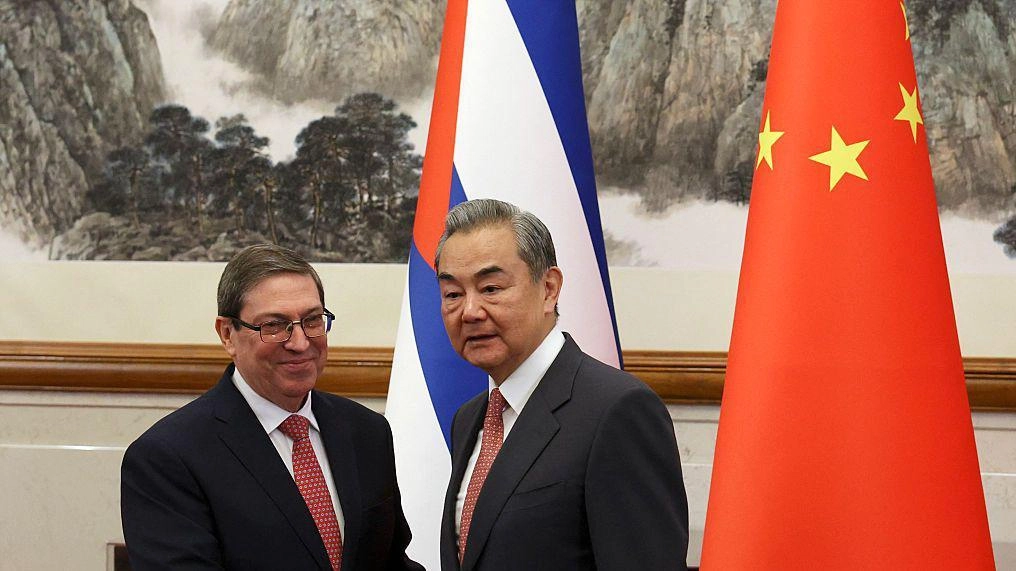

“Good brothers, good comrades, good friends.”
That is the phrase with which Chinese leader Xi Jinping has described his country's relationship with Cuba on several occasions.
And it is not just a diplomatic slogan, but a reflection of the close bond that both nations have built over decades.
The island is considered one of Beijing's main bridges with Latin America and the ideological and political ties between both countries are historical and long-standing.
But despite this special relationship, China has acted cautiously in the face of one of the Caribbean country's worst crises.
Why doesn't the Asian giant do more for this historic ally?
Beijing's gestures
It is undeniable that China has made significant gestures with Cuba in recent decades, but its support seems to be limited by strategic, economic and geopolitical considerations.
China has been a key trade partner for Cuba for years, in addition to allowing the country on more than one occasion to restructure its debts in the face of the economic difficulties it has faced in meeting its payments.
"For a long time we saw a relationship based on the idea of helping Cuba from a primarily political and ideological lens. And that continues today," says Margaret Meyers, director of the Asia and Latin America Program at the Inter-American Dialogue, based in Washington.
In the midst of the current crisis, exacerbated by the threat of sanctions by the United States on the shipment of oil to the island since the end of January, China has sent various donations to Cuba.
Among them, nearly 60 thousand tons of rice and a donation of 80 million dollars for electrical equipment and energy infrastructure.
China has also supported Cuba with direct investments and donations in the development of renewable energy, particularly through the installation of photovoltaic parks that allow the island to depend less and less on scarce oil.
According to the Ember Energy Study Center, Cuba would be carrying out one of the fastest solar revolutions with the help of Beijing.
The value of imports of photovoltaic solar panels and batteries from China to Cuba increased more than 1,800% between 2020 and 2025, according to figures disclosed by Ember to CNN.
Limited support
Experts consulted by BBC Mundo assure that although Chinese solidarity has been significant for Cubans, its support remains limited.
For Helen Yafe, an academic in Latin American political economy at the University of Glasgow, "China has been very vocal, it has clearly said that it opposes the measures taken by the United States and has defended Cuba's right to have its own economic and political system. But those are words. In terms of concrete actions, support has been limited."
It has also become evident that China has assumed a more contained position than other allies of Havana such as Russia or Venezuela.
“Compared to other allies or external partners, China is clearly more cautious,” Meyers emphasizes.
Business is business
Cuba has not been an exception in the pragmatic and strategic approach with which China has conducted its economic policy.
For Beijing, the benefits of the commercial link with Cuba are limited and this is reflected in the exchange between both nations.
Cuba is far from being China's largest trading partner in Latin America. Its economic integration is substantially greater if we look at the exchange with countries such as Argentina, Brazil or Chile.
Imports from Cuba to China - in products such as nickel, zinc and others - decreased by nearly 600 million dollars from 2017 to 2022, according to figures from The World Integrated Trade Solution (WITS). Although according to Havana, trade exchange increased between 2024 and 2025.
Emily Morris, senior researcher at the Institute of the Americas at University College London (UCLIA), affirms that Chinese aid has been crucial, especially in energy matters.
However, he also maintains that "China does not want to simply throw money at Cuba as if it were a bottomless pit. It does not want to assume the role of the former Soviet Union. It does not want to have states dependent on it. Relations operate according to market criteria and prices."
"From a strictly commercial point of view, China really doesn't have much to gain in Cuba. It hasn't been a particularly profitable place," Meyers adds.
For the academic, Beijing's approach responds, among other factors, to China's own economic interests and its industrial policy:
“China today has less capital available to invest globally and needs to direct it much more specifically and strategically.”
"And if operating in one region proves problematic — for economic, geopolitical or security reasons — then that capital is redirected elsewhere. And that's exactly what we're seeing now."
The United States factor
That the United States is on the other side of the Cuban crisis is not a minor factor in the equation for China.
The economic and energy crisis affecting the island – aggravated by the US oil blockade and US political pressures – is viewed with concern from Beijing.
China has condemned the embargo and blockade and recently did the same regarding Donald Trump's decision to bring former President Raúl Castro to justice.
As concern grows in Havana about possible intervention, Foreign Ministry spokesperson Guo Jiakun declared that “the United States should stop using sanctions and the judicial apparatus as tools of oppression against Cuba and refrain from making threats of the use of force at any time.”
But, according to experts, China is far from assuming a role that goes beyond rhetoric in favor of Cuba and that involves risking its own relationship with the North American power.
In this, Trump's renewed “Monroe Doctrine” in Latin America is key.
The White House has been explicit that the “America for Americans” emphasis is aimed at pushing back against foreign influences — such as China — in the region.
For Shawn Yuan, editor of the BBC China service, the signals that the US has given with its intervention in Venezuela and its campaign to regain absolute control in the hemisphere have permeated Beijing's perspective.
“China fully understands what that means for the United States,” he says.
"Beijing is not in a position to get deeply involved in Cuban affairs. Definitely not in the context of Trump's strong narrative regarding the island," he adds.
Meyers maintains that “anything China does in Cuba — and there are those who suggest that it could offer more financing or some other type of support to the Cuban people — can be seen as problematic from Washington.”
In that sense, experts assure that Beijing is practicing a delicate balance between showing that being its ally continues to be valuable and, at the same time, taking care of relations with the United States.
"It's about acting more carefully, at least for now. That doesn't mean China is withdrawing. But we are seeing more discreet, less publicly visible relationships."
Yuan adds that “from a purely economic perspective, the United States is a much bigger partner for China.”
"Upsetting the United States over a small economy like Cuba is not in China's interest. Cuba is simply not that important to China economically."
Regarding the island's expectations, Cuban economist Tamarys Bahamonde states that probably “China's aid will remain in that order, in moral support.”
The other island
The Taiwan factor is also an element that experts highlight to explain China's position regarding Cuba.
Beijing considers Taiwan part of its territory and Xi Jinping himself described this issue in the framework of Trump's recent visit as “the most important” in the bilateral relationship with the United States.
“In the case of China, the geopolitical situation is very complex because if China tells the United States ‘stay out of Taiwan and don't get involved in our region,’ then the United States can adopt exactly the same position with respect to the Americas,” says Yafe.
Yuan recalls, in the same sense, the words of the American president after returning to Washington after his visit to China: "Trump pointed out something very interesting; that Taiwan is only 59 miles from mainland China. 'We are 9,500 miles away and that is a problem,' he stated. And that is exactly the same sentiment that Beijing probably shares."
“We could literally replace the word Taiwan with Cuba and mainland China with the United States and it would be exactly the same.”
For Yuan, the ideological similarities between China and Cuba do not necessarily outweigh all other strategic calculations that Beijing has regarding Taiwan.
In the era of Xi Jinping it seems that ideological closeness matters less than the global hegemonic dispute.
Experts say that, furthermore, China's perspective on the expansion of communist ideas outside its borders is not something that is necessarily in its main interest.
For this reason, strategic calculations seem to weigh more at this time.
"Probably the most important partner China has is Russia. It's not really Venezuela, Cuba or North Korea. Putin's idea of challenging Western dominance led by the United States after World War II is something Xi Jinping deeply shares," Yuan says.