

Why Saudi Arabia's spending hundreds of billions of dollars on futuristic, outlandish ideas has come to an end
Mohammed bin Salman's Vision 2030 project seemed straight out of science fiction. Now reality hit the kingdom
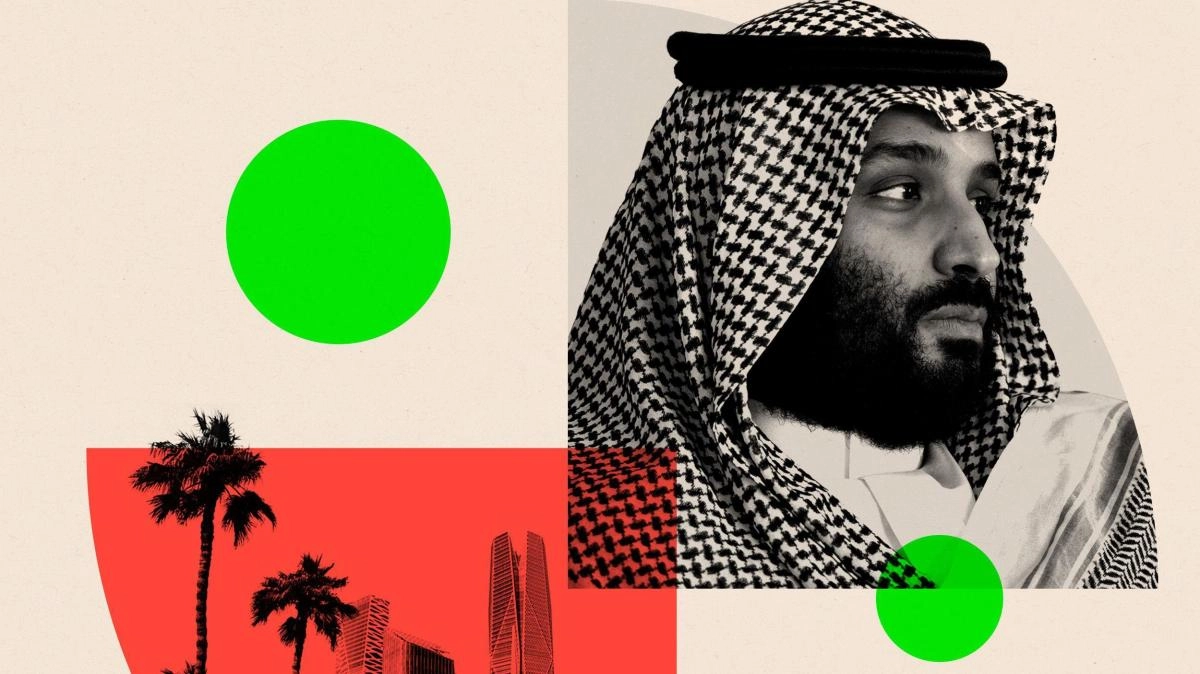

Autocratic monarchs once left an echo of their glory in the ruins of the megaprojects they directed at the height of their undisputed power.
Those monumental physical footprints are found in the fertile plains, mountain slopes and deserts of the Middle East. But one of its most prominent modern counterparts may have only left a fingerprint for some of its most ambitious concepts.
A decade ago, Saudi Arabia's Crown Prince Mohammed bin Salman—or MBS, as he is popularly known—decreed an overhaul of his country that seemed straight out of science fiction.
It was called Vision 2030. Extraordinary monolithic structures were to contribute to the development of new technological wonders, not only for the Kingdom, but for the world.
These ideas were materialized in ostentatious public relations material that evoked fantastic landscapes and attracted a great deal of media coverage, mixing admiration and ridicule.
This was made possible by Saudi Arabia's nearly $1 trillion sovereign wealth fund (PIF), whose oil-dependent wealth would be used to lay the foundation for an oil-free future.
Four years from 2030, there has been, perhaps predictably, a reduction in spending.
Part of this is due to financial imperatives, as the sharp drop in oil prices before the current war in the Middle East caused even Saudi Arabia's extraordinary wealth to take a hit.
Although those prices skyrocketed because of the war, the uncertainty generated by the conflict will continue to limit Saudi income and spending. Furthermore, the influx of foreign investment into these ultra-high-cost visionary projects has never materialized to the extent that the Saudis had hoped.
But is this a recalibration or a withdrawal?
From fantasy to realism
Some of the most striking projects are being diluted, paralyzed or even abandoned. Several of them are included under the once ambitious Neom megaproject, valued at US$500 billion.
It seems that The Line, which sought to redefine the concept of a city by stretching in a straight line across more than 100 miles of virgin land in northwest Saudi Arabia, is becoming considerably more prosaic.
The Trojena ski resort, in the mountains of the country's northwest, has also suffered cuts.
Although there is snow, which belies the image of Saudi Arabia as an unforgiving desert, it does not last long. The concept of a year-round hill station led the area to artificial terrain that is no longer considered viable.
A complex was planned with miles of ski slopes and a town complete with an artificial lake, hotels and luxury shops: a kind of mini St. Moritz in the Arabian Mountains.
It was supposed to be ready to host the 2029 Asian Winter Games, but these were canceled and the Games will be held in Kazakhstan.
The Cube, a massive apartment and office structure that could have housed the Empire State Building twenty times over, was scrapped entirely. Its estimated cost was US$50 billion.
Recently, one of the flagship projects of the Kingdom's ambition to become a global sporting power from scratch, the LIV golf circuit, was reassessed as a dismal failure that has cost some US$5 billion to date and has generated neither financial nor reputational benefits.
Some veteran Saudi Arabia watchers, like Ellen R. Wald, author of Saudi, Inc., feel they've seen this before.
"It's the same strategy, the same with The Line. You know, 'We're going to build something huge. Oh, wait, now we're going to scale it back significantly.' And it's the same thing over and over again, and it's been that way even before Mohammed bin Salman. They make big, big announcements, and then it either doesn't get built or it gets built on a much smaller scale or in a way that's not what it was."
Wald remembers the new cities that were planned to be built in the 2000s under the reign of the previous monarch, King Abdullah.
The “Economic Cities” program also aimed to diversify the Saudi economy, reducing its dependence on oil, which has been a staple in the Kingdom for decades.
Relying almost exclusively on a non-durable natural resource has long been considered an obstacle to the development of a much more diversified and resilient economy.
The results were generally disappointing, despite the billion-dollar investment.
Several of the proposed cities never materialized, and others were transformed into more modest projects.
The most ambitious, the $100 billion King Abdullah Economic City on the Red Sea coast north of Jeddah, was built, but its goal of becoming a business and tourism hub has not materialized.
The hope was to attract significant foreign investment and create real jobs, outside the stagnant state sector, for Saudi Arabia's large and growing young population. But in 2016, the unemployment rate was still around 12%.
Wald believes there is a fundamental lack of realism on the part of the officials responsible for these projects. "Where did they think the market was? Who told them this was possible? There is a general submissive mentality. There are those who tell the king what he wants to hear. And this also applies to consultants, because they go for the big contracts. So they say what they think their Saudi clients want to hear, and then the projects do not meet expectations."
This pattern goes back decades: Foreign companies often don't want to risk the lucrative contracts they've won by asking questions.
radical change
Some believe that when MBS became de facto ruler of the Kingdom in 2017, he inherited a system that was in urgent need of reform.
Ghanem Nuseibeh, an economic analyst who has closely followed changes in Saudi Arabia for years, says MBS inherited “a socioeconomic system totally out of step with the modern world” that was “heading toward total stagnation.”
Vision 2030 was designed to transform Saudi Arabia in three areas: economic, political and social. “The really complex thing for them was to implement these changes in a coordinated way.”
The social control exercised by the country's powerful and ultra-conservative Islamic leadership was seen by MBS and his advisors as a major obstacle to Saudi Arabia reaching its full economic potential.
The political change under MBS was presented as the transfer, for the first time, of the reins of power to a younger, more dynamic generation. However, this did not mean that a new space for political debate was opened.
Indeed, as Nuseibeh acknowledges, MBS himself was responsible for some of the problems that have slowed the scope and pace of change, as well as overshadowing his mandate.
Just as he became de facto ruler in 2017, he ordered the mass detention of senior Saudi officials and businessmen at the Ritz-Carlton hotel in Riyadh, a move the Saudi government presented as an anti-corruption campaign but which others interpreted as extortion.
The brutal murder of Saudi journalist Jamal Khashoggi in the country's consulate in Istanbul in 2018 left a stain on the crown prince's reputation, which, while it may have faded, remains indelible.
One Saudi with direct experience of how his country's authorities repress dissent is Abdullah al-Ouda, a US-based academic and human rights activist. His father, Salman al-Ouda, a prominent Saudi Islamic scholar, has been imprisoned since 2017 accused, among other charges, of “inciting revolt.”
Abdullah believes that episodes such as the Ritz-Carlton purge have been counterproductive to the goal of financing Vision 2030, even if those held in that luxurious prison contributed approximately $100 billion.
Investor fear
“In the long run, it has actually scared away investors,” he said. “And all the oppression has also affected the way investors view Saudi Arabia as a government, as a country, which lacks what investors are looking for: predictability.”
“When there is no predictability, you can simply be an investor one day and an arbitrary detainee the next, and nobody wants that.”
Vision 2030 contributed to changing the landscape, as did the succession of large sporting and entertainment events that began to arrive in Saudi Arabia starting in 2016, greatly transforming both its internal reality and its external image.
Not everything was superficial; Shocking measures like finally granting women the right to drive did transform Saudi society. To such an extent that a prominent Saudi fashion influencer based in the United States told me that her Saudi friends bothered her for her old-fashioned attitude every time she visited them.
But human rights issues continued to overshadow these changes.
As MBS and the Saudi sovereign fund ventured into new areas, accusations of image-washing through sports, art, eco-laundering, etc., multiplied.
Many prominent figures from the world of sports and entertainment were happy to visit Saudi Arabia, but others declined, citing its human rights record.
Thousands of fans have flocked to Riyadh for events such as motor racing and boxing, but other potential tourists have been put off by the negative view of the Kingdom.
However, this does not deny that for many young Saudis, MBS's ambitions have been inspiring and popular.
Saving Vision 2030
The drastic spending cut on some of the most ostentatious projects—which from the outside looks, at least partially, like an admission of failure—is being presented in the most positive light possible by the Saudi authorities.
“The idea now is to get small wins, small successes here and there, instead of these megaprojects,” Abdullah says. "For example, the Sindalah resort on the Red Sea island could be a small win they can promote; it's a very traditional-style resort, which can still be presented as part of the vision, rather than projects like The Line and The Cube. So they can say, 'This represents the foundation of Neom, and we didn't need to have it all.'"
This coincides with what the authorities have begun to say. PIF Governor Yasir al-Rumayyan recently stated that under a new five-year plan, the fund “would focus, through its strategy, on improving the efficiency of its expenditures and disbursements, along with a sustainable evaluation of the performance of its businesses, to achieve balance and ensure the sustainability of its financial resources.”
For some analysts, this refocusing is, in essence, the best option for authorities and a way to save Vision 2030 itself.
Thamer Shaker, a prominent Saudi businessman and management consultant, puts it another way: "What we are seeing is the natural evolution from an ambition-driven phase to an execution-driven phase. Every major national transformation reaches a point where prioritization, sequencing and resource allocation become more important than the magnitude of the announcements themselves."
Some of the most notable projects – with a less futuristic approach – will continue to be developed.
These include the redevelopment and revitalization of the former capital, Diriyah, in Riyadh, and the huge, state-of-the-art Six Flags Qiddiya City theme park, also near the capital.
The successful development of the ancient site of AlUla in the north, famous for its Nabataean monuments that rival those of Petra, serves as a model for similar projects.
The project to transform a once-forgotten corner of the Kingdom into the flagship project of Saudi Arabia's renewed national and cultural identity has already cost several billion dollars, and billions more have been earmarked to try to turn it into a global tourism hub. A more achievable goal than, for example, The Line project.
And of course, in sports, the Saudis won one of the biggest prizes of all: the 2034 World Cup. MBS will no doubt try to ensure that the designs have a visionary component, although some of the more ambitious concepts appear to have been tempered to try to keep the cost under control.
Saudi officials are clearly trying to present the relative transparency in Vision 2030's change of course as a break with the past of concealment and ambiguity.
The impression conveyed is that they have recognized their mistakes and rectified their course.
Mate Szalai, a specialist in the political and economic dynamics of the Gulf, says this is useful, to a certain extent, for foreign politicians and diplomats.
"For them, the fact that the Saudis are at least partially admitting their mistakes and talking about them is certainly a positive sign. But I don't think this goes as far as most investors and stakeholders want."
Saudi businessman Thamer Shaker is more optimistic: “In many cases, disciplined prioritization can actually increase investor confidence… The international debate is increasingly shifting from ‘how important are the announcements?’ to ‘how credible is the delivery model?'”
Close the tap
The reassessment of Vision 2030 was already underway before the US-Israeli war against Iran. The conflict has shaken the status quo across the Gulf region and raised questions about the strategy the United Arab Emirates pushed to become a global trade and tourism hub, a strategy that Saudi Arabia clearly aspired to emulate and even surpass.
Szalai says that, just months after his realignment, the war has created even more confusion about the future of Vision 2030.
"Before the war, the key areas where the Saudis were seeking further investment were AI and other substantial projects: tourism, manufacturing, mining and some local industries. However, all of them have been severely affected by the war, except mining."
"Before the war, the main message was that Neom would redefine itself as a hub for AI-focused industries. This makes sense in the context of the war, of course, but it shows that the main message changes monthly. This indicates some strategic confusion. But it is also a positive sign, as Saudi officials know they must come up with a new plan."
Vision 2030 has contributed to the emergence of a different Saudi Arabia, to the celebration of some and the condemnation of others.
But although the transformation was based on three pillars, there is still a long way to go.
Politically, dissent is punished with the same severity as always.
Socially, there have been great changes that have transformed the experience of living in a city like Riyadh. This has increased Saudis' own spending on a wide range of entertainment that simply did not exist 20 years ago.
Economically, the Vision 2030 megaprojects aimed to propel the country towards a future in which private and foreign investment was on par with the State's immense oil wealth. This has only partially materialized.
For the Saudi leadership, of course, it has been presented as a success, although not on the scale initially planned. As much as MBS wants to be seen as a visionary, it seems clear that he and those around him also want to appear practical and pragmatic when necessary.
They are not accountable to the Saudi people for the billions of dollars spent on projects that could now be relegated to the internet.
As far as is known, the crown prince's popularity remains high among young Saudis. This allows megaprojects like The Cube to be discarded as if they were waste paper, which, in the case of The Cube, may not be far from the truth.
The big players in the world of sports, entertainment, art and other fields, who came to depend on Saudi money, now face a new reality in which the tap barely drips or has been turned off.
According to Ellen R. Wald, some of those projects, like the LIV Golf Tour, never seemed to make sense from the beginning. "The question is, what was their original strategy? ... I guess they didn't spend all that enormous amount of money just on PR. That would be crazy."