

Xi Jinping visits Kim Jong-un: what is the origin of the love-hate relationship between China and North Korea
Beijing attempts to reassert its influence over a strategically vital but also deeply unpredictable partner
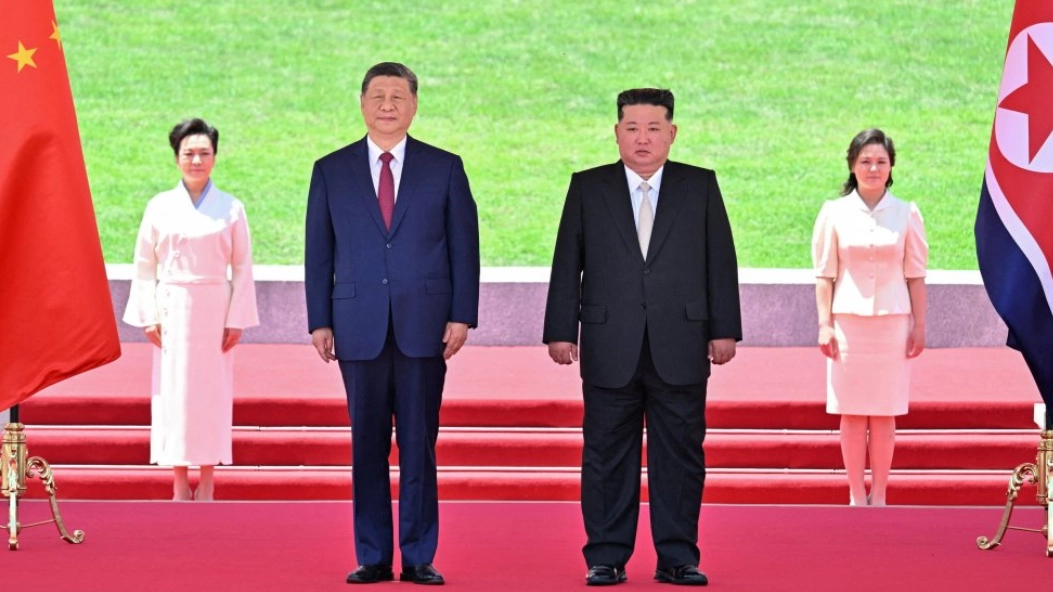

Chinese President Xi Jinping arrived in North Korea on Monday to meet with Kim Jong-un, in a historic visit that marks his first trip to the country in almost seven years.
Xi will remain in Pyongyang from June 8 to 9, following an invitation from the North Korean leader. His last trip to the North Korean capital dates back to 2019.
The meeting comes a few weeks after Xi received US President Donald Trump and Russian President Vladimir Putin in Beijing, two actors with key influence on North Korea's foreign policy.
China is the main economic and political partner of North Korea, a country under severe international sanctions for its nuclear program and allegations of human rights violations.
Both countries share a 1,400 kilometer border and are united by a mutual defense treaty, the only one of its kind that Beijing maintains with another State. The pact provides for reciprocal support in the event of an attack.
This year marks 65 years of that treaty.
For Kim Jong-un, the visit has obvious propaganda value. In recent years, North Korea has sought to strengthen its international position after resisting the pandemic and aligning itself with Russia in the context of the war in Ukraine.
However, despite the close ties he maintains with Pyongyang and Moscow, Xi is cautiously watching the growing rapprochement between Kim Jong-un and Vladimir Putin.
But what is the origin of this historical relationship that has oscillated between closeness and distrust?
A relationship “forged in blood”
For Chinese leader Xi Jinping, North Korea is a neighbor that China can neither control nor lose.
Beijing and Pyongyang often describe their relationship as a friendship “forged in blood,” a reference to the Korean War more than seven decades ago, when China intervened in support of the North.
However, in recent years, mistrust has deteriorated these ties.
Now, Beijing seeks to reassert its influence over a partner it considers strategically indispensable, although also deeply unpredictable.
China needs stability on its southeastern border and wants to maintain the ability to influence North Korea, but without being dragged into the crises caused by the nuclear ambitions of the Kim Jong-un regime.
So Xi's visit to Pyongyang this week is likely to have less to do with the historic friendship between the two countries and more to do with the need to reassert his influence.
South Korea believes that the Chinese president could try to position Beijing as a mediator between North Korea and the United States.
But China might have other goals in mind.
Western diplomatic sources consulted by the BBC indicate that Beijing observes with growing concern the strengthening of ties between Pyongyang and Moscow.
Following Xi's meeting last week with Russian President Vladimir Putin, the Chinese leader may be seeking to ensure he still retains the ability to influence Kim Jong-un, especially as China seeks to expand its role on the international stage.
China seeks to protect its interests
The cooling of relations between Beijing and Pyongyang has been evident, although it has manifested itself in a subtle way.
In October 2024, both countries commemorated the 75th anniversary of the establishment of diplomatic relations without grand gestures or notable celebrations. Public communication was scarce and discreet.
A month earlier, the Chinese ambassador also did not attend the celebrations for the anniversary of the founding of North Korea.
Furthermore, there were no high-level exchanges throughout the year, a stark contrast to the increasingly evident rapprochement between Pyongyang and Moscow.
And it is precisely this growing closeness with Russia that has generated concern in Beijing.
Since Russia's invasion of Ukraine, North Korea has deepened its military cooperation with Russian President Vladimir Putin.
That relationship reached a new level with the signing of a mutual defense pact during Putin's visit to Pyongyang in 2024.
According to a BBC investigation, some 2,300 North Korean soldiers have died fighting alongside Russian forces in Ukraine.
Pyongyang has also been accused of supplying ammunition for war in exchange for oil and economic assistance, a dynamic that has raised alarm bells in Washington and among its allies, and which China views with growing concern.
“China wants to ensure that its interests in North Korea remain protected at a time of rapid convergence between Moscow and Pyongyang,” says Ankit Panda, a nuclear policy expert at the Carnegie Endowment for International Peace.
China only maintains a formal defense treaty with this country, so it is difficult to imagine that Beijing would welcome a scenario in which Russia becomes the main influence on Pyongyang.
A more self-confident Kim Jong-un and less dependent on China would inevitably imply a reduction in Beijing's ability to influence.
Faced with this situation, China has tried to rebuild the relationship.
Late last year, Xi Jinping invited Kim to a military parade in Beijing and reserved a prominent place for him alongside Russian President Vladimir Putin.
It was the first formal summit between these leaders in six years.
Xi described China and North Korea as “good neighbors, good friends and good comrades united by a shared destiny,” and called for closer strategic coordination.
However, in the public statements the absence of any reference to the North Korean nuclear arsenal was striking.
The pragmatism of the partners
According to Lee Seong-hyon, a visiting scholar at Harvard University's Asia Center, Beijing has "mixed feelings" about strengthening ties between Pyongyang and Moscow.
On the one hand, this alliance is convenient for China because it forces Washington to distribute its attention and complicates its strategy on several fronts.
But at the same time, an even closer military rapprochement between Russia and North Korea could spur closer cooperation between the United States, Japan and South Korea, a possibility that Beijing views with concern.
This same logic explains Beijing's ambivalent position regarding the North Korean nuclear program.
China does not support Pyongyang's development of nuclear weapons, as it believes this strengthens the US military presence in the region and strengthens cooperation between Washington and its allies.
However, it is also not willing to openly pressure the North Korean regime.
In 2022, China and Russia vetoed a US-sponsored resolution in the UN Security Council that sought to impose new sanctions in response to North Korea's missile tests.
“If China adopted a tough stance against the North Korean nuclear program, it would only push North Korea even further into Putin's arms,” says Victor Cha, president of the Foreign Policy area at the Center for Strategic and International Studies.
For his part, Kim also cannot afford to put his relationship with his main breadwinner at risk.
Chinese exports to North Korea reached $2.3 billion last year, their highest level in six years.
In addition, passenger rail service between Beijing and Pyongyang, suspended since the pandemic, resumed at the beginning of this year.
According to analysts, these gestures are part of a calculated strategy by China to draw North Korea back into its sphere of influence.
For Kim, maintaining balance is also a matter of pragmatism.
If the war in Ukraine comes to an end, Moscow's need for North Korean support could diminish.
And while Vladimir Putin remains relatively isolated on the international stage, Xi Jinping continues to host leaders from around the world in Beijing.
In this context, the North Korean leader has reasons to avoid excessive dependence on a partner whose weight and influence could weaken over time.
A relationship marked by tensions
But the relationship between both leaders has always been marked by tensions.
Upon assuming power, Kim Jong-un made it clear that his priorities differed from those of his father.
While Kim Jong-il cultivated a close relationship with China and visited the country on numerous occasions, his son opted to accelerate North Korea's nuclear and weapons development.
During his first six years in power, he oversaw about 90 ballistic missile tests and four nuclear tests, more than his father and grandfather combined.
The escalation began to worry Chinese authorities.
The execution in 2013 of Jang Song Thaek, Kim's uncle and considered by China a moderate figure within the regime, only aggravated the rift.
Xi responded with a rare show of diplomatic discontent. In 2014, he visited South Korea before meeting the North Korean leader, a gesture widely interpreted as a snub to Pyongyang.
The answer did not take long to arrive. North Korea even accused China of being a “traitor” and “enemy” nation.
The turning point came in 2018. When international sanctions began to hit the North Korean economy, Kim Jong-un undertook his first public trip abroad since coming to power. Aboard his trademark armored train, he headed to Beijing to meet with Xi.
That meeting marked the beginning of a cautious approach.
In the following months, Kim Jong-un met with leaders of the US and South Korea, but only after consulting with China beforehand.
The message was unequivocal: Pyongyang was willing to negotiate, but not to do so without Beijing's support.
Today, North Korea remains both a strategic asset and a constant source of problems for China.
It acts as a buffer against the US military presence in the region, but its weapons tests and periodic provocations fuel the instability that Beijing says it wants to avoid.
Meanwhile, Kim Jong-un seeks to maintain China's protection without being subject to its influence.
Mutual distrust persists. For now, however, both sides remain convinced that they need each other more than they would like to admit. And that, at least for now, is enough to keep the relationship alive.
With reporting by Laura Bicker and additional information by Kelly Ng.