

The fastest plant in the world: a car every 10 seconds
South Korea is home to the largest and fastest car plant on the planet: Ulsan, the Hyundai industrial complex capable of producing 1,500,000 vehicles per year
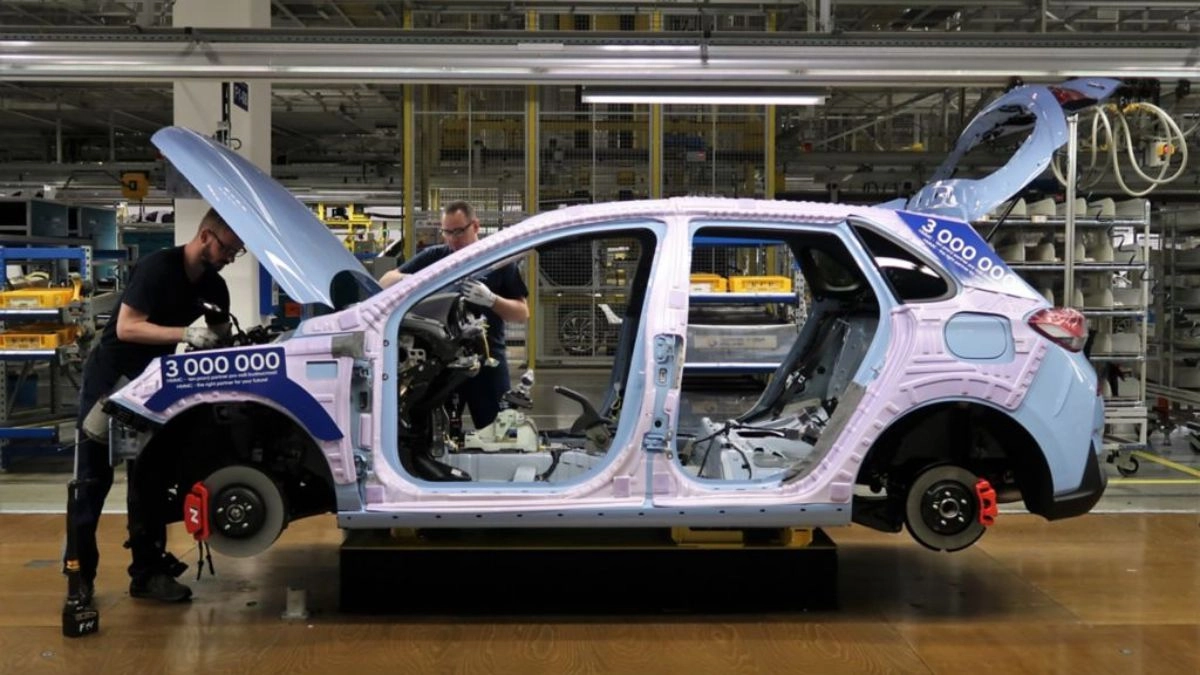

When we talk about speed in the automotive industry, the first thought that usually comes to mind is related to powerful engines, circuit timers, or acceleration records.
Also read: Tesla faces doubts after the massive sale of shares
However, the real long-distance race is not over not on the tracks, but on the production floors. In that field, a facility located in South Korea has achieved what seemed impossible: manufacturing a car every 10 seconds.
You can read: Lamborghini reveals the Fenomeno, a luxury of only 29 units
The feat corresponds to neither Tesla, nor Xiaomi, nor any of the Chinese brands that have gained prominence in the last decade. The record belongs to Hyundai, through its gigantic Ulsan complex, considered not only the largest car factory in the world, but also the most efficient.
There, the combination of engineering, automation, and large-scale logistics has made it possible to reach an annual production of 1,500,000 vehicles, easily surpassing historical competitors such as Toyota, Volkswagen, or General Motors.
An industrial city with its own port
The Ulsan complex is not simply a factory: it is practically a city within a city. It spans over 5.5 million square meters, the size of more than 500 soccer fields.
Five autonomous plants, an engine and transmission production center, and even its own seaport that connects directly to international export routes operate within its boundaries.
This port is key to Hyundai's global strategy: around 75% of the cars produced in Ulsan are shipped abroad.
Cargo ships, such as the 380-meter-long Morning Christina, which can carry 6,000 units in a single trip, depart for destinations as far away as California. The port's proximity to the assembly lines reduces logistics times and costs, consolidating the company's efficiency model.
The world's fastest plant
What sets Ulsan apart from any other facility is not only its size, but its speed. Every 10 seconds, a fully assembled car leaves the production line. Multiply that pace by the 18 hours of operation per day, and the result is an unstoppable flow of vehicles that surpasses anything known in the industry.
The comparison shows that the South Korean complex is not only a leader in volume, but also in efficiency and speed.
Flexibility and diversity in production
One of Ulsan's most notable strengths is its ability to adapt to different models and market segments. Currently, 17 different vehicles are assembled there, including bestsellers such as the Hyundai Tucson, the Santa Fe, and models from the premium Genesis brand.
Furthermore, the complex is not limited to combustion vehicles. In recent years, the company has stepped up production of electric and plug-in hybrid vehicles, such as the Hyundai Ioniq 5 and the Kia EV6.
In fact, a sixth plant within the complex, specializing exclusively in electric vehicles, is scheduled to open in 2026. Its first major project will be the Genesis GV90, a luxury SUV that will mark Hyundai's commitment to the premium segment of sustainable mobility.
The strength of electric vehicles
The global electric vehicle market has changed the automotive landscape. Hyundai and Kia, which are part of the same conglomerate, sold more than 600,000 electric units in 2024, a figure that brings them closer to leaders Tesla and BYD.
This growth is no coincidence. Hyundai's strategy has been clear: accelerate the electrification of its portfolio, take advantage of Ulsan's production scale, and optimize costs without sacrificing quality.
Thanks to this, the brand has managed not only to position itself in the global market, but also to compete in higher value-added segments, such as premium electric vehicles.
Technology and automation at the service of efficiency
Behind Ulsan's impressive numbers lies a choreography of advanced technology and specialized labor.
State-of-the-art robots perform welding and assembly tasks, while artificial intelligence-based systems monitor each phase of the process. These algorithms detect faults in real time, preventing them from reaching the final stage and minimizing production rejects.
The hybrid model—high-precision automation combined with human expertise—has become a standard that allows high levels of quality to be maintained without losing the dizzying pace of a car every 10 seconds.
A benchmark for the competition
The Ulsan plant not only sets a speed record, but also redefines the parameters of the industry. At a time when the transition to electric mobility marks the global agenda, Hyundai's ability to mass produce efficiently gives the brand a strategic advantage.
While Tesla remains the benchmark in innovation and BYD in the volume of electric cars, Hyundai has achieved a rare balance: large production scale, model diversification, and an efficient logistics network that allows it to reach every corner of the world.
Hyundai's challenge is not only to maintain its position, but to expand it in a market where competition is relentless.
The company has announced multi-million-dollar investments in new electric production lines and more advanced battery technologies, with the aim of consolidating Ulsan as the world capital of sustainable mobility.