

Facts of the week in immigration: another death of an immigrant at the hands of ICE
Violence in ICE operations, new immigration rules and complaints of abuse marked another week in the US.
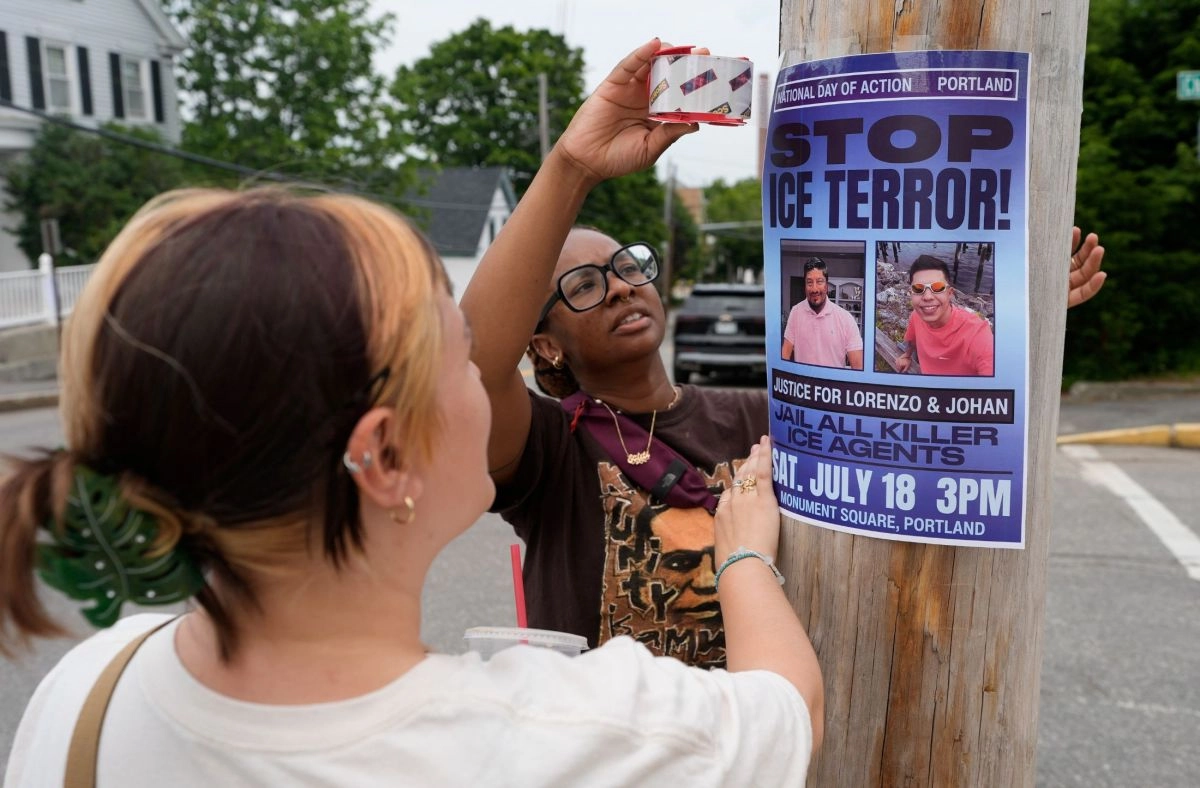

This week opened with the tragic shooting death of 25-year-old Colombian immigrant Joan Sebastián Durán Guerrero at the hands of an Immigration and Customs Enforcement (ICE) agent in Biddeford, Maine, just six days after the death of Lorenzo Salgado Araujo in Houston, Texas, on July 7, also by an ICE agent.
The deaths of two Latino workers and parents have generated vigils and demonstrations across the country calling for independent investigations that result in the accountability of those responsible for the deaths and for the violence that characterizes the immigration operations of Donald Trump's government.
Joan Sebastián Durán Guerrero, like Lorenzo Salgado Araujo, was intercepted by immigration agents while driving to work and was shot in his car.
The Department of Homeland Security (DHS) alleges that the immigration agent shot Joan Sebastián for reasons of “public safety.” In the case of Salgado Araujo, the agency argued that the agent fired in “self-defense” because the immigrant allegedly used his vehicle “as a weapon” to run him over. The three witnesses who were traveling in Lorenzo's truck, and who are detained by ICE, refute this version and assure that the agent's life was never in danger.
Now the government is even trying to justify the intervention with Salgado Araujo by alleging that there was an order to search the truck for suspected presence of narcotics, La Opinión reported.
“One of the aspects that caught the most attention is that the court order does not use as its main basis the alleged attack against federal agents announced days before by ICE, but rather the possible presence of narcotics,” the newspaper wrote.
“KHOU 11 Legal Analyst Carmen Roe found it unusual that the document was made public so early in the investigation,” the article says. “It seems like an attempt by the government to reinterpret the situation that we all saw unfold,” said Roe, who “questioned that the FBI would dedicate resources to a possible drug possession when there is still an open investigation into the shooting.”
La Opinión also highlighted an article from The Atlantic that states that the agent who shot Joan Sebastián was a new recruit who previously worked as a police officer for the Department of Veterans Affairs.
And the Trump government has imposed a quota of 2,000 daily arrests and for that it needs more agents and more space to lock up the detainees.
According to The Atlantic, "the agency added nearly 8,000 new officers over the past few months. As part of that process, some received reduced training before hitting the streets."
With these two deaths, there are now 11 people who have been shot dead by immigration agents since Trump took office for his second term in January 2025.
Vehicle detention will continue
After the deaths of Salgado Araujo and Joan Sebastián, the Trump administration indicated that it would temporarily stop traffic stops to “retrain” officers, but the next day the president himself backed down.
“We cannot give up one of ICE's most important and effective crime-fighting tools, traffic stops!” the president wrote on his Truth Social platform.
Another detail is that in both incidents the agents were not wearing body cameras despite having $20 million at their disposal to purchase them.
La Opinion wrote that after the shootings, ICE ordered the use of cameras by arrest teams.
“Ensuring that all of our ICE agents have body cameras throughout the country is a top priority for DHS,” according to a press release cited by La Opinión.
“Cemetery of living people”: HRW report
As the debate over the use of lethal force by ICE intensifies, Human Rights Watch (HRW) and the American Civil Liberties Union (ACLU) presented a report on mistreatment at the Camp East Montana detention center, on the grounds of the Fort Bliss military base, in El Paso, Texas, wrote EFE, via La Opinión.
The report denounces “beatings, medical negligence, prolonged isolation, unsanitary conditions, and there have been deaths.”
The groups maintain that “the documented abuses constitute cruel, inhuman or degrading treatment and qualify the death of (detainee) Lunas Campos as an “extrajudicial execution” in accordance with international law.”
"The organization interviewed 71 people who were detained in the center, all from twelve countries in Latin America and the Caribbean. Most of them (64) reported having been beaten or having witnessed beatings against other detainees by the center's guards," the article says.
“Lunas Campos, father of four children, was one of the three immigrants killed at Camp East Montana in the last six months and one of the 50 who have died in ICE custody since Donald Trump's return to the White House: 31 in 2025 and another 19 so far in 2026, according to data from the organization Detention Watch Network,” the article adds.
Government proposes stricter “public charge” rule
Meanwhile, La Opinión reported that “President Donald Trump's administration will once again apply a stricter interpretation of the so-called public charge test, a criterion that will allow the Department of Homeland Security (DHS) to consider whether some immigrants used programs financed with public resources, such as Medicaid, food stamps (SNAP) or housing assistance, when deciding whether they can obtain a Green Card.”
"Specialists consider that the greatest impact could be indirect. The department itself estimates that nearly 950,000 people belonging to immigrant households could stop applying for public benefits for fear that this will affect their chances of obtaining permanent residence," the article adds.
Likewise, the State Department is considering imposing a bond of $100,000 on green card applicants.
La Opinión reported that "through a statement addressed to the newspaper The Hill, Tommy Pigott, spokesperson for the Department of State (DOS), pointed out that, with the objective of guaranteeing that immigrants are "financially self-sufficient", a proposal is being evaluated to require a deposit from them to demonstrate that, instead of being projected as a financial burden for the government, their presence in the country can mean a contribution when undertaking a project."
Trump already tried to apply the same deposit to H-1B visa applicants, but ultimately backed down. This new attempt can be interpreted as another effort to stop authorized immigration by his government.
Quote of the week
"A gun is not a license to kill. These agents do not have to draw their weapons. They are not judge, jury or executioner, and they do not have the right to kill people like they are doing," Katie, a 48-year-old teacher from New Hampshire, told Mother Jones, reacting to the death of Joan Sebastián Durán Guerrero in Biddeford, Maine, at the hands of an ICE agent.