

How much Petro transformed Colombia, “the president of change” who risks his legacy even if he cannot be re-elected
Four years after achieving the presidency, BBC Mundo takes stock of what changed in Gustavo Petro's Colombia
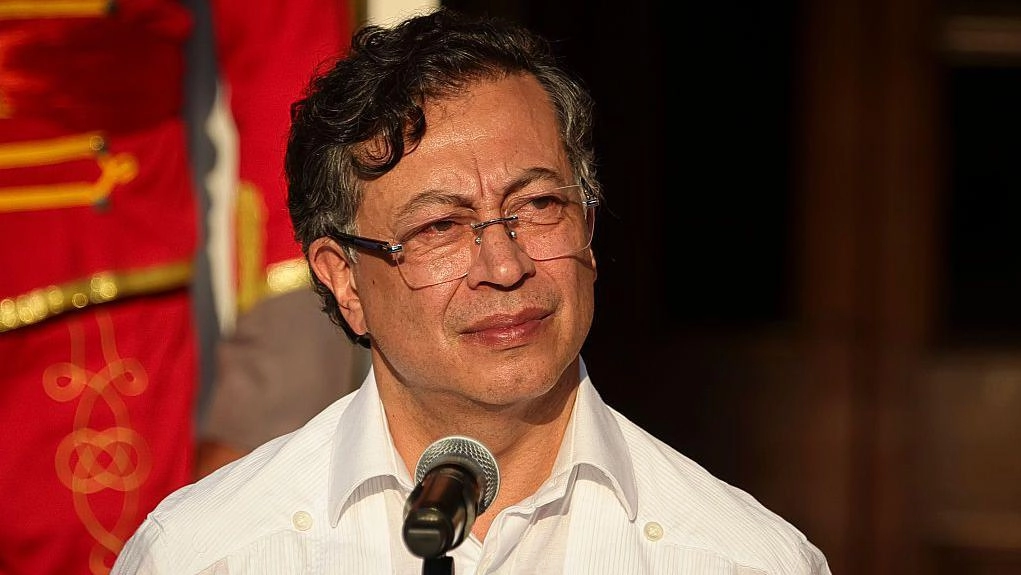

Gustavo Petro will not be in the runoff on June 21, when millions of voters choose his successor between the left-wing philosopher Iván Cepeda and the right-wing lawyer Abelardo de la Espriella.
The Colombian Constitution does not allow re-election, but the current president has a lot at stake that day.
In Colombia, it is perceived that the first progressive president in its modern history submits to a verdict on his management in the elections.
This promoted an ambitious agenda of change that included health, labor, educational, economic, agrarian, environmental, security and peace reforms.
Almost four years after taking office, several promises remained incomplete. Some due to the opposition of Congress. Others due to lack of time. Some, perhaps, crushed by their own expectations.
But even among the most skeptical there is a feeling that the country did change in these four years. Whether it was for better or worse is something that Colombians will decide at the polls.
Cepeda, from Petro's party, Historical Pact, promises to continue his transformative agenda.
De la Espriella, a staunch critic of the president, proposes almost dismantling it.
The legacy of the so-called “president of change” is being tested.
How has he transformed the country since coming to power in 2022?
Colombia from within
Petro came to office a year and a few months after the social outbreak considered the most important in Colombian history.
Tens of thousands of people initially protested against a controversial tax reform proposed by Iván Duque's government, but the demands expanded to demand more social justice, equal opportunities and a change in the economic model.
The violence in the protests and the response of the authorities marked those events that began in 2019 and reached their most critical point in early 2021.
Police and military repression included homicides, eye injuries, arbitrary detentions, violence based on gender and race, reports of disappearances, and harassment of the press.
Such episodes have been frequent in the history of Colombia, marked by serious waves of political and civil violence.
For the Colombian philosopher Óscar Guardiola-Rivera, one of Petro's greatest changes was evident in “the decoupling between the interests of the State and the more and less formal forms of violence exercised on its citizens.”
The president reformed the Mobile Anti-Riot Squad (ESMAD) of the police with a new model called the Dialogue and Maintenance of Order Unit that, according to the institution, “replaces the reactive approach with a preventive one, focused on respect for human rights and the use of assertive communication to de-escalate tensions.”
It was not the only transformation at the national level.
Laura Bonilla, deputy director of the Pares Foundation, highlights that with Petro it also changed that only “certain circles of society, very elite and only white, mostly held public positions.”
"For the first time, people were able to see more people like them in the State. For example, black people in the Ministry of the Interior. That creates a bond of recognition, especially among many popular sectors. I think that is the greatest cultural and symbolic transformation of the government," adds the analyst.
Similarly, in the country there was a noticeable change in the conversation.
From security and the fight against drugs dominating the agenda, a large part of society began to debate their labor rights, their health system, their pensions and the environment.
This is evident in the fact that, despite Petro's four years, which also show wear and tear, his successor in the project, Cepeda, managed to gather more than 40% of votes in the first round with an agenda based on the same path of change and social progress.
On the other hand, his rival De la Espriella arrives as a favorite in the second round with 43% of the ballots with a radical speech focused mainly on security.
Under Petro, in addition, the trend of the last five years in the reduction of monetary poverty was consolidated, reaching 28% of the Colombian population, and an unemployment rate of 8% reached in 2026, the lowest in two decades.
Colombia out
Sandra Borda, a specialist in foreign relations at the Universidad de los Andes, maintains that another of Petro's big changes was in foreign policy.
He points out that the president moved away from Colombia's traditional position, close to Israel and the US, to adopt a critical position that included the breaking of relations with the Israeli government due to the war in Gaza and tensions with Washington since the arrival of Donald Trump.
It also highlights the environmental emphasis: “it is the first government to invest so much in this issue.”
This has served, in his opinion, to project a more constructive foreign policy.
Unlike the past, Borda compares, when Colombia seemed to attract international attention for being the “eye of the hurricane where all evils converge, it is positive that the environmental issue has been placed at the service of international consensus.”
Petro promoted the independence of extractive economies in the country and has sought to lead that debate at a global level.
Borda's doubt is whether these legacies will last or be reversed, becoming tied to the president's “personalism” and his post-presidential career.
De la Espriella, Petro's political antagonist, has already announced that he will seek more cooperation with Israel and the US and that he intends to encourage Colombia's mining and energy potential.
To this end, it has not ruled out using practices such as fracking, questioned by environmentalists for its environmental impact.
Petro's debts
Petro reaches the final stretch of his mandate with three approved reforms: one tax, one pension and one labor.
The labor and pension initiatives arrived in one of the most unequal countries in the world, with 55% informality and one of the least productive economies in the world, according to the OECD.
Labor increased surcharges for overtime and rest days for workers, limited the prolonged use of permanent contracts and formalized the jobs of thousands of community mothers and children's home workers.
The pension expanded coverage for millions of retirees and modified the distribution of resources by transferring a large part to a public fund and taking weight away from private funds.
Even so, both were questioned. The first barely solved the serious problem of informality. The second raised doubts about its long-term financial sustainability in a population that is aging at worrying rates. The Supreme Court, in fact, keeps it partially suspended.
But the big stone in Petro's side was health reform.
Not only was it rejected in Congress, but in the midst of decrees and interventions by private entities by the president, a system that was already facing challenges has suffered delays in appointments, shortages of medicines, debts and an increase in patient complaints.
In contrast, the government also made progress on the agrarian level, a historical debt of the country.
Colombia has one of the most unequal land distributions in the world. According to the Agustín Codazzi Geographic Institute, 1% of landowners own almost half of the rural area of private land.
During the Petro government, at least two and a half million hectares were managed for purposes such as delivering them to peasant families, formalizing them and expanding territories for traditionally excluded populations such as indigenous and Afro-Colombian people.
This agrarian reform has improved the lives of thousands of families, but the distribution problem in the Colombian countryside is still far from being completely resolved.
Finally, Petro's government was not immune to questions due to cases of corruption that plagued it.
Among them is the process against his son, Nicolás Petro, for alleged illicit enrichment and money laundering, as well as the scandal in the National Unit for Disaster Risk Management.
In this, former administration officials are investigated for their alleged participation in a scheme to divert public resources that would have served to bribe congressmen in exchange for support for government reforms.
Both cases are being investigated, but the noise around them has clashed with the anti-corruption discourse that Petro maintained during his career as a congressman and, later, during his presidential campaign.
Total peace, great frustration
Few Petro proposals generated more expectations than the so-called “total peace.”
In this, the president sought a simultaneous dialogue with armed groups to achieve a peace that resists more than 60 years after the birth of the first guerrillas and a decade after the agreement was signed between the government and the FARC to demobilize their insurgents.
Almost at the end of the mandate, the policy did not meet expectations.
The country has suffered repeated security crises in areas linked to drug trafficking such as Catatumbo and Cauca and a presidential candidate, Miguel Uribe Turbay, was murdered in 2025, bringing back memories of the worst times of political violence in Colombia.
In addition, the majority of armed groups continued to strengthen in a trend that began in 2018 and conversations with powerful actors such as the ELN and FARC dissidents such as the EMC and the Second Marquetalia are suspended.
Analysts also agree on other lessons.
“Global strategies were lacking for each table, the peace and security policy clashed, the victims had little prominence and the laying down of weapons was unclear,” exemplifies Conflict Responses (CORE), a foundation that studies and combats misinformation about armed conflicts and peacebuilding.
However, not everything is black and white.
At CORE they believe that the ceasefires achieved at the beginning of the legislature weakened some groups and that there were reductions in violence in some cases.
The foundation adds that progress was made in agreements for territorial transformations, land titling, destruction of weapons, search for missing persons and replacement of coca with other crops.
Although experts defend that the setbacks in security are not a primary consequence of “total peace,” this frustration, like other pending accounts and transformations achieved by Petrism, will weigh on the voter.
Millions of Colombians will decide whether to give a second chance to the change proposed by Petro and Cepeda or take a 180-degree turn towards the position of De la Espriella, who proposes reversing several policies of this government with a conservative and heavy-handed agenda.