

How violence was transformed in Colombia and why it continues to define the elections
At one point it seemed that Colombia had turned the page on violence, but this Sunday's elections showed that there is still much to be resolved
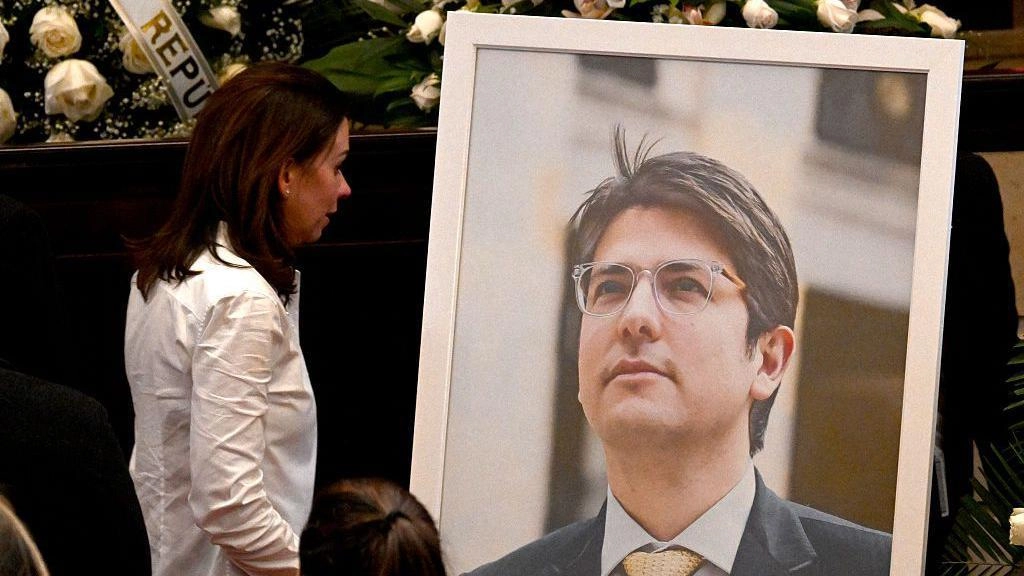

The day they attacked presidential candidate Miguel Uribe Turbay, a rising figure on the right who was only 39 years old, Colombians had déjà vu. “We returned to the past,” many thought.
Uribe's death—in August 2025, two months after the attack—was a bucket of cold water for a nation that seemed to have overcome the worst moments of the war, the 80s and 90s, when assassinations, bombs and kidnappings were a matter of routine.
Colombia no longer has an armed conflict that threatens its democracy or homicide figures that make it the most violent country in the world, as happened 30 years ago.
Even with its problems, the signing in 2016 of the peace agreement between the State and the largest guerrilla of the moment, the FARC, meant an evolution: the opening of an era in which issues such as pensions, inequality or the environment began to lead the ranking of priorities.
And so it was. In 2022, after a social outbreak that showed the will for change, former guerrilla Gustavo Petro won the presidency. It was the first time in two centuries that a popular leftist movement came to power.
Some might have thought that the page on violence was being turned.
But it wasn't like that. During his four years in office, Petro has wanted to negotiate the demobilization of the various armed groups that still operate in the country. He called it “Total Peace”, an ambitious initiative to reach agreements with everyone, despite the notable differences that existed between them: there are drug traffickers, extortionists, ex-guerrillas, ex-paramilitaries and a long etcetera of variants that are chaotically juxtaposed.
Violence in Colombia, although it decreased after 2016, did not stop, but rather transformed, fragmented, and became disordered.
The assassination of Uribe Turbay – whose mastermind the Prosecutor's Office attributes to one of the FARC dissidents, the Second Marquetalia – is not the most talked about issue of the presidential campaign, but, seen from now, on the eve of this Sunday's elections, it did set the tone of the contest.
Colombians seem moved by fear more than any other aspect: insecurity, according to various surveys, was once again the issue that worries them most ahead of the election.
More than a debate about ideas, the campaign was an avalanche of accusations about the lethal dangers posed by the opponent.
Colombia refuses to turn the page on violence.
Candidates marked by conflict
Perhaps the best proof of this is the profile and speech with which the candidates present themselves with options to win or go to the second round, which would be on June 21.
All, in fact, have reported having been threatened during the campaign.
And the Ombudsman's Office issued alerts about armed proselytism by illegal groups that seek to condition the vote of communities and limit the freedom of voters.
None of the candidates, according to the experts consulted, seems to have a convincing recipe for resolving the violence.
Iván Cepeda, the ruling party's candidate, is a veteran congressman who has made a career as a representative of victims and in search of peaceful solutions to violence. He is one of the authors of Total Peace. The murder of his father, a communist leader, in 1994 marked his career.
And he is, symbolically, the antithesis of Álvaro Uribe, the former president who cornered the guerrillas with a strong hand between 2002 and 2010.
If for some a Cepeda presidency would be a historic vindication for the victims, for others it would be the consolidation of a communist regime that would give concessions to criminals.
Then there is Paloma Valencia, a member of a powerful family, heir to a political class that for many is responsible for the political persecution of the left. And she is the candidate of Uribe, her “political father.”
If some see it as an option to return to order after Petro's "chaos", for others their government would repeat, for example, the "false positives", the extrajudicial executions of civilians who reported themselves as guerrillas.
There is a third and new candidate with a chance of winning: Abelardo de la Espriella, a lawyer who represented criminals and controversial politicians and who appeals to the population, especially older and male, skeptical of institutions and interested in gimmicky solutions.
If some see it as a root solution with its “iron fist” policy, others believe that it would be the end of the rule of law.
So, Colombians go to the polls with a multiplicity of options. They all represent a different way of seeing the problem of insecurity and violence, which is the same as a way of seeing the country.
The fact that centrist options, such as the candidacies of Sergio Fajardo and Claudia López, have little chance of winning is evidence that Colombians are not interested in more moderate visions.
Fear, it seems, makes them think that categorical positions are needed.
How violence transformed
Colombian violence today, although it is less than that of the past, has more diverse and regional causes. Each type of conflict requires a particular, local, contextualized solution.
If signing an agreement with the largest and oldest guerrilla was complex—it took 10 years and its results are mixed—it is likely that finding solutions to the multiple armed groups that filled the gaps left by the extinct guerrilla will be even more difficult.
María Victoria Llorente, director of the Ideas for Peace Foundation (FIP), explains that in the last decade the Colombian scene “became Mexicanized,” in the sense that “armed groups proliferated without political cause, interested in the criminal governance of strategic territories.”
Among experts there is a heated technical and political debate about whether the transformation and increase in violence during the last four years are a consequence of the Total Peace.
Although the trend emerged during the previous government of Iván Duque, analysts agree that the problems of the Total Peace fostered a strengthening of armed groups.
For example: according to the FIP, the Clan del Golfo, the largest armed group today, went from having 4,000 members in 2022 to almost 10,000 in 2025, despite the military blows it received.
“There were no pre-established red lines,” says Kyle Johnson, director of Conflict Responses, a think tank. “The dialogue tables did not set limits or consequences for the groups and gave them a wide margin in the territory.”
Jorge Restrepo, director of the Resource Center for Conflict Analysis (CERAC), adds: “The government granted the will for peace to criminal groups that by definition do not have it.”
According to surveys, between 10 and 20% of Colombians believe that Total Peace is on the right track and between 60 and 70% feel more insecure with this policy.
Colombians see security as a priority, they hold Petro partially responsible for their deterioration, and yet, Cepeda, one of the precursors of Total Peace, is the favorite to win.
And that is in part because many Colombians do not blame Petro—but rather his predecessors—for the insecurity; They give more importance to social advances and celebrate measures that sought to address the causes of violence, such as the delivery of land to peasants, the reduction of poverty and reparation to victims.
The effect on the elections
To the Colombian broth, to this multiplicity of elements that are complex to understand and solve, we add that common crime in cities has continued to be a problem for the majority.
Gustavo Duncan, an economist who is an expert on conflict and author of several books on the subject, says that “violence has changed and is much less than before, but people are especially bothered by local crime and extortion.”
According to CERAC, 70% of homicides, which increased slightly during Petro's mandate, occur due to confrontations between criminals. Extortion increased fivefold and kidnapping tripled.
“People do not associate Total Peace with daily insecurity because they understand that the group that extorts in their neighborhood is not the same group with which the government dialogues,” says Restrepo.
And Juan Fernando Giraldo, political scientist and director of buho Clarity, a think tank, states: “The fact that Cepeda has an advantage shows that Total Peace is not a consideration for his voters (…) The competition to govern is not at stake, but rather the ability to represent political and class identity.”
For all candidates, security is one of their main cards: Cepeda proposes continuing with Total Peace but strengthening the social transformation of each affected region; Valencia hopes to strengthen the army in search of recovering territory controlled by the State in a reissue of Uribe's Democratic Security; and De la Espriella — who appears at rallies wearing a bulletproof vest and armored glass — wants to build prisons, use intelligence and break off dialogue with groups that fail to comply in a recipe in the style of Nayib Bukele, the president of El Salvador.
For the analysts consulted, who respond to different political affiliations, there is consensus that none of the candidates is thinking of new formulas for new problems.
Restrepo says that “none of the three has a chance of Colombia being a safe country in the next 4 years”; Duncan points out that “none of the candidates propose a change in security doctrine, a post-conflict army that knows how to confront the new existing groups”; and Johnson assures that “the strategies are the same as always, the same ones that we know do not work.”
Violence in Colombia has transformed, but the way politicians seek to reduce it has not.
“Scenarios are being mixed,” says Llorente. "In a campaign of fear, you have one part of the country (the left) afraid that the political persecution of before will return; another part (the right) afraid that private property will end and we will become Venezuela; and another part afraid that they will be robbed on the corner of their house."
"They are all genuine fears, but none of them respond to complete reality; we have very fresh political violence, the murder of Miguel Uribe awakened a ghost in us, and we read what happens with those eyes," he concludes.
What Colombia changed is more than what the mentalities of Colombians changed. The wound of violence is open. And from there they will vote for their next president.