

Hoppers: The film where Pixar dared to break its own rules
The director of We Bare Bears brought the pace of television to Pixar. We visited Emeryville to discover how Hoppers breaks the studio's formula
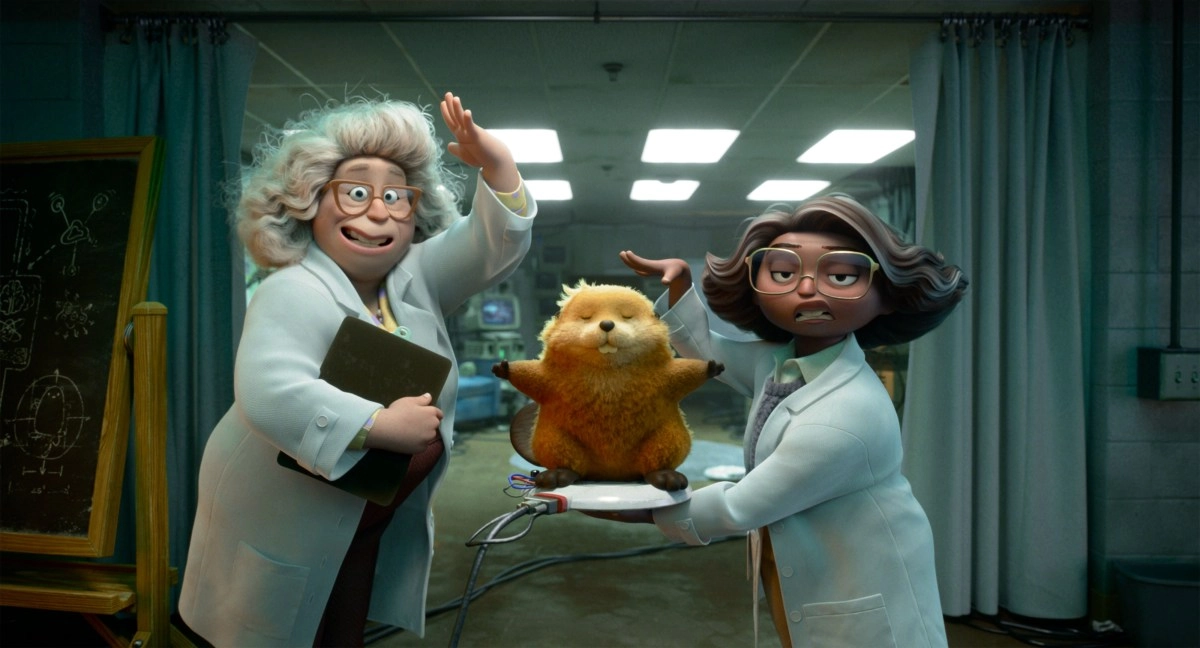

“Hoppers,” which arrives in theaters on March 6, 2026, tells the story of Mabel, a 19-year-old obsessed with animals who discovers a revolutionary technology: robotic bodies that allow her to transfer her mind into different animals. His mission is to infiltrate the animal world to convince the beavers to save a pond, a space he shared with his grandmother, from the real estate greed that the mayor (Jon Hamm) wants to destroy.
It sounds like a standard Pixar premise. Mission Impossible. An underground world to discover. An animal society with its own rules.
But Hoppers is not a standard Pixar film.
The director who came from television
Daniel Chong created “We Bare Bears” for Cartoon Network. He produced 140 episodes of that series. It was almost five years of weekly writing, figuring out how to tell stories in 22 minutes, mastering the timing of television comedy, and experimenting at a speed that requires mental agility and mastery. When Chong first arrived at Pixar as a feature film director, he brought exactly that: the mental speed of television. “I think I came in with a very strong obsession to make a funny movie,” Chong explained during the press presentation at Pixar Studios in mid-January. “Everyone says a Pixar movie makes you cry. That’s true. But for me, a Pixar movie is about characters, comedic characters that are genuinely entertaining and that you invest in.”
What was interesting was what he added next: “In television, you make 140 episodes; inevitably, you’re doing a lot of different genres. You’re parodying different movies. When I came to Pixar, I wanted to bring that: different tones, genres, weirdness, surrealism, but also shocking things and action.”
That was the gamble. That Pixar would let someone from television in to contaminate the process with television energy. That a studio built on deep emotional storytelling would allow someone to say:“I want to make the timing of the comedy everything.”
Beavers were the unexpected heroes
“I originally pitched penguins,” Chong acknowledged at the press conference. “The idea was that penguins were disappearing. They traveled to the Arctic to investigate what was happening. They infiltrated penguinguin society. Part of the joke was that there are so many penguins that you’re looking for suspects and clues—an element of mystery.”
The concept was going to be global. A Mission: Impossible-type movie. Spies in the Arctic.
But something changed during the pandemic. Pixar worked with Damon Lindelof, creator of Lost, in a creative development session. Nicole Grindle, the producer, recalled that moment: “Damon was very emphatic. He said, ‘The movie is too big. Just do it in a local area. That’s going to simplify everything.’”
He was right. The penguins were shelved.
“It didn’t die because of that,” Chong explained. “It died because there are too many penguin movies.”
But the change was deeper than simply changing species. By narrowing the geographic scope, Pixar allowed Chong to delve deeper. The Glade became a specific place. The beavers ceased to be mere supporting characters and became a complex society. The film gained specificity.
When the team had to relearn
On January 14, I was at Pixar Studios. I spoke with animators who have been with the studio for over a decade. They all said something similar: Hoppers forced them to rethink how they animate.
Luis Uribe Cordoba celebrates 11 years at Pixar this year. He has worked on “Elementary,” “Luca,” and “The Good Dinosaur,” to name a few. He knows the Pixar system like few others. But on Hoppers, he had to become a student again.
“Animators are like actors in the film,” Uribe explains in one of the studio's workrooms. “The director gives you a kickoff and explains what they need in each scene. On 'Hoppers,' for example, with King George, we needed him to convey power and emotion in every movement.”
The problem: animating quadrupeds.
“Animating a quadruped is always incredibly complicated,” Uribe says. “When you're bipedal, you just look in the mirror. But with a quadruped, you really have to study reference videos, see all the details of the body mechanics.”
The beaver's flat, heavy tail. The hind legs doing all the work when it swims. The particular weight of a large head on a bulky body. Pixar brought in an animal behavior expert. The team spent weeks studying just that.
“It was hard work,” Uribe recalls. “We spent months understanding it.The director had to adapt to how we do things here, and we had to adapt to his vision.”
The result? A team that saw things differently. Uribe and his colleagues animated beavers and, in the process, discovered a new visual language within the Pixar language.
Part of that came from looking back. “We were very inspired by 2D techniques,” Uribe explains. “We watched a lot of the show that Daniel had done outside the studio. We reached a point where we met.” He liked what we were doing, and what you see on screen is what ended up here.”
The Research Nobody Sees
Gaston Ugarte has been an art director at Pixar since 1997. He worked on “WALL-E,” “Coco,” and “Luca.” At Hoppers, he designed iconic spaces: the Super Lodge (the beavers’ fortress), the lab, the university, and the town.
His work begins with an obsession for research.
“The hardest part was the research,” Ugarte says during our conversation at Pixar. “We traveled to Colorado to examine the beavers’ habitats.”
But the crucial thing is this: Pixar didn’t just hire a documentary filmmaker or ask their team to download images from Getty. What they did was go directly to Colorado.
“Beavers are super shy animals,” he explains. “They’re always hiding. They’re nocturnal.” When we went to do our research, the hardest part was finding a real beaver to observe.”
That’s Pixar. A studio that sends its art team out at night in Colorado to look for nocturnal beavers. Because visual authenticity doesn’t come from the internet. It comes from seeing with your own eyes.
The team also visited the Oakland Zoo. They were out in the field, studying real-life situations, then translating that into the Super Lodge, that architecturally complex water maze that is one of the film’s most memorable spaces.
“Our job is to recreate everything that isn’t a character,” says Ugarte. “From the rocks to the houses, the trees. Everything.” In 'Hoppers,' that meant that every beaver, every water scene, every corner of the Glade felt real within the fiction.”
The Obsession with Comedy
But this is where Daniel Chong's obsession becomes visible.
There's a line in Hoppers that says, “This is like Avatar.”
It's a brilliant joke. The film plays on the premise that Mabel is doing exactly that—transferring her consciousness into an animal body. The line is self-aware, ironic. But the important thing is how it's said.
Piper Curda, who voices Mabel, had to record that line 84 times.
“It's not a criticism of Piper at all,” Chong clarified when someone at the conference asked about it. “She's incredible. She did 84 very different readings.”This speaks to how obsessed I am with comedy.”
He continues: “The timing of every frame, every reading, every inflection matters. There are so many ways to say 'This is like Avatar.' But which one is the most unexpected? It has to feel natural, like it was thrown effortlessly.” That's when it gets funnier, because it doesn't feel acted.”
Sometimes, according to Chong, the change came because the story had evolved. The setup of the joke changed. Previous scenes were modified. That meant the inflection that worked on Monday no longer worked on Tuesday.
That's comedy at Pixar under Chong: scientific obsession. Lab precision. Timing is everything.
Meryl Streep and the Casting Risk
Nicole Grindle, the producer, told the story of Meryl Streep's casting as the Insect Queen.
“We used Meryl as a reference when we were designing the character,” she explains. “We needed people to understand how serious and powerful this character was.” We didn't really think we could cast her.”
But then they thought, “We could just ask.”
They did. And Streep said yes.
“When we showed her the film on Zoom before she signed, she connected with the material. She laughed a lot. “When we recorded her, there was a sense of playfulness, of ease, of joy in working with her,” Grindle recalls.
It should be noted that we are finally seeing the actress's debut in a studio film.
That's the kind of gamble Pixar rarely takes. But Hoppers allowed it. Because the tone of the film left room for something like that.
How is Pixar addressing the AI ??dilemma?
Towards the end of the interviews with the creative team, something unplanned came up: artificial intelligence.
Pixar recently formed an interdepartmental committee to think about how to ethically integrate AI into its processes. Gaston Ugarte, as a representative of the modeling department, explained the studio's position:
“We recently formed a committee with supervisors from different departments. We're looking at how to integrate AI ethically, so it doesn't impact the artist or the things we know we do very well.”
What's that plan? “To use AI to facilitate the tedious work of a 3D production. To render faster. To be more efficient. To make it easier for animators to finish their animations, perhaps with AI for polishing. But without touching the artistic side.”
Luis Uribe was more direct: “The studio's position is that AI should not be used to generate content: not script, not concept art, not animation.”
Why does this matter in Hoppers? Because the film exists because there were humans in a room.Humans who filmed themselves doing the acting. Humans who drew, designed, and iterated 84 times. Humans who went to Colorado at night to look for beavers.
“Hoppers” is, tacitly, a defense of human labor in the age of AI.
Why Hoppers Matters
When you leave “Hoppers” on March 6, you’ll probably laugh. There are moments that will move you. But what you’ll remember is that you saw something Pixar hadn’t done before.
The pacing is different. The comedy is edgier. The characters have sharp edges. There are camera shots that look like they were stolen from a sitcom. There's an emphasis on the absurd that isn't typical of the Pixar canon.
That was allowed because a TV director walked into a 30-film studio and said, “I want to do something different.”
And Pixar (after “Toy Story,” “Finding Nemo,” “Inside Out,” “Coco”) said yes.
That's more valuable than a budget. It's creative confidence. It's a willingness to take risks. It's admitting that even after three decades, there's still uncharted territory.
It's hard to say whether “Hoppers” will be Pixar's most successful film. It probably won't win an Oscar. But it represents something critical in the industry today: the possibility that studios will continue to allow experimentation. That they'll let in new voices. That winning formulas will be broken in favor of something fresh.
That, after everything we've seen in Hollywood these past few years, is an act of creative courage.