

An AI solved a mysterious game from the Roman Empire from more than 1,500 years ago
For decades, a white stone with engraved lines silently kept its secret. Until now.
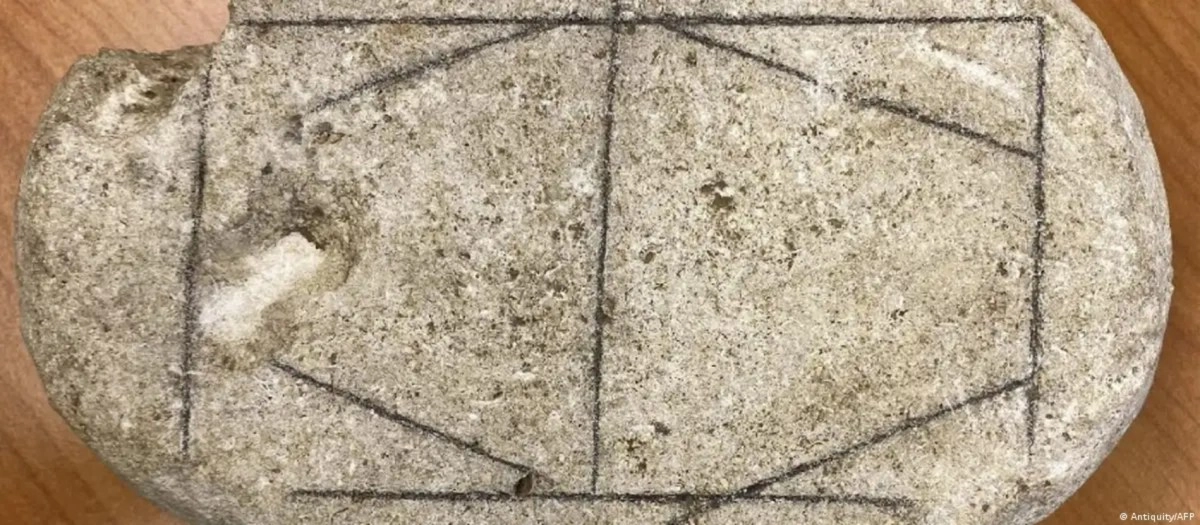

A smooth, white stone dating back to Roman times and unearthed in the Netherlands has long puzzled researchers. Now, with the help of artificial intelligence (AI), scientists believe they have solved the mystery: the stone is an ancient board game, and they have even deduced the rules.
AI deciphers markings on Roman stone
The circular piece of limestone has diagonal and straight lines engraved on it. Using 3D imaging, scientists discovered that some lines were deeper than others, suggesting that the pieces were moved along them, some more than others. “We can see wear along the lines in the stone, exactly where one would slide a piece,” said Walter Crist, an archaeologist at Leiden University specializing in ancient games. The object, known as 04433, found at the Roman settlement of Coriovallum (modern-day Heerlen, Netherlands), likely dates to the Late Roman period, between approximately 250 and 476 AD. The study proposes that it is a fragment of ornamental stone that was reused and subsequently worked and incised during that period, when it was common to repurpose architectural elements within the fortified city. Ludii: The AI ??that Reconstructs Ancient Games. Other researchers at Maastricht University used an artificial intelligence program that It can deduce the rules of ancient games. They trained this AI, named Ludii, on the rules of about 100 ancient games from the same area as the Roman stone. The computer “produced dozens of possible rule sets. It then played against itself and identified some variations that are enjoyable for humans to play,” said Dennis Soemers of Maastricht University. They then compared the possible rules with the wear on the stone to discover the most likely set of moves in the game. However, Soemers also issued a warning.
“If you present Ludii with a pattern of lines like the one on the stone, they will always find rules for the game. Therefore, we cannot be certain that the Romans played it precisely in that way,” he said.
The objective of the “deceptively simple but exciting strategy game” was to hunt down and capture the opponent’s pieces in the fewest possible moves.
The research and the possible rules were published in the journal Antiquity.