

The Russian Soldier at the center of the first trial in Ukraine for an execution on the battlefield
Dmitriy Kurashov is the first Russian soldier to be tried in Ukraine for a battlefield execution

In January 2024, in the middle of winter, a Ukrainian soldier witnessed the aftermath of a Russian assault on the frozen front line of Russia's invasion of Ukraine.
Two weeks earlier, an 18-man Russian assault team had broken through a defense line in the east of the city of Zaporizhia, in southeastern Ukraine.
They took three positions, killed five Ukrainians, and lost 10 soldiers before ceding the narrow strip of land to the Ukrainians a few hours later.
The three positions that had momentarily changed hands were a few trenches in the ground. Small dots in a devastated landscape riddled with craters and smashed trees.
The Ukrainian soldier filmed as he examined the remains of his fallen comrades.
“This is Vitas, the little one,” he said, using the dead man’s nickname.
Then he examined another body: “A silver ring, this is Grinch,” he added.
With difficulty, he turned over another frozen body. It was in bad shape, but the face was recognizable.
The soldier sighed. “What can I find to cover you, so you don’t get cold?” he said to the dead man.
He took a nearby helmet and placed it over his wounded face. “We found the Penguin,” he continued.
A year later, in January 2025, a Russian soldier was dragged down the hallway of a dilapidated local courthouse in Zaporizhia.
He was flanked by five Ukrainian soldiers and a large Rottweiler that had been trained to track the Russian and was tugging on its leash to attack him.
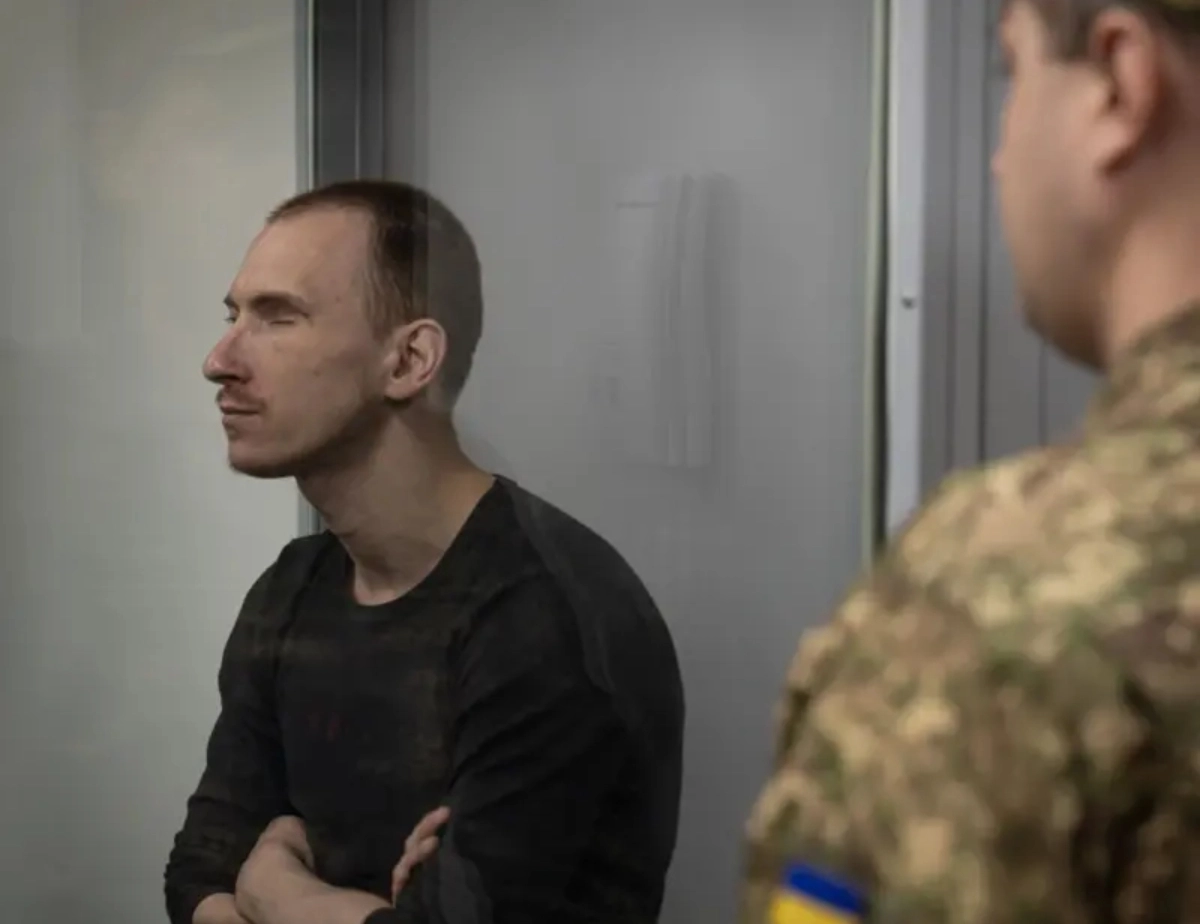
Dmitriy Kurashov, nicknamed “Stalker,” was about to go on trial for the alleged battlefield execution of Vitalii Hodniuk, a 41-year-old Ukrainian army veteran known as the “Penguin.”
The trial is the first of its kind.
According to Ukrainian authorities,Russian troops have executed at least 124 prisoners of war on the battlefield since the full-scale invasion began.
Kurashov is the first person to be tried in Ukraine for this crime.
His case is one of the few—among the tens of thousands opened for war crimes—in which a suspect has been captured and can be brought to trial.
Adding to the unprecedented nature of the case, three members of Kurashov’s own unit agreed to testify against him.
Cannon Fodder
In the light, square courtroom, Kurashov was locked in a glass-enclosed dock. Short in stature and with his head often bowed, he was withdrawn.
When he looked around, he was forced to turn his head because he had lost an eye on the front lines to a grenade.
This was not Kurashov's first time in the dock; he had been imprisoned twice in Russia and was among thousands of prisoners released by the Russian state to fight the war.
The prosecutor read out the charges. Kurashov was accused of shooting Hodniuk execution-style as the Ukrainian soldier tried to surrender, a violation of the laws of war.
Kurashov had initially pleaded not guilty during the pre-trial phase, but now, in court, he had changed his plea to guilty.
Informally, he maintains his innocence. According to him, this change of statement is only intended to speed up the process.
According to the UN, battlefield executions by Russia have increased at an alarming rate over the past year.
In a February report, the UN human rights mission in Ukraine said it found evidence of 79 executions by Russian forces since August 2024, as well as three unlawful executions carried out by Ukraine using drones.
The UN also said it found at least three calls from Russian public officials ordering or approving executions, and according to Ukraine, there is evidence that Russian commanders on the battlefield ordered executions all along the front line.
The assault by Kurashov’s unit was its first proper operation, just weeks after joining the war.
The unit was part of “V-Storm,” a detachment of the 127th Division motorized rifle unit, composed almost entirely of liberated prisoners.
Storm-V units have been used by Russia as cannon fodder, sent to carry out assaults in the toughest areas of the front.
They are a grim echo of similar units formed by Stalin, characterized mainly by their extremely high attrition rate.
Execution-style shooting
The operation began in the early hours of January 6, 2024, under dense fog. The 18-strong Tomenta-V unit approached the front line in two armored personnel carriers and a tank, and began the assault.
Kurashov headed towards a small group of trenches where Hodniuk and other Ukrainian soldiers were hiding after a Russian artillery barrage.
This is where Kurashov’s account differs from that of the prosecution and the Russian soldiers who testified against him.
They claim that Kurashov demanded that those inside surrender from a trench and that Hodniuk emerged unarmed and knelt on the ground, before Kurashov shot him with a burst from his AK-47 rifle.
Kurashov claims that it was not he who fired the shots, but another Russian, a medic nicknamed “Sedoy,” who subsequently died.
The Russians were unable to hold the position for long. Overwhelmed by Ukrainian forces a few hours later, Kurashov and the other survivors crawled out of the trenches and surrendered.
They were marched from the front to a Ukrainian armored vehicle and taken as prisoners of war. Ukrainian soldiers who saw Hodniuk’s body informed the country’s state security service, the SBU, that he was lying face down with no weapons nearby.
The SBU was unable to access the scene because it was too close to the line of contact, but the agency began what would become an extensive remote investigation.
Enough evidence to bring him to court
Last month, at an SBU headquarters in Zaporizhia, the officer in charge—who spoke on condition of anonymity because of his job in the security service—drew a map of the scene and explained how they managed to get Kurashov into the dock.
“The first step was to interrogate the eight prisoners of war,” he said.
“They were questioned as witnesses, and their identities were subsequently fully confirmed through social media, mobile phone and partial radio intercepts prior to the incident. The entire the unit in that sector."
Initially, two executions were suspected. A witness stated that another Ukrainian—the one identified by the nickname "Grinch"—was beaten to death with a shovel. But the SBU was unable to obtain any evidence.
“The polygraph did not confirm the information, and when the bodies were finally recovered from the battlefield, none of them bore such injuries, ”the investigator stated. “In my opinion, after examining all the facts, this was fabricated.”
He added that it was an example of Ukraine’s ability to investigate and prosecute war crimes impartially, despite being the victim of the conflict and in a state of war because of the aggressor.
“We have a suspect on trial for an execution,” the SBU investigator said, referring to Kurashov.
“I signed it and sent it to the court because we have gathered sufficient evidence pointing to his guilt. If our goal was simply to suspect someone and bring them to trial, we would have ten prisoners going through this every day.”
The seriousness with which Ukraine is treating this criminal process is evident.
The SBU investigation yielded more than 2,000 pages of evidence. Each witness was subjected to filmed reconstructions of the events at a Ukrainian army firing range.
In court, the prosecution and judges have done their best to ensure that Kurashov understands his rights, can understand his interpreter, and has the opportunity to cross-examine the prosecution's witnesses, an opportunity he has so far declined.
Kurashov's public defender declined to speak to the BBC. She only spoke briefly in court, to discuss administrative matters and to clarify some of witness descriptions of the events.
The testimony of Russian soldiers against him
The three Russian witnesses testified on the first day of Kurashov's trial. They are former prisoners who, like Kurashov, had gambled on surviving the war to win their freedom.
One was serving a sentence of 25 years to life for the murder of two drug traffickers; Another, nine years for grievous bodily harm for killing a man with a brick during a fight; and a third, eight years, also for grievous bodily harm.
They gave their statements by video link from an adjoining room, so they could be locked in their own box.
Dmitry Zuev, 44, became the key witness. He testified in court that he saw Kurashov ask the Ukrainians to come out of the trench and surrender, after which Hodniuk emerged and knelt with his hands up. More gunshots and explosions were then heard, Zuev said, and then he saw Hodniuk fall face first into the mud. Zuev also testified in court that he personally knew Dr. Sedoy, whom Kurashov accused of the murder, and that Sedoy was not there. Oleg Zamyatin, 54, testified that Hodniuk was not carrying a gun when he came out of the trench. Zamyatin did not see Kurashov fire the alleged shots, he claimed,because explosions occurred at that very moment.
“But I can say it was him,” Zamyatin told the court. “Because there was no one else in that place apart from him.”
Konstantin Zelenin, 41, the commander of Kurashov’s small assault group, told the court he was hiding in a crater when he saw Hodniuk emerge from the trench on the right side with his hands up.
“Then, just a split second later, when the shelling started again, I heard a burst from an automatic rifle,” Zelenin added.
“On the right side was ‘Stalker’, and he was there alone.”
In the dock, Kurashov remained virtually silent as his former unit mates testified against him, only occasionally speaking to his lawyer through a small gap in the glass-enclosed dock door.
He tells the BBC how he became a ‘Stalker’
It is not yet known whether he will testify in his own defence. The day after one of his hearings, he agreed to speak to the BBC about how he had ended up on trial in Ukraine.
The interview, coordinated by the SBU, took place in an abandoned building in Zaporizhia, used as a secure location by the service, which confirmed the basic facts of Kurashov's life.
He appeared to be in good health and said he had freely agreed to take part in the interview.
The lead judge in the case authorized the interview, and an SBU press officer was present for part of it.
Kurashov's statements to the BBC will not be admissible in court.
His journey to that wretched stretch of the front line where Hodniuk was killed and how he became “Stalker” began in an orphanage in Gremyachinsk, a run-down old mining town about 1,000 kilometers from Moscow, en route to Siberia.
Orphaned at birth, Kurashov He grew up in a group home.
As a teenager, he got into a fight with a police officer and was jailed for assault. He served four years, but when he was released he had no family, friends, or place to live, so he became a drifter.
He began robbing summer homes and shops to get food and money, he said, which resulted in another incarceration, this time in a remote penal colony alongside men serving life sentences for some of the most brutal crimes possible.
Six months into that sentence, representatives of the Russian military came to the penal colony and told the convicts they had a chance to start a new page in their lives.
Kurashov still had five years left to serve. “They told us we could start from scratch,“Become clean people,” he declared. “We just had to sign this contract and leave.”
“Leaving” meant going to the “special military operation” in Ukraine.
Kurashov claims he knew little about it, but believed anything was better than five more years in the penal colony or being thrown out onto the street at the end of his sentence.
So he signed the contract and was immediately transferred to a training camp on Ukrainian territory occupied by Russian forces.
Kurashov described his unit as composed entirely of “people oppressed by life and rejected by society, who were on the margins of society.”
They received 21 days of training, he said, during which they were drunk almost all the time.
“They didn’t want to study or train,” he recalled. “Everyone said they were just there to die.”
“We were told not to take prisoners.”
There was no training on the Geneva Convention, to which Russia and Ukraine are signatories, and which prohibits killing people who have surrendered or no longer pose a threat.
In fact, the instructors told them otherwise, Kurashov claimed.
“Those who taught us how to take up positions told us not to take prisoners,” he said. His description matches the testimony of his fellow units, who told Ukrainian investigators that they were instructed to execute prisoners and throw grenades into dugouts even if the enemy had surrendered.
It also matches the accounts of other Russian POWs.
“I don’t remember receiving training in international humanitarian law,” one Russian POW recently told the UN.
“During our military training and afterward, commanders warned us not to take [Ukrainian soldiers] as prisoners of war. It’s logistically cumbersome.”
According to Kurashov, the unit was told they would be conducting logistical operations such as digging trenches, but instead found themselves directly en route to combat.
During the brief assault on the Ukrainian position, Kurashov’s impression was not of a military unit competent in warfare. “What I saw were people who just lay down and died,” he said.
Within hours, 10 of the 18 members of the assault team were dead, and the remaining eight were being held captive.
Within 15 days, the incident had become one of thousands of war crimes cases in Ukraine. The country does not have specialized war crimes courts, so cases usually fall back on local courts where the crime occurred. In this case,Zavodskyi District in Zaporizhia.
Before the full-scale invasion, prosecutor Mykyta Manevskyi, 32, had handled various civil crimes such as theft, hooliganism, and fraud, as well as two murder cases, but never a war crime.
“When you work with an ordinary murder case, it presents difficulties, but it’s quite simple,” Manevskyi explained.
“You know where the murder was committed, you can collect DNA and fingerprints, you can find the murder weapon. You have almost immediate access to the body. You can perform forensic tests.”
In this case, Manevskyi’s crime scene was on the contact line. “We couldn’t even extract the body for two months,” he said. “This made any kind of forensic examination difficult. The body was exposed to the sun, rain, and snow for too long, and was damaged by artillery fire.”
All of this made it difficult to accurately determine the nature of the shots that killed Hodniuk.
“Unfortunately, this is not the level of detail needed when investigating a murder,” Manevskyi said. “That’s why we had to focus more on working with the witnesses we had.”
In fact, the prosecution relies almost exclusively on the testimony of Russian soldiers. There are no other eyewitnesses, there is no drone footage of the actual event, and the physical evidence is circumstantial, much of it severely deteriorated by battlefield conditions that persisted for weeks before the bodies could be recovered.
But the testimonies are not without complications. All of the witnesses are prisoners of war, detained by the prosecution. Each was interrogated up to 10 times by the Ukrainian state security service, during which some of their stories evolved.
One held a grudge against Kurashov because of their shared training time, he told investigators. Another said he resented the defendant because, in his opinion, it was his fault they were captured.
“It’s a sensitive issue,” said Sergey Vasiliev, a professor of international law at the Open University of the Netherlands. “Prisoners of war are a particularly vulnerable category of witness; any testimony they present must be treated with caution.”
There was nothing inherently wrong with the prisoners of war testifying, Vasiliev said, but several factors could have influenced their decision to appear before the prosecution.
“Perhaps they expect better treatment in Ukrainian custody, perhaps they hope to be prioritized in a prisoner exchange,” he added. “They could have various incentives to lie.”
Kurashov maintains his version of events regarding Dr. Sedoy. He told the BBC that he pleaded guilty because he believed the sooner the trial ended, the sooner he could be sent to Russia.
But if Kurashov is found guilty, he will no longer be a prisoner of war. He will simply become another prisoner under Ukraine's civilian justice system.
Yuriy Belousov, head of the war crimes department at Ukraine's Prosecutor General's Office, told the BBC that Russian soldiers convicted of war crimes would go to prison in Ukraine and remain there.
"We act on behalf of the victims and their families, and they should feel that justice has been done," Belousov said.
In the end, it may not be that simple. Russia has captured thousands of civilians during its massive invasion of Ukraine and is holding them virtually hostage in Russian prisons.
If the Kremlin decides it wants Kurashov back, it could have the leverage to get it.
“It’s less a legal issue than an ethical one,” Belousov said. “If, say, 100 people were offered in exchange for this one, then yes, maybe. It’s our obligation to prosecute the victims, but it’s also our obligation to save our people who have been held back in Russia.” Belousov and his colleagues are targeting bigger fish than Kurashov. Their goal for this year and next is to bring charges against the middle and upper-level Russian command, he said. According to testimony from Russians captured in Kurashov’s unit, their top commander gave the order just before the assault not to take any prisoners of war. Belousov said similar evidence has been found all along the front. Dreadful video evidence, sometimes shared on Russian social media, appears to confirm this. Russia, in turn, has accused Ukrainian troops of extrajudicial killings, and Ukraine has launched several investigations into its own forces (the exact number is unknown). However, the number of accusations against Russia far exceeds those against Ukraine. Russia has previously denied committing war crimes in the conflict. The UN has also documented several cases of Russian public figures ordering executions. Last July, after Ukraine’s Azov Brigade posted a video on social media showing one of its members shooting a Russian soldier in a shelter, the deputy head of the Russian Security Council, former Russian President Dmitry Medvedev, demanded the “total execution” of Ukrainian servicemen.
“Not a word of mercy. No humanity. No forgiveness. They have no right to life. Execute, execute, execute!”Medvedev wrote on the social network Telegram.
Medvedev's words will cost him nothing. On the contrary, they are on a downward spiral to the level of Vitalii Hodniuk, Dmitry Kurashov, and all the other Russian and Ukrainian men who kill each other in service of the dark aims of war.
In this case, one of those men is accused of breaking laws in the killing spree he was tasked with committing—laws he might well have been ordered to ignore.
If convicted, Kurashov could face life imprisonment. At the end of his conversation with the BBC, he claimed to have no real vision for the future, except a desire to return to Russia.
“At least I’ll have a disability,” he said, referring to the loss of his eye and the benefits he anticipated. “I won’t have to be a bum anymore.”
Vitalii Hodniuk doesn’t have that option, of course. It took two months before his body was recovered.
His family did not want to speak publicly about his death, but cooperated with the SBU in its investigation.
Hodniuk’s record shows he was an experienced soldier who defended Ukraine against Russian-backed forces from 2015 to 2020 and joined the fight again in 2022.
Last May, six months after his death, “Penguin” was brought back to his village for burial. On a bright morning, near where he grew up and went to school, people knelt in the street to watch his coffin pass by.
Daria Mitiuk contributed to this report. Photographs by Joel Gunter.
Click here to read more stories from BBC News Mundo.
Subscribe here to our new newsletter to receive a selection of the best content of the week every Friday.
You can also follow us on YouTube, Instagram, TikTok, X, Facebook and on our WhatsApp channel.
And remember that you can receive notifications in our app. Download the latest version and activate them.