

MAIA, the pioneering school in Central America that fosters the talent of indigenous girls in Guatemala
BBC Mundo traveled to Guatemala to visit the school that is transforming the future of hundreds of girls from impoverished Mayan villages
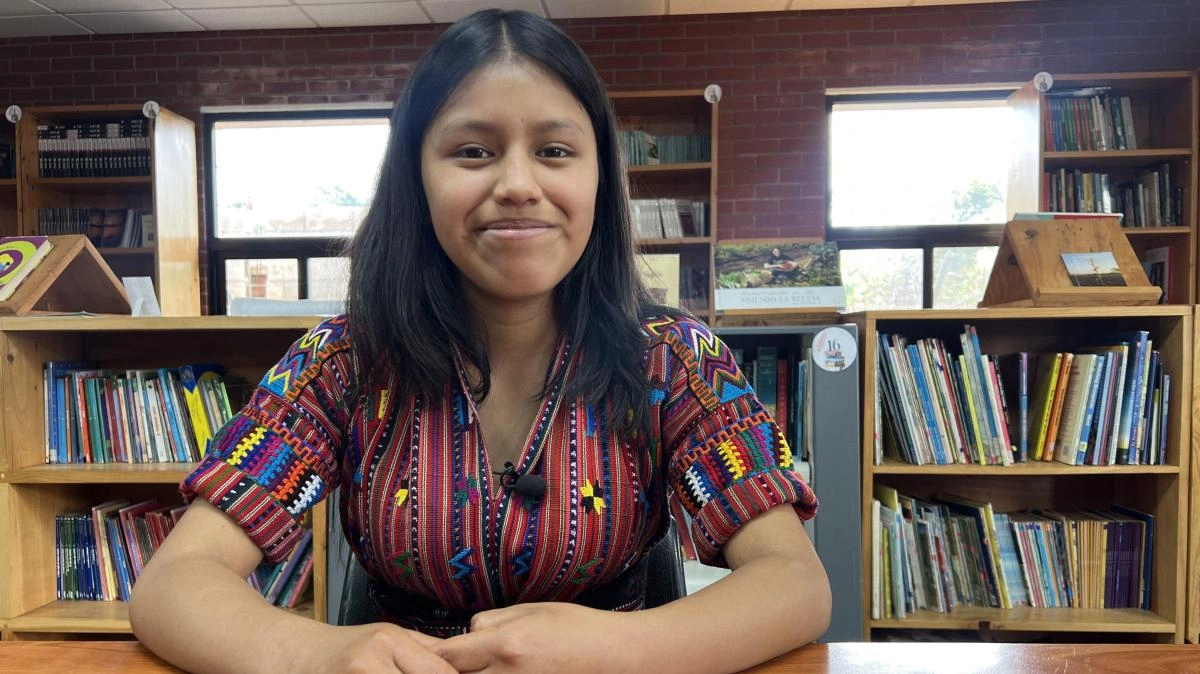

Fifty girls from Mayan villages enter a school each year that changes not only their future, but also that of their families and one of the most disadvantaged communities in Guatemala.
To learn about their story. BBC Mundo traveled to Solola, a department bathed by Lake Atitlan with privileged views of the imposing San Pedro volcano. Despite the frequent flow of visitors to one of the country's main tourist destinations, poverty predominates in the province, where 96% of the population belongs to Mayan communities and 75% live on less than US$2 a day. On one of the roads that climb into the mountains from the municipal capital of Solola, we arrived at Colegio Impacto MAIA, an educational oasis in this rural environment marked by a lack of development and opportunities. In its facilities, which include a three-story building with classrooms, a dining hall, a library, and sports spaces, more than 300 students from 40 indigenous communities receive a high-performance education that combines the official curriculum with leadership programs, family support, and socio-emotional development. Each student remains at MAIA for seven years with the goal of achieving at least 15 years of schooling and accessing the university or formal employment.
The results are compelling: in the national math tests, female students achieve 86% compared to the national average of 13%, and 60% are already studying at university.
All this in the country with the worst educational statistics in Latin America: Guatemala invests US$841 per student each year, the lowest figure among 56 nations analyzed by the Inter-American Development Bank (IDB).
Only 35% of Guatemalan youth finish secondary school, and the rate drops to 14.7% in the case of indigenous women, of whom only 1.5% manage to complete university studies.
At Yazmin's house
More than half of Guatemalan indigenous girls become mothers before the age of 20, according to UNICEF data,And in rural areas like Solola, it's common for them to marry and become pregnant at 15 or 16.
MAIA tries to provide a space to change these statistics and prevent young women from dropping out of school at an early age.
This is the case of Yazmin, 14, who is in second grade at MAIA. She came from the public school in her community in Solola where "they didn't teach much," and also "there were favored students, who were boys."
"You're already 15, you're ready to get married" is a common piece of advice that adults give to young women in her community, says Yazmin.
When she entered MAIA a year ago, she was very behind, with low levels in reading comprehension and science, but she says she has made a lot of progress since then.
She is not an isolated case: according to the school's teachers, most students enter at 11, 12, or 13 years old with a level equivalent to third or fourth grade, even though they should already be in secondary school.
To close this gap, MAIA applies an intensive leveling and support program that, in a matter of months, allows the young women to recover lost ground and adapt to a higher academic standard.
The school also uses group dynamics and educational games to enhance the students' social skills.
“Before, I was a very withdrawn girl, not interacting with others. Now I am very sociable, both with my classmates and with the teachers,” Yazmin explains to us.
That same afternoon, we went with her to a rather unusual extracurricular activity: Ana Yaxon, MAIA's mentor, visited her home for a support session.
To get to where the young woman lives with her parents and two siblings, we walked uphill for 10 minutes along narrow and intricate dirt paths between plantations of corn.
At their home, we are welcomed by Carlos, a bricklayer's assistant, and Maria, a homemaker, whom we accompany in the session with their daughter Yazmin and the mentor, Ana.
In a mixture of Spanish and their ancestral language, Kaqchikel, the four participating in a board game that represents the life of a young Guatemalan woman: the square for completing secondary school allows them to roll the die again; the square for becoming pregnant at 15 returns the token almost to the beginning.
At the end, they reflect on the result and discuss the lessons the board has taught them.
Yazmin's parents married young—"I was about to turn 16," says Maria; "I was 18," adds Carlos—but, unlike other neighbors in the community, they envision a different destiny for their daughter.
"We want our daughter to graduate and become a professional, to build her own future, Let him fulfill what I failed to do. “I'm not going to tell her 'don't get married,' but her studies come first,” her mother tells us.The family acknowledges that finances have always been an obstacle to her education, and sometimes they've even lacked food or money for the bus that Yazmin takes to school every morning. That's why, with MAIA's guidance, they established small financial habits: “We have piggy banks at home to save every spare quetzal, and my mom opened a family savings account.” Yazmin has two clear goals: in the medium term, she wants to win a scholarship to study abroad—she hasn't decided on a major yet—and, as an ultimate goal, she longs to “build a new house so we can be comfortable and well protected.” We asked her if she sees it as possible to prosper without leaving Guatemala. “It's almost impossible, because there are few opportunities and a lot of corruption here,” she replies. Guatemala suffers from high levels of corruption. —ranked 146th out of 180 countries in Transparency International's ranking—a problem that, according to experts, distorts not only the country's economy but also its prospects for development and social justice.
A Factory of Leaders
MAIA was founded in 2017 as the first school in Central America dedicated to providing an elite education to young indigenous women from impoverished rural areas.
The organization, however, began to take shape much earlier, following the experience of a microcredit program for women.
“When women had access to microcredit, they invested their earnings in their families, their children's education, housing, health… And they asked themselves: how far could an indigenous woman with this talent go if she had gone to school?” “Then MAIA was born,” summarizes Andrea Coche, its executive director. The MAIA Impact School opened its doors in 2017 and this year surpassed 400 students from 40 indigenous communities. Each year, about 50 new students enroll, remaining for seven years to reach at least 15 years of schooling. The school selects indigenous girls between the ages of 11 and 13 each year who live near Solola, demonstrate good academic performance, personal motivation, and family support. After a nearly year-long process that includes applications, academic evaluations, interviews, and socioeconomic studies, the admitted students receive a full scholarship, and their families commit to actively participating in sessions and covering part of the transportation costs. Maintaining this model is costly: “We invest US$4,000 annually in each girl.” It includes everything: the academic program, family support, the leadership program, plus nutrition and preventative health.”Coche explains.
This amount, which contrasts with the aforementioned figure of US$841 annually that the Guatemalan State invests per student, does not include public funds.
“We live off individual donations and large foundations when projects arise. “We are always constantly searching for resources,” says the director.
In its short history, MAIA has gained international prestige: in 2023 it was included in the Top 10 of the best schools in the world (World's Best School Prizes) and has received other recognitions, such as the Zayed Sustainability Award from the United Arab Emirates.
Its students have represented Guatemala in international forums, from Japan to New York, and the Ministry of Education itself has begun to take an interest in replicating some of its strategies.
“In fact, this year we are in a program where we share with them the best practices that are viable in a public system,” adds Coche.
Some 150 students have already graduated from the school, while the organization's team—made up mostly of Indigenous women—has grown and become more professional, now boasting 15 mentors and a local teaching staff that receives more than 50 hours of professional development each year.
“We empower young Indigenous women through education to transform their stories, their communities, and their countries. Hence our motto: 'An empowered woman is an infinite impact,'” says the director.
Dulce's Story
Unlike Yazmin, who has been at MAIA for less than two years, Dulce is a veteran about to complete her sixth year at the institution.
We spoke with this 17-year-old, whose eloquence reveals a high level of academic preparation.
She explains nostalgically that in a few months she will graduate and leave MAIA behind: “It has been more than a school. It's more like my second home. For me, it's “I would stay and live here,” she affirms.
As the eldest of three siblings, her childhood was marked by the absence of her father—who went to Guatemala City—and her mother's precarious jobs working in other people's homes.
“It was a little hard, because my mom had to work from house to house, and I had to do it too. When I started school, I considered it my salvation, because I don't like working outside the home,” she recalls.
Dulce was always passionate about studying: in elementary school, she was the flag bearer, a awarded distinction to those with the highest academic averages, and a Mayan princess, a school recognition linked to the cultural representation of her community, in addition to being on her public school's honor roll.
However, her memories of that time are marked by an almost robotic teaching style: “It was always like a 'copy and paste,' copy what you have in the book, “We dictate what you have in the book and you paste it, and it was a little frustrating.”
The difference with what she found upon entering MAIA was abysmal.
“I think my brain expanded. Before, it wasn't like that;Now I think more, I analyze better,” she summarizes.
For Sofia Cuc, a math teacher at the school, this evolution is due to a different methodology.
“Here we don't say, 'Let's look at this, do it.' We use exploration, games, experiments, problems… The young women discover new knowledge, they solidify all the processes, and in the end we confirm: 'Yes, it's done this way,'” she explains.
Many students arrive with a low academic level: “Many enter without being able to add, divide, or subtract. “We hope they will master trigonometry and combinatorics, and be able to apply all that learning in their daily lives, in decision-making,” she says. Dulce confirms that the rigor at MAIA goes beyond simply repeating what is written in a book: "When I face an exam here, it's completely different from my previous school. It's more about analysis. In mathematics, it's not just about practicing, it's about thinking," she explains. She experienced the same contrast in sexuality, a major taboo in Guatemala, where conservative doctrines of evangelical churches predominate, particularly strong in rural and indigenous areas with low levels of education and socioeconomic status. "In my primary school, they would take the boys out of class to teach about the female reproductive system and vice versa. Here they teach us everything without taboos and tell us to go back to our homes, to our communities, and show them that we all have the same rights," she says. After graduating, her goal is to begin a career in accounting “to become an auditor and do everything fairly and legally, since I don't like corruption or the idea that money can buy everything,” she affirms. Like Yazmin, Dulce wants to expand her horizons beyond Guatemala. “I heard about the She Can scholarship (a program for Guatemalan women who want to pursue undergraduate studies at a university in the United States) a year ago and I fell in love with it,” she says. "They give an opportunity to indigenous women like me. I have potential and I need to expand it; “I'm not going to leave it here," he concludes.