

One year after Trump raids, Los Angeles remembers pain and resistance
Immigration operations marked thousands of families and transformed the community response
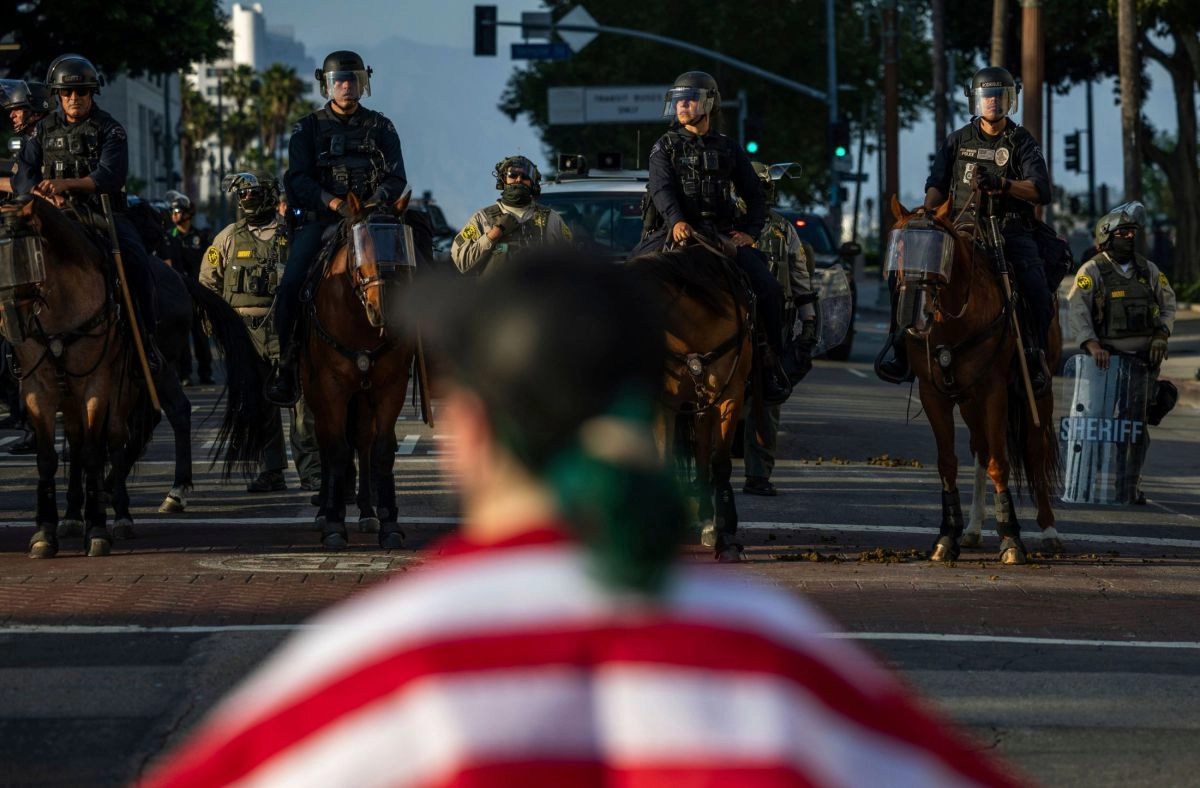

An indelible mark of pain, but also of resistance, was left in Los Angeles by the immigration raids unleashed a year ago, when the county served as a laboratory to test President Donald Trump's mass deportation machine, which produced the deaths of undocumented immigrants and Americans.
On the morning of June 6, 2025, masked agents from Immigration and Customs Enforcement (ICE) and Customs and Border Protection (CBP) unleashed multiple operations that spread throughout the county, the most populous in the United States and home to more than 3 million immigrants.
“Emotionally, it leaves a mark that was marked forever,” one of the workers detained at the Ambiance Apparel company, one of the first targets of the raids, where more than 40 workers were detained, told EFE.
The 33-year-old immigrant, who did not want to identify himself for fear of reprisals in his case, believes that he was detained “without giving him rights” and that due process was not respected.
It took more than a week for the worker to be able to speak with a lawyer and he was detained for more than two months in the Adelanto immigration prison, in California, subject to multiple complaints of negligence.
“It hurts to remember it and I always think it will be like that, one is left as if marked,” says the immigrant, who is part of the Lucha Zapoteca campaign, promoted by the Warehouse Workers Resource Center, which supports the 15 workers of indigenous roots detained in that company, three of them already deported.
Los Angeles, laboratory of mass deportations
That morning, the simultaneous operations spread to more than seven locations, including a Home Depot establishment, where day laborers offering their labor were surrounded and forcibly detained.
Civil rights advocates responded to try to prevent irregularities, but they too were arrested and charged with federal charges.
The operations that day revealed the tactics that the Trump Administration would implement for months across the country to reach the goal of one million deportations in its first year.
“It targeted the most vulnerable immigrants,” Ron Gochez, spokesperson for the Unión del Barrio collective, told EFE, who believes that Los Angeles was a laboratory to implement a plan aimed at terrorizing the community.
Protests, community organization and resistance
But the arrests, in which excessive use of force was evident, provoked a series of demonstrations and protests that the White House tried to counteract with the deployment of the California National Guard, without the authorization of Governor Gavin Newsom, in an event that had not occurred for more than 60 years.
“A year ago, Los Angeles experienced the militarization of our neighborhoods, but our response was clear: we would not allow ourselves to be intimidated by racism and division,” Angélica Salas, director of the Coalition for the Human Rights of Immigrants (CHIRLA), told EFE.
Outrage over the raids went beyond protests by civil rights advocates: Neighbors, churches, unions, elected officials, the county and the state joined together in an unprecedented response to counter the arrests.
A community alert network was created that included the use of social networks to document the operations, which were reduced after a lawsuit alleging that the Government “unconstitutionally” arrested and detained people to meet an “arbitrary” quota of arrests.
In 2025, more than 14,000 people were arrested in the Los Angeles metropolitan area; most had no criminal records, according to an LAist analysis based on data from the Deportation Data Project.
The raids in Los Angeles resulted in the death of two immigrants, who suffered accidents while trying to flee, a harbinger of other deaths, including those of Americans Renee Good and Alex Pretti, who were shot in Minneapolis by immigration agents.
This Saturday and for the next week, Los Angeles will host various events to remember the damage caused by the raids while promoting the continuity of the community fight.
“We demonstrate that immigrant communities are not passive victims, but a powerful force that sustains and enriches this city,” said Salas.