

Physicists witness something impossible: the explosion of a black hole that could explain almost everything
A single neutrino with record energy could become the first evidence of Hawking radiation ever observed
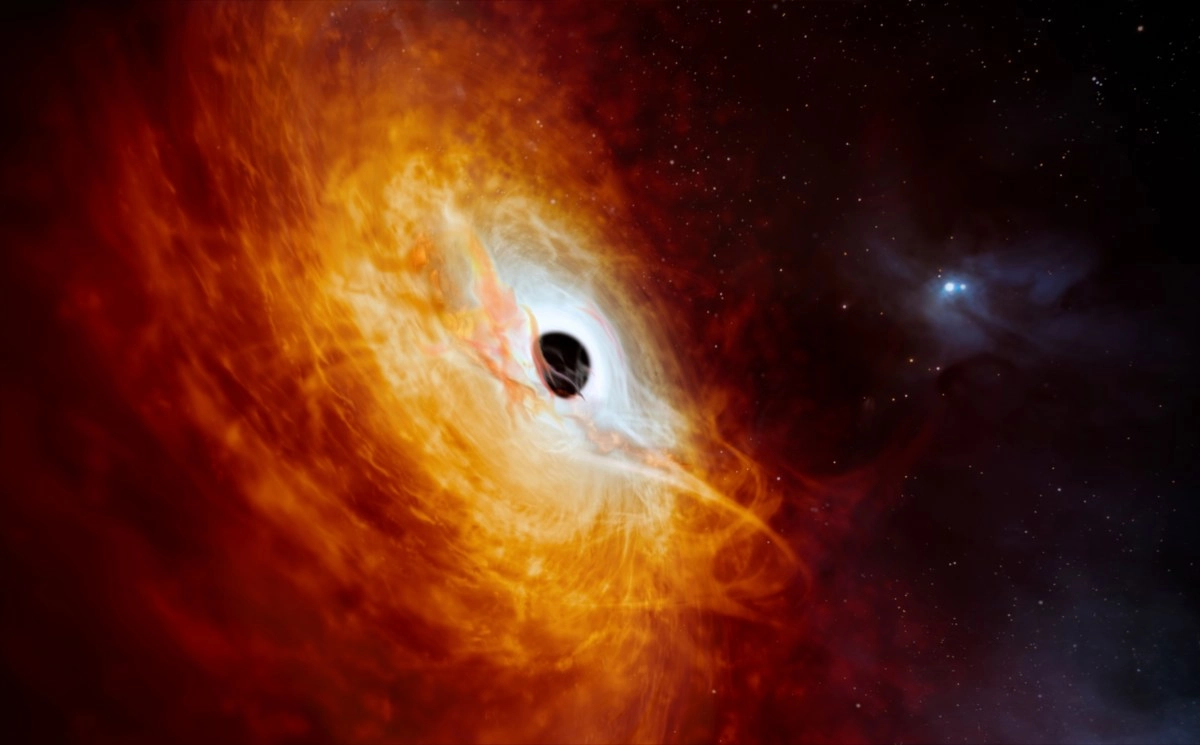

Until recently, the idea that a black hole could die seemed purely theoretical. They were imagined as eternal, growing without an apparent end. But in the 1970s, Stephen Hawking proposed the unthinkable: that even these cosmic monsters seemed gradually losing energy by emitting radiation, slowly evaporating over eons, in a process so slow it was unobservable. Now, a group of scientists believe we have already detected signs of the death of one of them, and that the signal arrived in the form of a single, but extraordinary, particle.
An impossible neutrino detected in the Mediterranean
It all began in 2023, when a neutrino—an almost massless particle capable of passing through entire planets with hardly any interaction with matter—crossed Earth with enormous energy, leaving scientists perplexed.
It carried about 100,000 times more energy than any particle created in the Large Hadron Collider, becoming one of the most extreme events ever observed. Its origin? No one knows for sure, but physicists at the University of Massachusetts Amherst, in a study published in Physical Review Letters, propose a bold explanation: it could be the final trace of an evaporating black hole. The event was detected only by KM3NeT, a neutrino observatory located on the bottom of the Mediterranean Sea. The recorded energy exceeded by about a hundred times the maximum events observed by IceCube, the large detector located in Antarctica, which has been operating longer and covers a much larger observation volume. What is puzzling is that IceCube did not record anything similar at that time. Statistically, it would be reasonable to expect that it would have been the first to capture a phenomenon of such magnitude; in fact, it has never observed anything comparable. But that was not the case. The particle, cataloged as KM3-230213A, seemed almost impossible, and yet it occurred. Primordial black holes: Relics of the Big Bang
Conventional black holes, born from the collapse of massive stars, can hardly explain such a phenomenon. But there is another possibility:so-called primordial black holes, hypothetical objects formed in the extreme conditions that followed the Big Bang. These bodies could be tiny—even the size of an atom—and, over billions of years, slowly evaporate through Hawking radiation.
The end would come when the black hole had already lost almost all of its mass. “The lighter a black hole is, the hotter it should be and the more particles it will emit,” explains Andrea Thamm, co-author of the study and professor of Physics at the University of Massachusetts Amherst, in a statement. In that final phase, the researcher adds, evaporation would skyrocket and end in an explosion whose radiation could be detectable from Earth.
According to the team, these outbursts might not be so rare and could occur, on average, once a decade in our galactic region. This raises a troubling question: if these black holes explode with some regularity, why do we almost never detect these explosions?
The detection paradox and the “dark charge”
Herein lies the real enigma. If primordial black holes release extremely high-energy neutrinos in their final stage, we should have detected many more similar events. And, above all, IceCube—the world's largest neutrino observatory—should have seen something comparable to the event recorded by KM3NeT. But it didn't.
To resolve the paradox, the researchers propose a more exotic scenario: “almost extreme primordial black holes” endowed with a hypothetical “dark charge,” an unknown version of electromagnetism associated with equally hypothetical particles, such as the so-called dark electron.
According to the model, this charge would make these black holes extraordinarily stable for much of their existence. However, upon reaching a critical final phase, the equilibrium would break down, and the energy emission would concentrate in a very intense episode, dominated by extremely high-energy particles and with relatively little lower-energy radiation. This would help explain why only KM3NeT recorded such an extreme event, while other detectors did not observe comparable signals.
The key to understanding dark matter?
The proposal goes even further. If the model is correct, these tiny black holes could also be a possible candidate to explain dark matter, one of the great enigmas of the universe. According to calculations in the study, each would have a mass of just over 320 kilograms compressed into a volume much smaller than an atom and would be dispersed throughout the galaxy, invisible until the moment of its final disappearance.
The model must also fit with another piece of the puzzle: the gamma radiation that should accompany such an explosion. The HAWC observatory, which monitored the corresponding region of the sky, did not detect any signal. However, at such extreme energies,the sensors could become saturated and hinder the detection of the signal, so more sensitive instruments will be needed to confirm or rule out this possibility.
For now, everything remains theoretical. Neither primordial black holes nor this hypothetical “dark sector” have been directly observed, and the model relies on hypotheses about the earliest moments of the universe, a stage where physics is still highly speculative. Furthermore, as Study Finds reminds us, the entire proposal remains on a single event: fascinating, yes, but statistically insufficient.
Even so, the stakes are enormous.
If the interpretation is confirmed, this “impossible” neutrino would not only reveal the existence of primordial black holes, but could also become the first observational evidence of Hawking radiation, offer a possible explanation for dark matter, and force an expansion of the Standard Model of particle physics itself. A discovery capable of changing our understanding of the universe. It would offer a possible explanation for dark matter and would force an expansion of the Standard Model of particle physics itself. A discovery capable of changing our understanding of the universe. It would offer a possible explanation for dark matter and would force an expansion of the Standard Model of particle physics itself. A discovery capable of changing our understanding of the universe.